Category Archives: Uncategorized

the Clinton Foundation and the new gift economy

The Atlantic’s David Graham describes the “forthcoming book by Peter Schweizer [that] has excited the political world with allegations of quid pro quos, in which foreign governments gave to the Clinton Foundation and Hillary Clinton, then serving as secretary of state, did them favors—essentially alleging bribery in foreign affairs.” (For additional coverage, see Jonathan Chait, “The Disastrous Clinton Post-Presidency” or Graham, “A Quick Guide to the Questions About Clinton Cash.”)

I don’t think the real issue here is potential bribery. According to the federal bribery statute, 18 U.S. Code § 201, “a public official” receives a bribe if she or he, “directly or indirectly, corruptly demands, seeks, receives, accepts, or agrees to receive or accept anything of value personally or for any other person or entity, in return for: (A) being influenced in the performance of any official act …”

So bribery would have been committed if the Clinton Foundation accepted money “in return for” some favorable treatment by Secretary Clinton. That is the kind of quid pro quo that the Justice Department alleges in the pending case of Senator Menendez. But it isn’t how things usually work in power politics, and it isn’t the heart of our systemic problems with money in politics.

A New York Times’  news story, “Cash Flowed to Clinton Foundation Amid Russian Uranium Deal,” suggests how things actually work. A financier gives the Clinton Foundation $31.5 million. At an event with Elton John and Shakira to celebrate the gift, Ms. Clinton lauds the donor’s “remarkable combination of caring and modesty, of vision and energy and iron determination,” … adding: “I love this guy, and you should, too.” The same financier later on receives US State Department approval for a joint venture with a Russian uranium firm that affects control over this military/strategic commodity.

In a contract-based economy, parties agree to some kind of exchange before the goods, services, or money change hands. That has the advantage of efficiency and reliability. But when it comes to money and politics, such an agreement has the disadvantage of being a felony that can lead to imprisonment of no more than 15 years. There is an alternative, however–the older culture known as a gift economy. In a gift economy, goods circulate because A gives presents to B in the hopes that B will later give favors to A, but A studiously avoids any contract or explicit expectation.

The traditional reason is honor: it’s dishonorable in many societies to expect a return. In the current political environment, honor has the additional buttress of 18 U.S. Code § 201.

Yesterday’s New York Times editorial, after raising “questions about the interplay of politics and wealthy foreign donors who support the Clinton Foundation,” hastens to acknowledge: “Nothing illegal has been alleged about the foundation, the global philanthropic initiative founded by former President Bill Clinton.” However, the editorial warns, “accusations … will fester if straightforward answers are not offered to the public. [Hillary Clinton] needs to do a lot more, because this problem is not going away.”

I’m actually not sure what Ms. Clinton could do or say that would reduce criticism of the nexus between huge contributions to the Clinton Foundation, favorable treatment of its donors by the US government, and personal benefits to the Clinton family. It’s a gift economy, and exhaustive investigation is unlikely to reveal a quid pro quo or lead to any legal action (or legal exoneration).

Donors to the Clinton Foundation don’t necessarily know what they want when they give; they may have a mix of motivations, including altruism. The Clintons don’t take specific actions for donors just because of the money. But they do accept their gifts at glitzy events with Shakira and express their love for the donors. As in Beowulf, “treasures will change hands and each side will treat /the other with gifts; across the gannet’s bath,/ over the broad sea, whorled prows will bring/ presents and tokens” (Heaney trans., lines 1859-63) The public can see what this amounts to, with or without additional disclosures. The question is whether voters should tolerate it.
job openings in civic renewal (9)

This is the ninth in a series of occasional posts with lists of open positions:

Executive Director, Opportunity Nation: “Opportunity Nation is a bipartisan, multi-sector national campaign comprised of more than 300 employers, educational institutions, faith-based and civic organizations, community groups and nonprofits working to expand economic mobility and close the opportunity gap in America. As it moves to execute on an ambitious two-year strategic plan, Opportunity Nation seeks a skilled leader, influencer, storyteller, and champion to usher in a new era of growth and collective impact as Executive Director.”

Program Manager, Healthy Democracy: “If you’re passionate about political reform and civic engagement, this position is a unique opportunity to advance your values while making a lasting and positive impact on democracy. Healthy Democracy is a nonpartisan, nonprofit organization based in Portland Oregon. Our mission is to elevate the voice of citizens in our democracy in order to give voters information they can trust.  Our signature program, the Citizens Initiative Review (CIR), brings representative groups of citizens together to fairly and thoroughly evaluate high-profile ballot initiatives for the benefit of all voters. It’s a new and highly effective approach to democratic reform.”

Research Director, Harvard’s Edmond J. Safra Center for Ethics (soon to be led by the excellent Danielle Allen): “Working closely with the Center’s Director, faculty, and fellows, the RD will develop and manage a portfolio of collaborative projects and dissemination projects that would yield a stream of work outputs of interest to broad audiences, and support the intellectual work of grant development to sustain this portfolio of activities. The RD will participate in thematic seminars and conferences, and will work with the Director on their development. … The RD will assist with the development of the newly launched Fellows-in-Residency program, including helping to plan and oversee a weekly seminar, and evaluating its progress. The RD will assist with short and long-range planning to meet objectives, policy development and implementation, and other projects such as writing the annual report and other communications.”

Budget and Fiscal Administrator at Tufts University’s Tisch College of Citizenship and Public Service at Tufts (where I work!). See the Tufts Careers website, and enter requisition 15001129.

Program Administrator, Talloires Network (also based at Tufts). The Talloires Network is a coalition of universities — 340 institutions in 75 countries — that are moving beyond the ivory tower to tackle pressing societal problems. The Network is the primary global alliance committed to strengthening the civic roles and social responsibilities of higher education. It mobilizes its members to improve community conditions and, in the process, to educate students to be leaders for change. … The Program Administrator is responsible for organizing and managing conferences, workshops and other meetings; leading office management and systems; managing the annual MacJannet Prize Program; contributing to other core programs; and managing membership affairs. “

signal

Eight with twenty-one zeros. That’s how many
Letters and numbers, dots, jots, tittles and clicks
Our chatty species sent around this year–
More than in a score of generations past.
Into that wind-whipped Sonoran, I cast
These sixty grains, these quiet sounds I hear,
In hopes their mood or sense or purpose sticks
In the swirl that obscures so much and so many.

the Millennials’ political values in context

The General Social Survey asked a set of questions about political values or principles twice, in 2004 and 2014. The questions were phrased, “How important is it ….?” and the items included: always to obey the law, always to vote, never to try to evade taxes, and always to understand other people’s reasoning. Respondents were also asked how important it is for people to be able to participate in making decisions. It’s a nice mix of conventional civic obligations and deliberative and participatory values.

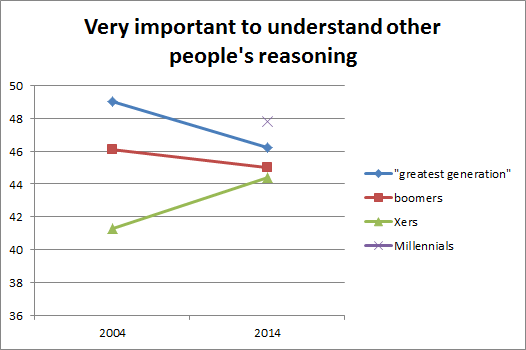
As is my wont, I have looked at the changes generationally. Graphs are helpful for visualizing these changes. For instance, the first graph below displays an interesting pattern in attitudes towards understanding other people’s reasons. Generation Xers have become substantially more committed to this value as they (or I could say “we”) have aged, although we still lag a bit behind our elders. Older Americans have lost their commitment somewhat, especially the group that was born between 1926 and 1945. Millennials enter the picture with the highest levels of support currently, although they rate listening as less important than their grandparents did a decade ago.

GSSothersreasons

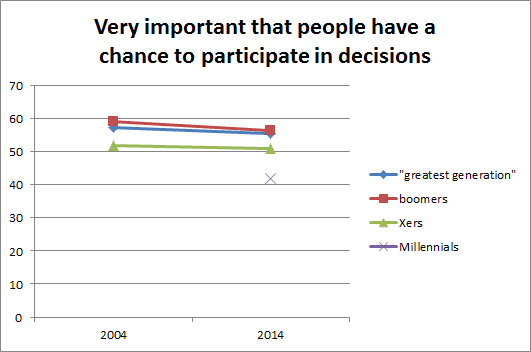
I’ll display a second graph that shows quite a different pattern. The younger you are today, the less likely you are to believe that it’s very important for people to be able to participate in decisions. At least since 2004, the older cohorts have not changed their minds on that topic. Millennials continue the pattern of declining support by entering adulthood with the lowest levels of commitment to the value or principle of participation. This graph suggests that unless we do something to change the trends, generational replacement will gradually lessen our commitment to participation.

GSSparticipation

The pattern for always obeying the law looks like the second graph above, although the gaps are smaller. Millennials seem less committed than their predecessors, which could reflect an openness to civil disobedience.

All the older cohorts have grown to oppose tax evasion more as they have aged. Millennials enter the picture least committed to that ideal, but they are just where the Xers were a decade ago, and it’s possible that people’s focus on this topic naturally grows as they age.

Voting, finally, shows a pattern like participation in decisions (the second graph above). Commitment is lower for each generation, and much lower for Millennials. The older generations did not change their minds between 2004 and 2014, but the shrinking of the pre-War cohort and the growth of Xers and Millennials pushes down the average for the population as a whole. Voting is becoming less of a perceived obligation due to generational replacement. However, it’s important to note that this is a question about the obligation to vote. Actual voting rates have been flat over time. In other words, Millennials vote at similar rates to their predecessors; they are just less likely to conceive of that action as a duty.

America’s Civic Renewal Movement: The View from Organizational Leaders

With support from the William and Flora Hewlett Foundation, Eric Liu—the founder and CEO of Citizen University and executive director of the Aspen Institute Citizenship and American Identity Program—and I interviewed 20 key organizational leaders about strategies to expand civic engagement in the United States. Our new paper is: Peter Levine and Eric Liu, “America’s Civic Renewal Movement: The View from Organizational Leaders” (Medford, MA: Jonathan M. Tisch College of Citizenship & Public Service, 2015).

Interviewees agreed that the nation faces polarization, corruption, and weakened civic capacity. David McKinney from the Alliance for Children and families observed: “Everyone is sick-and-tired of hyper-partisanship,” and we need “stories of leaders and their lives, folks that are doing the work in ways that are trying to cut through.” Anna Galland from MoveOn said, “Right now, our government is captive to lobbyists with money to spend.” Paul Schmidt of Ducks Unlimited observed that “the need and desire for affiliation has eroded.”

Most interviewees thought that citizens would have to play a major role in reversing these declines. John Bridgeland of Civic Enterprises said that we need civic engagement “now, more than ever” because of the paralysis and dysfunction of government and changes in society such as emerging conflicts, gaps in education and social mobility, racial conflict, and divides over immigration.

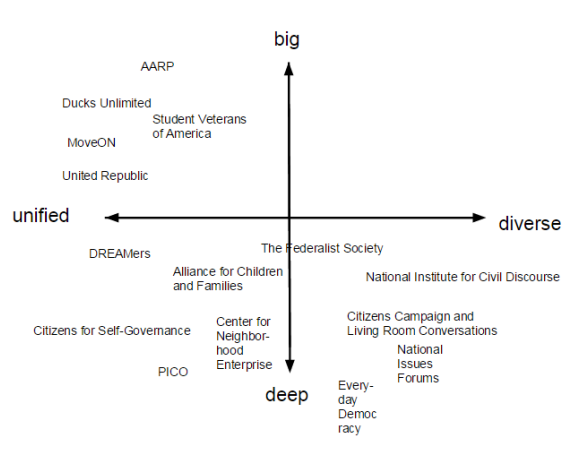
Some organizations included in this study are large, some are ideologically diverse, some have a coherent and focused agenda, and some are deep (engaging their members in learning, growth, leadership, and voice). But no organization has managed to be large, deep, diverse, and focused.

temp

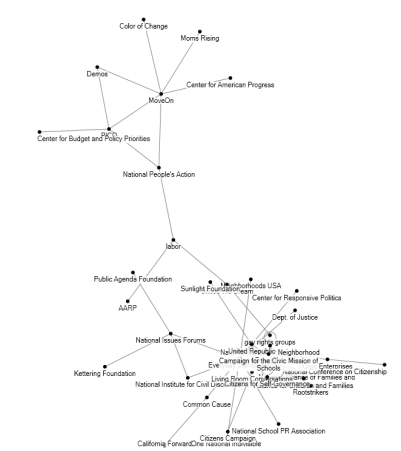
Furthermore, despite some working connections among these organizations, they do not yet form a coherent network. A simple network analysis of the connections that were either mentioned explicitly in the interviews or implied by the interviewees’ bios (for instance, when an individual holds leadership positions in two or more organizations) yielded the diagram below.

temp2

In exemplary episodes from American history, such as the Civil Rights Movement, networks of organizations have managed to be large, deep, diverse, and focused.

The paper concludes with some recommendations for research and convening to strengthen today’s network for civic renewal. You can download the full report here.