I like to post every work day (this is post # 2,978 since 2003), but I will be on vacation and trying to be off digital media until August 17.
on vacation
Leave a reply
(This was written in Lviv,  but posted in Cambridge, MA).
We all receive moral and political inheritances. Although the stories of our ancestors are not equally attractive, we all have exactly the same responsibility: to recognize our whole birthright, to address the shameful parts, and to use the best aspects of our histories to improve the human condition. I observe influential Ukrainians doing that very well right now, while the leaders and dominant voices in Russia do it very badly. And that is why I believe it is essential that Ukraine prevails.
1.
Seamus Heaney’s narrator seeks admission to the “Republic of Conscience.”
At immigration, the clerk was an old man
who produced a wallet from his homespun coat
and showed me a photograph of my grandfather.
Note: the immigration clerk does not show a picture of the would-be entrant, but rather of her or his grandfather. The photo symbolizes the past that we each must carry–both for good and ill. We cannot shed that inheritance without also renouncing all the other ways that our past has shaped us, including even the language with which we think.
The past also gives each of us gifts, and conscience demands that we offer them to humanity:
The woman in customs asked me to declare
the words of our traditional cures and charms
to heal dumbness and avert the evil eye.
It is tempting for an outsider to evaluate the inheritance of a given people and to draw comparative moral judgments about them as a whole group. Canadians born a few miles north of the US border are dealt a hand without the cards for slavery and genocidal settlement that I carry because I was born not far south of that same border. In that sense, at least, the Canadian inheritance is better.
I am not a relativist; I would insist that some political histories and cultures are superior to others. But there are two reasons not to focus on comparative judgments of this kind. If the inheritance of a people is largely evil (which I would not say of the US, by the way), it is too easy to ignore that people’s potential for doing good in the future. And if their inheritance happens to be largely innocent, it is naïve to assume that they will continue to act well once they obtain power.
2.
I have been visiting a country at war. To the east are people who call themselves “Russians.” They carry a thick book of history. One way to make sense of it is to say that the story began in the late 800s in Kiev. That does not imply that Kiev rightly belongs to Moscow today (the reverse would actually be more logical), but some Russian nationalists have drawn that inference. In any case, what followed after Kievan Rus has been–in this version–a long story of patriotism, suffering, military valor, victory under strong rulers, defense of Orthodoxy and other orthodoxies, and resistance to the decadence of the west and south. This is Putin’s way of playing the mixed deck that history handed him.
But it is not the only way. One could tell a story in which the diverse peoples who live within Russia are constantly being oppressed by bloodthirsty rulers from the capital, yet they show a special gift for turning their suffering into witness, resistance, and empathy. Then the best cards in the hand show Decembrists, Turgenev and Pushkin, and Akhmatova and Sakharov, and the worst show Stalin or the Tsars.
Ukrainians have also been dealt a vast and varied deck. One would have to give a different list for any Ukrainian city, but Lviv has been part of at least the Halych-Volyn Principality, the Kingdom of Poland and the Polish-Lithuanian Commonwealth, the Habsburg, Austrian and Austro-Hungarian Empire, the West Ukrainian People’s Republic, the Republic of Poland, the Soviet Union, the Third Reich, the Ukrainian Soviet Socialist Republic, and the Republic of Ukraine. Lviv can count among its famous citizens the Polish saint Józef Bilczewski, the German-Jewish-Israeli philosopher Martin Buber, the Austrian-American economist Ludwig von Mises, the Ukrainian national poet Ivan Franko, and Muhammad Assad, born Leopold Weiss, who translated the Koran into English and played a role in the founding of Pakistan.
A modern Ukrainian can play these and many more inherited cards in many ways—and can even decide whether or not to identify as a Ukrainian in the first place.
One important and influential group of modern Ukrainians views their inheritance thus: They are a pluralistic people, drawing from many roots. All of the residents of Lviv named above are part of the Ukrainian story. Ukrainians of all backgrounds have flourished best under governments that have been explicitly pluralistic, even when the center of gravity has lain far away, in the Polish-Lithuanian commonwealth or in Austria. That is one reason the European Union seems so attractive to Ukrainian protesters that some carried the EU flag into fatal conflicts with the police.
They also have a tradition of republican self-government that began in Kievan Rus, when the people held assemblies called veches to elect their leaders. The tradition reemerged in the Polish-Lithuanian commonwealth, the Cossack states, the late Austrian empire (when there was a Galician parliament in Lviv) and the two Maidan uprisings, when the impromptu meetings were again called veches.
Yes, some Ukrainians were complicit or even aggressively active in pogroms, slave raids, oppressions of serfs, the Shoah, and communist atrocities; but these are inheritances that the modern republic can explicitly acknowledge and mourn.
Meanwhile, I do not currently observe an influential movement of the same type in Russia, one that tries to make the liberal, pluralistic, and humane traditions of that country central while treating militaristic machismo as a threat to the Russian people and peace. A fine article by Karine Clément gives some insight into brave Russian organizers who are creating valuable spaces for democratic engagement; but the date of that article is 2008, and the subsequent seven years have been hard ones.
3.
The reason that liberals are influential in Ukraine and vanishingly marginal in Russia is not that Ukrainians are superior to Russians. No people is superior, and in any case, the differences in their current situations can probably be traced to local and recent contingencies, such as the greater efficiency of the Russian security and media agencies and the flood of petrodollars that fund them. But the fact remains that Ukrainians who are cosmopolitan, liberal, and republican hold considerable power in their country, and there is nothing similar right now in Russia.
It is a deep disappointment that, seven decades after the Second World War, so much of the world is dominated by regimes that are militaristic, authoritarian, and nationalist, devoted to the cult of the strong (male) leader, and content to combine kleptocratic crony capitalism with state repression. One could mention Xi Jinping, Nerendra Modi, Recep Tayyip Erdogan and many more along with Putin–and American voters are not immune to similar attractions. But Ukraine is a place where civil society has confronted the authoritarian wave and now has a chance to prevail.
And that is why I stand with the Ukrainian people and believe that their country is a front line in our era’s struggle for democracy and human rights.
Civic Science is an emerging scholarly conversation, and today we held a discussion of it at Tufts. In my group, we agreed that scientists are not value-free but are indeed defined by certain values. We went back to the list of four values that Robert K. Merton identified in 1942. Per Wikipedia, those are:
These “CUDOS” norms emerge from the practices of actual scientists, yet they are aspirational. In fact, they may be rarely honored in a given population of scientists, but they would still reflect the ideals of science. They thus provide tools for the critical assessment of actual science.
We proposed adding:
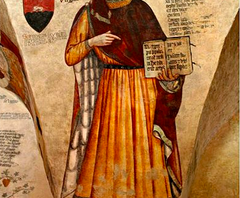

This is highlight #2 from our recent time in Italy. Lucignano is a small medieval town in Tuscany, notable for its street plan of concentric ellipses capping a steep hill. During the middle ages, it was contested by larger city-states, but it sometimes enjoyed a degree of independence or civic freedom. It certainly had its own town hall and, within that building, a Sala di Consiglio or council chamber.
At first, this room was decorated by one large fresco of the Madonna in Majesty. If I recall correctly, the inscription under her picture reminded Lucignano’s leaders to listen to both sides of every dispute. Then, between 1438 and 1475, the town’s councilors contribruted personal funds to cover the ceiling with frescoes of exemplary figures from history, each labeled with a name, and most accompanied by an instructive quotation. “Virgil the poet” is shown above.
Christiane L. Joost-Gaugier offers excellent background information on this decorative scheme.* It was not uncommon to depict heroes from the past (often known as “worthies”) in public spaces. And there was a very famous model of a council chamber decorated with frescoes about good (and bad) government in nearby Siena. But the Lucignano frescoes were unique in that the list of exemplary figures came from a specific source, Dante, who also provided many of the quotations painted on the ceiling.
Dante held an elaborate political theory that I will not attempt to summarize comprehensively here. But it seems to me that Lucignano’s civic elders borrowed the following elements of his thought for their council chamber:
People who thought in this way were liable to see themselves as appropriate heirs to the republican citizens of ancient Rome, capable of self-governance, obligated to sacrifice for the common good, and committed to the same law that had prevailed in Rome. This room is a vivid illustration of the idea that civic republicanism flourished in late-medieval Italy and came to the Atlantic world from there.
*Christiane L. Joost-Gaugier, “Dante and the History of Art: The Case of a Tuscan Commune. Part II: The Sala del Consiglio at Lucignano,” Artibus et Historiae, Vol. 11, No. 22 (1990), pp. 23-46.
Below are my keynote remarks yesterday at …

The video is here:
I departed from the prepared text a fair amount in order to address the audience of civic innovators who had gathered in Austin. By the time I spoke, I knew more about their projects. These are the prepared remarks:
A presidential election cycle is a great civic ritual. Even though only about 60% of adults vote—when we’re lucky—a national campaign still touches most Americans in one way or another. It challenges us to consider fundamental issues. And it connects us to our political heritage, for many of the greatest moments in our political history have been presidential elections.
As the 2016 cycle heats up, what should we expect from this great national civic experience? What do we have a right to expect from the election?
I would say …
The campaign must engage all Americans, without respect to wealth, social status, age, race, gender, disability, and political and religious opinions.
It must give all Americans equal weight and importance, honoring the fundamental principle of one person/one vote. It must make our leaders accountable to the people as equals.
The campaign must provoke a serious conversation about the most fundamental issues facing us as a country.
It must enlist our higher instincts. It is absolutely fine for citizens to retain their diverse political ideologies and their various and conflicting interests. But we must all be reminded of the more generous and idealistic aspects of our own views and interests—or what Lincoln called, after the fateful campaign of 1860, “the better angels of our nature.”
During a national political campaign, Americans must have respectful interactions with fellow citizens who hold different views from their own. The goal is not consensus but mutual understanding and an awareness that we are all legitimate participants in one great political debate.
Some of our interactions must be personal, in the sense that we get to know one another and can actually reply to each others’ ideas—whether online or face-to-face. In other words, it’s not enough to relate to politicians and other celebrities by following what they say. We must also relate to one another.
Citizens must see ways of acting on their political values that go beyond casting a ballot in November, important as that is. If, for instance, you are moved by the problem of climate change or concerned about moral decline, the campaign should inspire you to reduce carbon or to restore traditional values by working with neighbors and peers. The act of voting should be just one of the political efforts that you undertake as a result of the election.
Finally, a diverse set of new actors must see openings to enter political life, whether as campaign volunteers and staffers, independent activists, or reporters, artists, and bloggers. Presidential elections are entry points for new generations of activists and leaders.
I have described a national election in rather glowing terms, but we all know that the reality falls far short. Continue reading