Category Archives: Uncategorized

the limits of civic life

(Phoenix, AZ), While I am here today as a guest of Arizona State, I will give a version of the following talk:

The video summarizes my view of civic life in about 10 minutes. By “civic life,” I mean applying our minds, voices, and bodies to improving the world. We can do that alone, but inevitably civic life is collaborative, because individuals rarely achieve much alone and because we need other people’s opinions and perspectives to inform our goals and values.

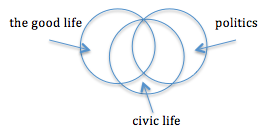
Civic life is important, but it is by no means the only important thing. It represents one circle in this Venn diagram, which also includes circles for politics–meaning all the ways that human beings govern ourselves and create a common world–and the good life.
Screen Shot 2016-03-27 at 11.51.21 AM

In civic life, certain ways of interacting are possible and desirable. We can and should be highly interactive while we are in smallish groups dedicated to improving the world. We can be responsive to one another’s needs and opinions and strive act in concert.

But a good life should sometimes be solitary and inward-looking, or directed to nature or God instead of fellow citizens. And politics should sometimes involve competition instead of deliberation and cooperation. For instance, we want incumbent politicians to be regularly challenged by outsiders who criticize them and strive to unseat them. We don’t want incumbents to get too cozy with their challengers. The same is true of business competitors and contending attorneys.

In the video, I argue—and I strongly believe—that civic engagement can enrich our inner lives and offer us psychological and spiritual benefits. But so can non-civic activities, such as observing and appreciating nature, understanding and making art, or loving and caring for other people intimately. Although I think that the spiritual benefits of civic life are often overlooked—and improving our civic culture would strengthen those benefits—I still resist the argument that the good life equals civic engagement.

Here is a typically subtle case: I love to walk in the woods with my family and dog. Enjoying those loved ones in a natural setting is not a form of civic engagement. However, it is only thanks to the Massachusetts Audubon Society and our state government—and the individuals who work in or with those organizations—that the woods have been preserved and opened for us to use. The worthy activity (a family walk) is not civic, yet it depends upon other people’s civic engagement. Still, it’s far too narrow a view of nature and of intimate personal relations to reduce them to products of civic life.

By the same token, civic life doesn’t exhaust politics or offer adequate means to improve politics. Large, impersonal institutions—such as markets and companies, governments and armies, and scientific and technical disciplines—play leading roles in 21st century politics. You and I have limited leverage over these institutions. We can form opinions about what they should do, but those opinions do not always imply meaningful actions for us to take.

If the institution in question is the United States government, I have a tiny but greater-than-zero form of leverage in the form of my vote. If the institution is Coca-Cola, I can decide whether to purchase its products or not. Allocating votes and money are worthwhile acts but hardly constitute a robust civic life. And if the institution in question is the Chinese Government or the market for oil rigs, my leverage approaches zero. In the video, I say that citizens ask, “What should we do?” rather than “What should be done?” But sometimes reasonable people realize that something should be done and yet cannot find anything to do about it themselves. That is the zone of politics that lies outside of civic life in the Venn diagram above.

In the video and almost all my work, I emphasize that “small groups of thoughtful and committed citizens” have the capacity and responsibility to change large systems. I began my professional career helping to advocate for political reform as a research associate at Common Cause, and while I worked there, Common Cause was losing its membership base due to the shrinkage of American civil society that Robert Putnam would soon diagnose in “Bowling Alone” (1995). I came to think that American politics was corrupt because citizens were not adequately organized and active, and I have spent the subsequent two decades working on civic engagement as a precondition for better government. Still, political reform eludes us in the face of hostile Supreme Court decisions, technological developments, and tenacious political opposition. When reform does come, it may be because of a massive scandal or a well-placed leader, not directly because of active citizens. In some other countries and in global markets, the scope for civic life is even narrower than it is in the US.

To discount the importance of citizens in politics is cynical, but to imagine that intentional civic action is all of politics is naive. To the extent we can, we should work to expand the overlap, so that civic life is more politically influential as well as more spiritually rewarding. But I think we will always be left with two hard questions (among others):

  1. How should we think and act and feel when bad systems are genuinely beyond our control? The Stoic and classical Indian answer was: seek equanimity and acceptance. Epictetus advised: “For if the essence of the good lies in what we can achieve, then there is no space for ill-will or jealousy. Rather, for yourself, don’t strive to be a general or an office-holder or a leader/consul, but to be free. The only road to that is contempt for things not in your power [XIX].” I am unsatisfied with that answer, because I think we have responsibilities to the world even when we cannot see a direct way to address its problems. But what are those responsibilities, exactly? And …
  2. When an aspect of the good life conflicts with civic responsibilities, how should we choose between them?
why don’t social movements have great leaders any more?

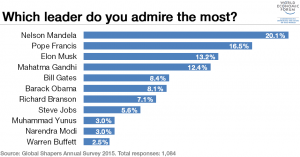
In a discussion with undergraduates a week ago, the familiar question arose: Why don’t social movements have great leaders any more? One could dispute the premise, arguing that we do have social movement leaders today and that we romanticize the past when we forget how divisive–even within their own movements–most leaders have always been. Still, I think the students were onto something when they posed this question. Here are the leaders whom young people around the world admired the most in 2015:

leaders

The two people who could clearly be classified as leaders of social movements are dead. Of the rest, five are business leaders and two are elected officials in very large and influential democracies. Only Pope Francis and Muhammad Yunus could be described as leaders in civil society, and neither is a classic example of a social movement participant. Meanwhile, some highly prominent current movements–the Arab Spring, #Occupy, Black Lives Matter–are known for their reluctance to anoint leaders.

I’d propose three theses:

1. “Apex” leaders are assets to social movements, even today. 

Leaders who become famous for their participation in social movements are useful. They symbolize the movement’s objectives and its spirit in human form. They can use their prestige to mediate disagreements within the movement. And they are available to negotiate with outside powers. It’s hard to imagine the victory of Solidarity in Poland or the Freedom Movement in South Africa if Lech Walesa and Nelson Mandela hadn’t ultimately been able to sit down across a table from the regime and work out a deal.

2. Social movements make leaders, more than leaders make social movements.

There is a widespread view that very charismatic and visionary leaders call social movements into being. Perhaps that has happened a few times, but the reverse seems much more typical. Social movements identify individuals who have potential to lead. They offer them opportunities to develop leadership skills and expand their reputations. Often, movement members must cajole the prospective leader into playing that role. They then deliberately construct a reputation for their leader, for the consumption of outsiders.

A classic example is Martin Luther King’s ascent to leadership in Montgomery ca. 1954. As Taylor Branch tells the story in Parting the Waters, King moved to Montgomery with ambitions to participate in civil right activism. Although still a young man, he had been groomed for leadership in his father’s Atlanta congregation and at Morehouse College, where President Benjamin E. Mays was a prophetic leader who had gone to India to meet Gandhi. These institutions, already pillars of the nascent Civil Rights Movement, had developed King’s skills and imparted an overwhelming sense of obligation. In his new city of Montgomery, he took deliberate steps to enter the black leadership, giving a “stirring speech” at the NAACP and joining its executive committee (which, needless to say, already existed). The Montgomery Bus Boycott was started by other people, mainly women, who used finely honed techniques to implement a carefully designed plan. King was recruited to join the effort after it had begun and was then nominated to be the president of the leadership team.

Idealists would say afterward that King’s gifts would made him the obvious choice. Realists would scoff at this, saying that King was not very well known, and that his chief asset was a lack of debts or enemies. Cynics would say that the establishment preachers stepped back for King only because they saw more blame and danger ahead than glory (Branch, p. 137). 

And–I would add–everyone assumed that a male reverend doctor would make a more palatable leader than Rosa Parks, a woman without a college degree who had been “focused for almost two decades on white men’s sexual aggression and violence against black women” and who had challenged the Montgomery bus system because of systematic sexual harassment against black female riders. Hers was not an agenda that would appeal to socially conservative African Americans or white liberals.

So King was chosen. This is not to detract from his personal gifts, but even those came in part from his training within the movement. The other church leaders in Montgomery identified King’s extraordinary talents, gave him an opportunity to use them, and helped develop his national persona. It’s in that sense that the Civil Rights Movement made Dr. King, more than the reverse.

3. Good social movements hold their leaders accountable and limit their powers.

We live in a time of “strong” leaders. China’s Xi Jinping, India’s Narendra Modi, Russia’s Vladimir Putin, and Turkey’s Recep Tayyip Erdogan’s alone preside over a contiguous bloc of countries whose populations approach three billion. Each of these men has consolidated power and projects a macho image. None is particularly accountable. Meanwhile, as I mentioned earlier, we see social movements develop without leaders at all.

The best cases surely lie in between. They are movements with “apex” leaders whose powers are circumscribed and who are held constantly accountable. Again, King is a great example. His main formal role was president of the Southern Christian Leadership Conference, which “differed from organizations such as the Student Nonviolent Coordinating Committee (SNCC) and the National Association for the Advancement of Colored People (NAACP), in that it operated as an umbrella organization of affiliates.” So King was not only accountable to a board, but the organization he led depended on churches’ voluntary and revocable decisions to join. He had no formal power over SNCC or NAACP, let alone the Nation of Islam. Indeed, these groups fairly often competed. To the extent that he was the leader of the whole Civil Rights Movement, he had to earn that standing by constantly serving the grassroots base. It’s that specific kind of leadership that seems especially lacking today.

See also the real Rosa Parksis the Sanders campaign a movement?; and how to respond to a leader’s call for civic renewal.

do we actually want higher youth voter turnout?

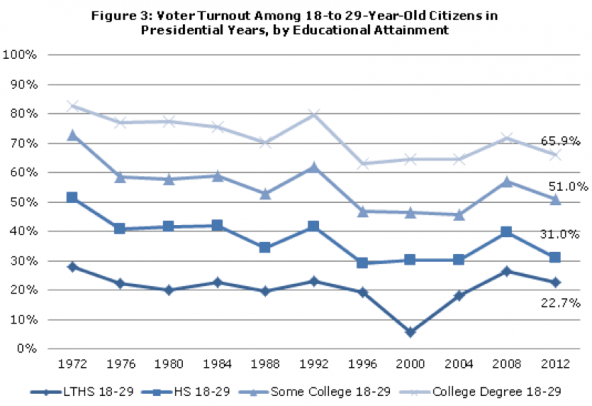
Abby Kiesa and I have a new piece in the Stanford Social Innovation Review (online), entitled “Do We Actually Want Higher Youth Voter Turnout?” We dispute the premise that youth turnout has declined–or risen. Instead, we note the “the relentless replication of political inequality by class,” as illustrated (for instance) by this graph:

We observe that the traditional solution to political inequality has deteriorated. “The civil society built in the 20th century tended to recruit young members for non-political reasons and then make them political. Large institutions—such as unions, churches, Urban League, and Elks—had the means and motivations to recruit widely, and they had incentives to interest at least some of their young members in politics. Belonging to these groups (or subscribing to a newspaper) was correlated with voting. But … all these organizations have lost youth members since the 1970s.”

We argue that no single reform or strategy will work in the 21st century, but that sustained investment by major organizations would pay dividends.

Some Twitter replies to the article have said that we overlook new platforms and modes of engagement that have arisen in this century. This is what we said, though:

To be sure, there are now alternatives to these organizations that serve to empower at least some young people. No one could join a social media campaign in 1974, for example. Still, the new array of civic networks and groups have not yet shown that they are capable of boosting youth voter turnout significantly or reducing gaps by social class.

how talking about Millennials obscures injustice

(Washington, DC) Generational analysis often conceals power and inequality and justifies the status quo. A great example is The New York Times‘ article yesterday about Mic.com, entitled, “What Happens When Millennials Run the Workplace?” Mic’s staff of 106 employees is described as “trim 20-somethings, with beards on the men and cute outfits on the women, who end every sentence with an exclamation point and use the word ‘literally’ a lot.” These folks like to “ride hoverboards into the kitchen for the free snacks. ” The challenges for the managers (who are also under 30) include handling “a sense of entitlement, a tendency to overshare on social media, and frankness verging on insubordination.”

All of this is presented as if it were typical of “millennials.” But the Bureau of Labor Statistics estimates that only 10,000 Americans between the ages of 20 and 24 (and another 28,000 between 25 and 34) are employed as “news analysts, reporters and correspondents.” Very few of those work for hip web startups. Meanwhile, 529,000 Americans between the ages of 20 and 24 work in “healthcare support occupations,” such as nurse’s aides, dental assistants, and vet techs. The fastest growing occupation of all in the US today is personal care aides, who help elderly and disabled clients with bodily (as well as social) needs. These aides earn about $20,000/year and need no preparation other than “short-term on-the-job training.” I guarantee that they never ride hoverboards into the kitchen or talk back to their employers, or else their highly contin[g]ent positions will cease within the hour.

Nearly two million people between 20 and 24 work in food service, of whom just 2.3% are chefs or head cooks. If you’re one of the 101,000 fast food counter-service workers in that age range, you are scrutinized closely to make sure that you are always perfectly deferential to customers, regardless of the situation. Talking back to anyone on the other side of the counter can get you immediately terminated.

So what does the Mic.com workplace represent? I would say: nothing distinctive about Millennials. I bet the Village Voice newsroom had a similar vibe in 1975. These are situations in which the workers have very high market value and lots of options, the management is not very distant from them in terms of market value, social status, or financial stake, and the culture of the occupation is informal.

If you own a piece of a startup whose value lies entirely in its skilled workforce, you’d better to be nice to those workers. If you sit in the headquarters of a multinational fast food empire, your only concern about your line workers is how to weed out the least efficient and deferential 50 percent of them and control labor costs. Since for each employee of Mic, there are about 20,000 food service workers of the same age, this is not an article about Millennials. It’s a timeless tale of how people act when they are worth a whole lot in a labor market.

is the Sanders campaign a movement?

My friend Micah Sifry has a must-read article in The Nation entitled “How the Sanders Campaign Is Reinventing the Use of Tech in Politics.” He interviews two key staffers, Zack Exley and Becky Bond, who reveal a lot about the way their campaign has engaged its supporters.

I’ve written before about an oscillation: campaigns go back and forth between using technology to empower volunteers and accumulating Big Data to make their centralized outreach efforts more precise. Bond is explicit about which direction the Sanders campaign wants to move:

We’re shifting the focus away from a small number of sophisticated data and technologists engaged in a kind of Election Day arbitrage that ekes out incremental advantages by using micro-targeting algorithms to identify and turn out voters based on a model. Instead, we’re putting hundreds of thousands of volunteers to work, and in some states have literally called every single voter who will pick up the phone to identify everyone who supports Bernie or is undecided. Then we have other volunteers persuade the undecideds and turn out those who indicated support.

The article repeatedly describes the campaign as a “movement.” For instance, Exley says, “When Claire and I first arrived at the campaign, we knew that a movement was already way out ahead of the campaign. We believed it was our job to set up structures and tools to … help grow the movement.” A campaign fueled by volunteer hours and small donations that encourages its activists to recruit and lead certainly has a movement “feel.” But what would qualify the Sanders campaign as an actual movement–or as part of one?

Some would say that it’s already a movement because it has engaged a lot of fired-up people in unpaid political activity. Exley describes “a massive volunteer organization that’s making more than 1 million calls every day right now, knocking on countless doors and doing so much more.” Those accomplishments are typical of big, grassroots-based campaigns–not only partisan electoral campaigns but also bursts of grassroots energy in civil society. According to the late Charles Tilly and his colleagues, such campaigns are components or activities of social movements. But one campaign–even a large one–does not itself constitute a social movement.

Others would say that Sanders is part of a movement because he belongs to a loose, evolving, open network of academics, cultural figures, union leaders, organizers, and a few politicians that originated in the New Left and that supports democratic socialism in the United States. Not only is that network called a movement, but it is sometimes called The Movement–as in, “I grew up in the movement, you know,” or “I got to know Bernie through the movement back in the ’70s.”

I personally do not identify with this network, in part because I haven’t done anything worthy of admission to it and in part because my actual political beliefs are too eclectic. (I am not sure you can love Hayek and be in The Movement.) But I’ve known and admired bono fide participants all my adult life. The questions are … Does this strain of political thought and activism really qualify as a movement, even as it has spanned multiple decades? Has it shown enough signs of motion to be a movement? And how much of a movement activist is Senator Sanders? My sense is that he has been a solo voice on important issues, but not much of a movement-builder. He is not known for training organizers or leading organizations. As a voice and a vote in the Senate, he may be an asset to the movement–much like a noted author or musician who supports the cause–but I’m not sure he’s a movement person.

His campaign could nevertheless be an important episode in a movement that spans a longer time horizon and that has many more leaders than Bernie Sanders. It’s too early to say whether that’s the case, because everything depends on what happens after the 2016 election.

Another question is what movement his campaign is part of, if it turns out to be part of a movement at all. Sanders’ own roots are in ’60s-style US-based democratic socialism (see the Port Huron Statement), but other currents are feeding his campaign. Bond says, “First of all, I want to take this opportunity to say that the movement to defend black lives is fundamentally changing the terrain of social-change organizing. After recognizing that, yes, the young people and working-class folks, many of whom are from communities of color, who are leading the movement behind Bernie Sanders as volunteers on the ground are changing American politics.” That comment sounds somewhat aspirational to me–Sanders would be closer to the nomination if he had engaged the Black Lives Matter movement more effectively. But a large coalition could still form after his campaign concludes. Influenced in part by Tilly, I’d look for these features as evidence that a movement is afoot:

  • A set of campaigns–such as the Sanders presidential run and the civil disobedience in cities like Ferguson–that gain rather than lose momentum over a span of years and that look increasingly interrelated.
  • A characteristic repertoire of political acts, which might encompass everything from viral “memes” on social media to people shutting down highways.
  • A diverse, not completely consonant, yet overlapping and interacting set of prominent leaders, some involved in politics and some outside of it.
  • Cultural manifestations, such as very popular music in support of the cause.
  • A set of increasingly specific demands that begin to be implemented by major institutions.

See also: questions for the social movement post Ferguson.