Category Archives: Uncategorized

social capital makes the labor market more fluid

In 2012, Kei Kawashima-Ginsberg, Chaeyoon Lim, and I published research for the National Conference on Citizenship showing a strong link between the civic engagement of cities and states and their economic performance after the great recession of 2007-9. Ours was a correlational study with lots of controls, and that method neither proves causality nor provides explanations for the correlations. We did hypothesize a whole set of explanations for why civic health would be good for economic health, and (specifically) employment.

Yesterday, the New York Times’ Patricia Cohen reported on a new Bookings study by Raven Molloy, Christopher L. Smith, Riccardo Trezzi, and Abigail Wozniak. The authors find that employment fluidity has declined. That would be OK if it meant that people were landing stable jobs that they like, but it appears that instead, many people are stuck in jobs that are not satisfactory yet don’t leave them, in part because opportunities are too scarce. Cohen writes:

One of the more intriguing findings was the role of declining social trust and what is known as social capital — the web of family, friends and professional contacts. For example, the proportion of people who agree with the statement, “Most people can be trusted,” has been shrinking for more than three decades. Researchers found that states with larger declines in social trust also had larger declines in labor market fluidity. The lack of trust may increase the cost of job-hunting and make both employees and employers more risk-averse.

Ms. Wozniak added that the benefits of LinkedIn and Facebook friends may not replace the personal connections that still remain the best way to find a job.

By the way, my Tufts colleague Laura Gee published a piece in The Conversation yesterday in which she noted that more than half of jobs are found through social ties, and that on Facebook, it is mostly people’s stronger and closer connections that land them jobs.

Additional points from the Brookings report itself (pp. 36-8): social capital is related to better economic performance, and the causal arrow seems to point from better social capital to “long-run growth at the country level.” Social capital helps job searches because people find jobs through networks, and networks reduce the cost of filling jobs. Social capital has declined in the US. At the state level, greater declines in social capital are associated–weakly–with declines in job fluidity.
three ages


1.

The sidewalk is significant.
Its ridges hamper wheels,
Its cracks harbor meadows
And little things with wills.
It is safe–the street, maleficent.
It is hard–it doles out blows.

2.

The sidewalk barely registers:
Eyes on faces, signs, and lights.
Can you say what bore your shoefalls
As you strode down streets and flights?
Thoughts on larger characters,
You miss the fragile kid who falls.

3.

When that child belongs to you, though,
Down you’ll stoop to scoop her up.
For you again it matters that
A stick is in a cup.
Significant is the crust of snow
And sun stripes on the cat.

the #1 goal of civics: making kids interested

Washington (DC): I am on a civics road trip: the First Annual Civics Literacy Conference in Massachusetts, an advisory board meeting for iCivics inside the Supreme Court building, and then a meeting with executive branch people.

The public discourse about civic education often takes the form: “Why don’t people (meaning adults) know basic facts about politics? Why do 10% of college graduates think Judge Judy is on the Supreme Court? We should teach schoolkids these facts!”

But almost all students study and face some kind of tests on facts like the number of US Senators. The problem is, adults don’t remember what they learned as kids.

That is because adults are not obligated to retain or update their civic knowledge. You spend 13 years of school learning to read and write. Then, if you have a job that involves written words, you must constantly update your literacy skills. You spend a few dozen hours in school learning about politics, and then you’re a citizen—but that role comes with no rewards or penalties. Nothing bad happens to you if you forget what you learned. Yes, politics affects us all. It is interested in you even if you aren’t interested in it. But just because it affects us all, each of us can let others take care of it.

Some of us do update and even dramatically expand what we learned as kids about civics. The reason is: we’re interested. Something made us feel that politics was intriguing, important, dramatic, and rewarding for us as individuals. I conclude that the main purpose of civic education in k-12 schools is to increase the proportion of young people who reach that conclusion.

Walter de la Mare, Fare Well

Derek Walcott says that he always “cherished” the poem “Fare Well” by Walter de la Mare “because of its melody and its plaintiveness.” I think Walcott proceeds to recite it from memory rather than read it, because his spoken rendition differs in very minor respects from the printed versions that I have found online (“or” instead of “nor”, “dost” instead of “wouldst”). Walcott’s recommendation is enough for me, so I offer de la Mare’s text below:

Fare Well

When I lie where shades of darkness
Shall no more assail mine eyes,
Nor the rain make lamentation
When the wind sighs;
How will fare the world whose wonder
Was the very proof of me?
Memory fades, must the remembered
Perishing be?

Oh, when this my dust surrenders
Hand, foot, lip, to dust again,
May these loved and loving faces
Please other men!
May the rusting harvest hedgerow
Still the Traveller’s Joy entwine,
And as happy children gather
Posies once mine.

Look thy last on all things lovely,
Every hour. Let no night
Seal thy sense in deathly slumber
Till to delight
Thou have paid thy utmost blessing;
Since that all things thou wouldst praise
Beauty took from those who loved them
In other days.

It’s quite straightforward, but I’ll add a few notes.

  • The “melody” that Walcott admires could be parsed as six rhyming couplets (AA, BB, CC) with 15 syllables before each rhyming word, arranged in in a pattern of trochee, trochee, trochee, spondee [line break], trochee, trochee, anapest [line break], trochee, spondee. It could be easily set to music.
  • De la Mare introduces some surprises. You would think that once you’re dead and buried, what you’ll miss is light. The narrator says instead that you will no longer see “shades of darkness,” which is true enough. A.E. Hausman Housman read the poem in a version with a misprint: “rustling” instead of “rusting harvest hedgerow.” Housman knew right away that the original must have read “rusting,” because the sound of wind in leaves is a cliché and unrelated to the poem’s theme, whereas “rusting” evokes autumnal colors and an imminent fall.
  •  “Wonder” is “the proof of” the narrator. Does “proof” mean a test that the narrator faced, or evidence that the narrator lived?
  • I take it the “thou” addressed in the third stanza is a reader after the narrator has died. We are to appreciate the beauty of the world as if it were about to pass and remember that those who have passed appreciated it before us.

the remarkable persistence of social advantage

Matthew Yglesias draws attention to a study showing that if you were wealthy in Florence in 1427, there is a statistically significant greater chance that your descendants are wealthy in Florence today (where “wealth” is defined as your relative standing atop the economic hierarchy of your own time). I’ve had the chance to live in Florence and have observed that the local aristocracy of the present bear the same names that grace the elegant chapels and palaces of the 1400s. This persistence should surprise us, however, because Florence has gone through tremendous political, economic, demographic, and technological change over the past six centuries.

Yglesias also cites evidence that people who have noble surnames in Sweden have above-average wealth today, even though Sweden stopped ennobling families in the 16o0s and has now had a century of democratic socialism. Yet you’re still likely to be wealthier in Sweden today if your paternal ancestor was an aristocrat in 1650.

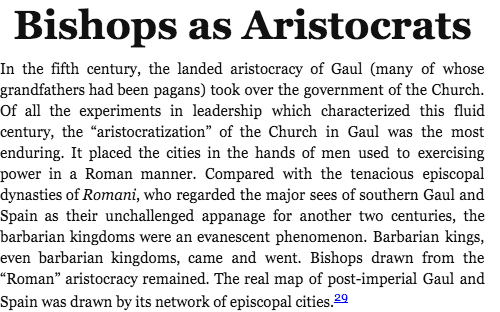
I’d add this passage from Peter Brown’s The Rise of Western Christendom: Triumph and Diversity, A.D. 200-1000 (p. 110):

Screen Shot 2016-05-20 at 3.58.02 PM

You would think that after barbarian invasions, the collapse of civilization as it was known, the replacement of aristocratic paganism with a radical religion of equality, and the rise and fall of barbarian kingdoms, the old pagan Roman landowning families would have slipped a notch or two. On the contrary, they seem to have morphed into powerful and wealthy bishops in Merovingian Gaul. Brown doesn’t trace the story after that, but it wouldn’t surprise me to learn that the provincial gentry of today’s France descend from these bishops’ families.

We needn’t be fatalistic. Societies change, often for the better. But it’s interesting that neither a radical Millenarian religion nor socialism–nor invasions and civilizational collapse–necessarily interrupts the transmission of advantage from one generation to the next. I presume that social and cultural capital can survive immense disruptions of physical capital, or–to put it more bluntly–people who know how to play one system make sure that their kids do well in the next one.