Category Archives: Uncategorized

Civic Deserts and our present crisis

My colleagues Kei Kawashima-Ginsberg and Felicia Sullivan have published an article in The Conversation that I believe supports an important diagnosis of the 2016 election and our current crisis. Their article is entitled “Study: 60 percent of rural millennials lack access to a political life.” They find that a majority of rural youth live in areas that they call “Civic Deserts,” which are “characterized by a dearth of opportunities for civic and political learning and engagement” and a lack of “youth programming, culture and arts organizations and religious congregations.”

Young people in these areas are less civically and politically engaged than other youth. They do not belong to groups and they rarely take civic actions, like voting and volunteering. “During the 2016 presidential election, young people who live in Civic Deserts were less likely to vote compared to others with more civic resources.”
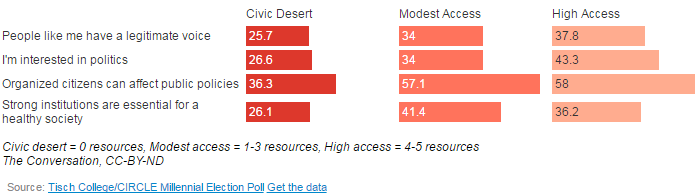
But if they did vote, “they were slightly more likely to choose Trump than those with better access to civic resources.” To illustrate that point: young urban Whites who lived in areas with many civic organizations voted for Trump at a rate of 17 percent. Young Whites who lived in Civic Deserts—which could be rural, suburban or urban—voted for Trump at more than twice that rate: 39 percent.

A person could prefer Trump over Clinton in the November election for a variety of plausible reasons. For instance, if you think that abortion is murder, that is a reason to pull the lever for Trump/Pence instead of Clinton/Kaine. But to like Trump—to appreciate his rhetoric and leadership—is a different matter.

I have argued that few people who belong to functional voluntary groups will appreciate Trump. In almost any kind of voluntary association (whether an evangelical church, a Farmworkers’ local, a business coalition, or a lending circle) leaders typically emerge who demonstrate two virtues: inclusiveness and accountability.

No matter how unified the group, it will encompass some diversity. Members normally expect their leaders to hold the group together by using words and taking actions that include, rather than exclude. Groups do sometimes expel or deliberately alienate members–but only in extremis. The normal goal is to hold the group together.

And members expect their leaders to deliver. If the pastor says the church is going to build a new playground slide, then a new slide had better appear reasonably soon, or the pastor will be blamed. If the informal leader of a social circle promises to organize a gathering but fails to set a date, her stock as a leader will fall.

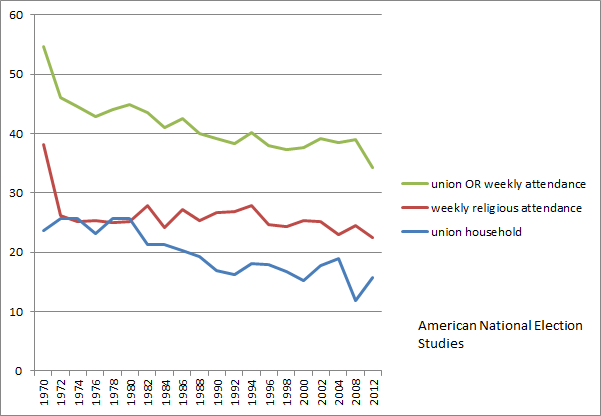
Donald Trump exhibits neither virtue. He is happy to exclude and he is utterly unaccountable. Indeed, I believe many of his fans don’t really expect him to deliver. For them, he is like a droll uncle sitting beside them on the couch, watching O’Reilly, and making remarks that reflect their feelings. When he says he’s going to drain the swamp, they take that to mean that he endorses their values and despises the lobbyists and politicians whom they despise, not that he will actually pass ethics reforms. I posit that this attitude reflects a lack of satisfying experiences with voluntary associations in which the leaders are inclusive and accountable. And that is an increasingly common situation given the steep decline in organizations like unions and churches.
http://peterlevine.ws/?p=17944

Thus I consider the decline in membership—especially among working class Whites—a fundamental cause of Trump.

As evidence, I cite my colleagues’ new finding that White Millennials who live in Civic Deserts voted for Trump. I’d also cite a recent conversation with a self-described Southern conservative evangelical pastor, who told me that he despises Trump because the president’s leadership style violates everything he believes about how to hold a community together.

I’d also cite Hannah Arendt’s argument that loneliness is a precondition of totalitarianism. For her “isolation” means being alone, but “loneliness” means having no felt capacity to control the world in conjunction with other human beings:

Isolation may be the beginning of terror; it certainly is its most fertile ground; it always is its result. This isolation is, as it were, pretotalitarian; its hallmark is impotence insofar as power always comes from men acting together, ‘acting in concert’ (Burke); isolated men are powerless by definition. …

In isolation, man remains in contact with the world as the human artifice; only when the most elementary form of human creativity, which is the capacity to add something of one’s own to the common world, is destroyed, isolation becomes altogether unbearable…

Isolation then becomes loneliness. … Totalitarian domination … bases itself on loneliness, on the experience of not belonging to the world at all, which is among the most radical and desperate experiences of man (The Origins of Totalitarianism, p. 474-5).

Donald Trump is no totalitarian, but the mechanism is similar. When individuals learn from hard experience that they stand alone in a harsh world, they are prone to follow leaders who simply echo their private thoughts and make them feel part of a unified mass.

See also the hollowing out of US democracyto beat Trump, invest in organizing and the “civic state of the union”

new project on the socio-emotional impact of civic engagement

(New York City) People can gain satisfaction, empathy, purpose, insight, and a host of other socio-emotional or psycho-social benefits from taking part in civic life. Also, if they demonstrate psychological maturity or even excellence, it can help them to be responsible civic actors. On the other hand, they can pay a psychosocial price from acting politically. I am haunted by Doug McAdam’s findings, in his great book Freedom Summer, about the longterm human costs of participating in the voter registration drives in Mississippi. Whether psychosocial development and civic engagement benefit each other depends on how we design those experiences, and in doing so, we must be attentive to the varying experiences of people who stand in different places with respect to the social issues (such as racism) that are at stake.

Therefore, I am pleased to share this news:

Tisch College is launching a new initiative in Social-Emotional Learning and Civic Engagement thanks to a generous gift from David T. Zussman, A53, J80P, and his family through the Zussman Fund for Social and Emotional Learning (SEL). The gift will support Tufts faculty’s integration of social-emotional learning into their teaching, and will promote related research and education across the University through frequent collaboration with the Center for the Enhancement of Learning and Teaching (CELT). A key aim is to encourage all Tufts students—undergraduate, graduate, and professional—to develop their social-emotional skills through civic experiences in and out of the classroom. The initiative will also generate new knowledge for the benefit of other institutions.

More at the link.

how to respond, revisited

Right after the election, I posted a flowchart about “how to respond” that was (by my standards) quite widely shared. I hear anecdotally that it is being used by community groups for discussions.

Incidentally, the question is open-ended; it doesn’t say “How to respond to Trump.” People could use it if they believe the current situation is dire but not because of Donald J. Trump, or not merely because of him.

Last night, I had a chance to use the flowchart with a group of about 16 people in my own community (Cambridge, MA). That discussion encouraged me to make some minor clarifications to the text; see below. (And thanks to my colleague Alberto for the improved graphics.) I’m always open to suggestions for bigger changes.

The people who met last night would like suggestions for concrete next steps, resources, and organizations for each cell. We could even think through what each cell at the bottom means for various institutions: schools and colleges, philanthropies, news media, religious congregations and denominations, municipalities, and so on. If, for example, you work in philanthropy and you want to support ideologically diverse deliberations, what should you invest in? If you’re a k-12 educator who wants to teach deliberation, what should you do, and who will support you? Canvassing these options is a good exercise for a group.

Right now, I think many people are focused on how to sustain momentum. There was a burst of energy around the Inauguration, and some people perceive a dip since then. This challenge also arose at the recent “Civic State of the Union” forum with Mara Liasson, Bob Putnam, Shirley Sagawa, and me.

I offer two thoughts. First, relationships create the motivations and accountability that power movements. People don’t stay involved because of an issue, but because of the other people. Therefore, it is worth cultivating relationships by adding regular social interactions to political efforts. Get together for pizza even if you aren’t sure what to do politically.

Second, we have to be willing to take satisfaction, even joy, from politics. Yes, people are suffering and even possibly dying, and I am not one of those harmed. (My taxes could well go down under Trump.) Therefore, it can seem self-indulgent for people like me to take pleasure from resistance. Yet political engagement is an aspect of a good life, the nascent resistance is a beautiful thing to be part of, and if we engage out of sheer duty, we’ll falter sooner or later. I’d say: less guilt, more joy, and let’s stick together.

(See also taking satisfaction from politics in the face of injustice.)

Trump v the judges: norms breaking down

I deeply oppose the Trump travel bans on two main grounds: 1) We should strive to admit refugees from the terrible war zones of the world, and 2) a policy that’s rhetorically linked to anti-Muslim motivations threatens the standing of Muslim citizens and residents of the US, as well as the religious equality and tolerance that should be important to all of us.

Nevertheless, I thought the revised travel ban was probably both legal and constitutional. One interpretation of the injunctions against the ban is that certain federal judges have overstepped their bounds because of objections to the policy (and the president) that I share, but that shouldn’t influence them in their judicial roles. I’d advance a different interpretation, however. These judges are relaxing some traditional norms and constraints because the Trump Administration has shed its commitment to norms that have constrained previous presidents. The resulting conflict is dangerous for the constitutional order but preferable to an alternative in which only the executive branch ignores key norms.

I’d have thought that the revised ban would be upheld for several reasons. First, Congress may regulate immigration by statute, but the law it has chosen to enact (8 U.S.C. § 1101) says:

Whenever the President finds that the entry of any aliens or of any class of aliens into the United States would be detrimental to the interests of the United States, he may by proclamation, and for such period as he shall deem necessary, suspend the entry of all aliens or any class of aliens as immigrants or nonimmigrants, or impose on the entry of aliens any restrictions he may deem to be appropriate.

Second, people who are neither citizens nor residents of the US are typically seen as having no rights under the US Constitution. Third, in a wide range of situations, courts don’t inquire into the motivations of policymakers when they assess legality and constitutionality. Finally, the argument that the revised order is a Muslim ban, and hence detrimental to US Muslims and every citizen’s religious liberties, could founder on the fact that of the ten countries with the largest Muslim populations in the world, only one (Iran) is on the banned list. The banned countries seem rather to be sources of refugees, and the president is not legally obliged to admit refugees, even if human rights and morality demands that.

Yet two federal judges have blocked the order, one with a nationwide injunction, and a Ninth Circuit panel has refused to reconsider its block of the earlier order.

Critics of the injunctions note that they seem to exceed precedents and they seem to rely on critiques of Trump as a person. Josh Blackman writes:

Judge [Leonie] Brinkema has applied a “forever taint” not to the executive order, but to Donald Trump himself. For example, the government defended the selection of the seven nations in the initial executive order because President Obama approved a law that singled out the same seven nations for “special scrutiny” under the visa waiver program. Judge Brinkema rejected this reasoning: “Absent the direct evidence of animus presented by the Commonwealth, singling out these countries for additional scrutiny might not raise Establishment Clause concerns; however, with that direct evidence, a different picture emerges.” That is, if Barack Obama selected these seven countries for extreme vetting, it would be lawful, because he lacks the animus. But because Donald Trump had that animus, it would be unlawful. … It will always a “Muslim ban” because of comments he made on the O’Reilly Factor in 2011, a policy he adopted in 2015, and abandoned after his lawyers told him it was illegal. She admits as much. “A person,” she writes, “is not made brand new simply by taking the oath of office.” Not the policy. The person. Trump.

Blackman thinks the courts are overstepping their bounds. See also David Frum on the “dangerous precedent” these injunctions could set. In his 9th Circuit Dissent, Judge Jay Bybee warns, “We cannot let our personal inclinations get ahead of important, overarching principles about who gets to make decisions in our democracy. For better or worse, every four years we hold a contested presidential election. We have all found ourselves disappointed with the election results in one election cycle or another. But it is the best of American traditions that we also understand and respect the consequences of our elections.”

Indeed, it’s worth worrying about what will happen if our courts start assessing individual presidents when they rule on legality and constitutionality. But this is my take (reminiscent of a piece by Benjamin Wittes and Quinta Jurecic):

The Constitution vests the various branches with powers and doesn’t say a lot about how they should be exercised. Like people playing a board game that has simple rules printed on the inside of the box, our officials have developed a long set of norms, some written as precedents and some unstated, to complement the basic rules. The board-game players know that no one will take an hour to decide on her move or start yelling insults during the game. Judges know that presidents will not single them out for abuse, deny the legitimacy of judicial review, blatantly lie and maintain their lies in the face of evidence, or say things–even informally–that undermine the basic principles of our republic, such as religious neutrality. Presidents, for their part, can count on judges to believe their assertions about national security and to read their executive orders charitably.

At least some judges believe that Trump is like a board-game player who is technically following the rules on the back of the box but violating the norms that make the game playable. So they are going to use their express powers under the basic rules to counter him and either force him to play by the norms or reduce his power. Even Judge Bybee (previously known to me only as an author of the “torture memos”), who dissented in the Ninth Circuit judgment, ended his dissent with a rather extraordinary coda:

Even as I dissent from our decision not to vacate the panel’s flawed opinion, I have the greatest respect for my colleagues. The personal attacks on the distinguished district judge and our colleagues were out of all bounds of civic and persuasive discourse—particularly when they came from the parties. It does no credit to the arguments of the parties to impugn the motives or the competence of the members of this court; ad hominem attacks are not a substitute for effective advocacy. Such personal attacks treat the court as though it were merely a political forum in which bargaining, compromise, and even intimidation are acceptable principles. The courts of law must be more than that, or we are not governed by law at all.

The prime danger is that Judge Bybee’s colleagues have judged Trump wrong and been biased by the abuse directed at them. But on balance, I think their response is for the best under these dire circumstances.

The “civic state of the union”

This is the video from the “Civic State of the Union” on March 7 at Tisch College. The participants are Mara Liasson, National Political Correspondent for NPR and contributor to Fox News; Robert D. Putnam, political scientist, Professor of Public Policy at the Kennedy School of Government, and author of numerous works, including Bowling Alone; Shirley Sagawa, President and CEO of the Service Year Alliance and a Visiting Senior Fellow at the Center for American Progress; and me. We talked about the civic condition of the United States and what to do about it.