Category Archives: Uncategorized

loyalty in intellectual work

(Los Angeles) Academics and scholars most commonly relate to institutions, movements, or fields of practice by assessing them. They identify the underlying theory or rationale of a given practical effort and assess its plausibility and its consistency with principles of justice. They also observe the actual performance of the practice to date and render judgments about success or failure.

Since my undergraduate days, I’ve instinctively adopted a different stance toward fields of practice. I’ve seen them basically as groups of people. I’ve never taken their theories completely seriously, because I expect them to evolve. And I’ve never seen the empirical data about success or failure so far as dispositive, because I assume that efforts will fail until they are refined and improved. You can start from many premises and get good results if you are open to reflection and change. The theory is less important than it seems.

Fields of practice are working communities of people who are either worth joining or not. What inclines me to want to join a group is a sense of its members’ motivations (in a very general sense) and their capacity or potential. Once I feel that I’m part of the group, I adopt a stance of loyalty. That doesn’t prevent me from making critical comments, either privately or publicly, if that seems helpful to the cause, but it does pose a question about any possible communication: is it helpful?

In this general mode, I’ve found myself part of the following fields or movements since my undergraduate days in the late 1980s:

  • service-learning
  • public deliberation and dialogue
  • university/community partnerships
  • campaign finance reform
  • public or civic journalism
  • k-12 civic education
  • relational community organizing
  • certain political campaigns
  • Action Civics

Clearly, these efforts share some principles or norms. Of the enormous variety of projects and groups that are active around us, most wouldn’t appeal to me as much as these. In We Are the Ones We Have Been Waiting For, I tried to analyze and defend the norms underlying the fields that I most admire in generic terms. Still, I don’t go around looking for movements that match all these principles. Instead, I tend to join movements that seem appealing and then try to reflect on their emergent principles.

Relating to fields of practice in this way sometimes causes misunderstandings. I’ve noticed that sometimes people expect me to endorse the underlying “theory of change” of a given field very strongly and are disappointed when I won’t. I usually cannot say that a given strategy or premise is the best one available, because I don’t really believe that. Instead, I think that a field or movement turns into what people make of it. So I see myself as a member who wants to make the movement as good as it can be, not as an independent scholar who has judged the movement and found it superior to others.

See also:  loyalty to place in the age of jet-set academiabringing loyalty backAlbert O. Hirschman on exit, voice, and loyalty; and “Seeing Like a Citizen: The Contributions of Elinor Ostrom to ‘Civic Studies‘” (because I see Ostrom as having a similar stance).
European Summer Institute of Civic Studies, this August in Chernivtsi, Ukraine

The Summer Institute of Civic Studies will take place in Chernivtsi, Ukraine, from July, 31st to August, 12th 2017 (at the Chernivtsi Yuri-Fedkovych-University). The Summer Institute of Civic Studies is organized by a team from Tufts University (Prof. Peter Levine), the University of Maryland (Prof. Karol Soltan) and the University of Augsburg (Prof. Tetyana Kloubert).

The total number of participants will be limited to 20. Ukrainian scholars and practitioners are strongly encouraged to apply. We will also consider the applications from Germany, Belarus, Poland and Moldova. We are especially interested in applicants who have a long term interest in developing the civic potential of Ukraine and the region.
The working language of the Summer Institute will be English. Your mastery of the English language must be sufficient to read and understand complex texts from multiple disciplines, and to take part in a lively discussion.

Objectives and topics

The Summer Institute of Civic Studies is an intensive, two-week, interdisciplinary seminar bringing together advanced graduate students, faculty, and practitioners from diverse fields of study.

The Summer Institute of Civic Studies deals with issues of development of civil society, the role of an individual/citizen in society, the role of education in promoting democracy, the role of institutions in the development of a civil society and questions related to the ethical foundation of civic issues in a (democratic) society. These topics will be examined in international and comparative perspectives, considering European (especially German) and US-American civic traditions. International examples will be discussed in the context of consolidation of democracy in Eastern Europe, particularly in Ukraine, Poland, Moldova und Belarus.

The Summer Institute of Civic Studies engages participants in challenging discussions such as:

  • What kinds of citizens (if any) do good regimes need?
  • What should such citizens know, believe, and do?
  • What practices and institutional structures promote the right kinds of citizen-ship
  • What ought to be the relationships among empirical evidence, ethics, and
    strategy?

Summer Institutes of Civic Studies were annually organized by Peter Levine and Karol So?tan at Tufts University since 2009. Read about the summer institutes.

How to apply

All application materials must be submitted in English. The application must include the following:

  • A cover letter telling us why you want to participate in the summer institute and what you would contribute (maximum 2 pages)
  • A curriculum vitae

All application material can be sent as an email attachment in DOC or PDF format to
tetyana.kloubert@phil.uni-augsburg.de.

Decisions will be announced before the end of May 2017. For best consideration apply by May 20, 2017.

Expenditures: Selected participants will be provided with accommodation, meals and full event access (in some urgent cases also with travel costs).

Contact: For more information about the Summer Institute of Civic Studies please contact tetyana.kloubert@phil.uni-augsburg.de

We encourage you to share this message with your networks of people who might be interested by the Summer Institute of Civic Studies.

Ostrom, Habermas, and Gandhi are all we need

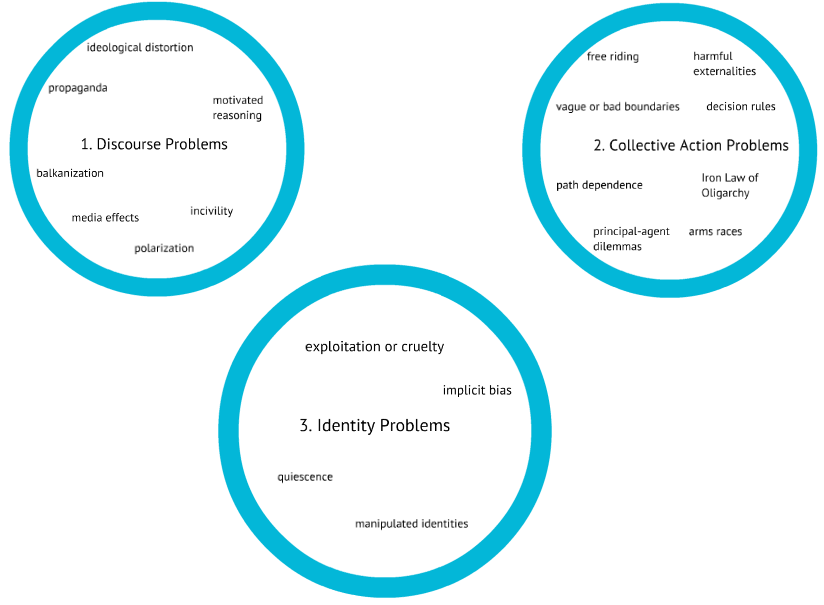
(Rancho Palos Verdes, CA) Back in 2014, I argued: [Elinor] “Ostrom plus [Jürgen] Habermas is nearly all we need.” I define a good citizen as anyone who seriously asks the question “What should we do?” Citizens face a dizzying variety of hard issues, but underlying them are general categories of problems. As of 2014, I thought these were the two basic categories:

  1. Problems of discourse make our thoughts and conversations go badly, so that we believe or desire the wrong things. Example include our susceptibility to propaganda and our strong tendency to “motivated reasoning,” or picking facts and theories because they yield the results we want.
  2. Problems of collective action cause us to get results that we do not desire, even when we agree about goals and values. An example is the temptation to “free ride” on other people’s contributions, or the tendency of small groups of specialists to dominate even democratic organizations (“The Iron Law of Oligarchy”).

Habermas and the postwar Frankfurt School provide a robust theoretical tradition, linked to practical experimentation, about how to address problems of discourse. Elinor Ostrom and the Bloomington School provide an equally robust theory/practice tradition about how to address problems of collective action. That was my basis for saying that Ostrom and Habermas nearly sufficed for a civic theory.

But I now think there is a third general category:

  1. Problems of identity and exclusion arise when some people simply won’t deliberate or collaborate with other people because they regard the latter as fundamentally different and inferior. Relatedly, sometimes people feel that they themselves don’t deserve to deliberate or collaborate because they are inferior.

The theoretical resources of Habermas and Ostrom are not sufficient for that third category, and we can learn more from theorists and practitioners of nonviolent social movements. That is the tradition that tells us what to do about problems of identity and exclusion if we choose to take violence off the table.

Therefore, I now believe that Ostrom, Habermas, and Gandhi are all we need–assuming that each name is synecdoche for a whole tradition of theory and practice.

Ostrom Habermas Gandhi
Fundamental problem People fail to achieve what would be good for them collectively People manipulate other people by influencing their opinions and goals. People fail to view others (or themselves) as fully human
Exemplary case of the problem We destroy an environmental asset by failing to work together Government or corporate propaganda distorts our authentic values One national or ethnic group exploits another
Characteristic starting point People know what they want but can’t get it People don’t know what they want or want the wrong things Some people won’t recognize other people
Essential behavior of a citizen Working together to make or preserve something. Talking and listening about controversial values. Using nonviolent sacrifice to compel change
Instead of homo economicus (the individual who maximizes material self-interest) we need … Homo faber (the person as a maker) Homo sapiens (the person as a reasoner) or homo politicus (the participant in public assemblies). A Satyagrahi (the person as a bearer of soul force)
Role of the state It is a set of nested and overlapping associations, not fundamentally different from other associations (firms, nonprofits, etc.) Citizens form public opinion, which should guide the state, which makes law. The state should be radically distinct from other sectors A target of demands
Modernity is … A threat to local and traditional ways of cooperating, but we can use science to assist people in solving their own problems A process of enlightenment that liberates people, but it goes wrong when states and markets “colonize” the private domain (for Gandhi) an imperialist imposition, undermining swaraj
Main interdisciplinary combination Game theory plus observations of indigenous problem-solving Normative philosophy (mainly achieved through critical readings of past philosophers) plus system-level sociology. Critical theology plus military strategy

why do students sometimes lead social change?

(Cincinnati) At several critical points during the past century, college students have been at the vanguard of social change. Their agendas have not always been desirable; fascism, for example, had a student wing. But student activism is an important phenomenon. I think four frames of reference are most common for explaining it:

Age effects: Traditionally, most college students have been young. During young adulthood, individuals become aware of the social world but are still forming their identities and opinions. That gives them a certain critical detachment that is favorable to radical activism. They are also not overly burdened by experiences of political failure. Using that framework, we would expect younger adults consistently to be more active.

Generational effects: People who come of age during the same historical moment may form a shared and lasting identity as members of a given generation. The classic example (analyzed by Karl Mannheim in his seminal article) is the experience of being drafted into WWI. With this framework in mind, we might presume, for example, that German college students became highly active after 1965 because they shared the experience of growing up in prosperous homes with suppressed memories of the Nazi past. People born around the same time in contexts as different as Germany, Japan, and the Soviet Union might even share a common generational identity (e.g., as children of The Sixties) if some of their formative experiences were similar.

Historical effects: Major events can affect people differently depending on their social circumstances. For instance, when a war breaks out, only the young single men may be drafted. A budget crisis can cause the government to cut funds for higher education; then college students see their fees go up. With this framework in mind, we would expect college students to become activated soon after major events affect them specifically.

Class effects: College students come disproportionately from middle-class or wealthy homes. Thanks to college, they are destined for positions in the top half of the income distribution. We might then interpret college student activism as “bourgeois” activism and ask why the bourgeoisie is, or is not, activated at a given moment.

I would like to add a fifth type of explanation, derived from some thoughts in Offe (1985). College students may face specific material circumstances that encourage–or discourage–them from being politically active. These circumstances are variables that will influence students’ levels and forms of engagement even of we hold age, generation, class, and historical moment constant. In other words, these are consequences of how college is organized socially.

Offe argued that certain demographic groups predominated in the New Social Movements of the 1970s and 1980s, such as Second Wave feminism and environmentalism. Two especially active groups were “housewives” (his word) and college students. He proposed that both groups were exposed to explicit discipline that provoked them to criticize social norms. Married women faced explicit coercion from their husbands; students, from their universities and parents. Yet both enjoyed a degree of flexibility about how to employ their time. That meant that they were able to protest if they wanted to.

I think we can elaborate on these explanations. Typically, college students who attend large institutions along with many other full-time students experience the following material circumstances:

  • A great deal of fluid social interaction, not limited to a nuclear family or work unit. That means that students can easily find and select into activist groups.
  • A concentrated population of other youth, which attracts political actors looking for support. Politicians speak on campuses; they don’t go around to fast food franchises hoping to talk to all the service workers.
  • Some useful non-cash assets for social-movement participation, such as flexible time, access to information and ideas, and connections to well-positioned adults.
  • A significant level of protection for free speech, especially as compared to workers in for-profit enterprises (and often in state bureaucracies).
  • Institutions designed for political discourse and communication, such as student newspapers and governments.
  • Some encouragement, via the curriculum, to think critically.
  • Some ability to choose courses of study and career pathways, which they can use as leverage over parents and universities. For instance, a student may be able to threaten to go into social work instead of accounting and then negotiate with tuition-paying parents. Threatening to drop out may also offer leverage.

If these factors matter, then we would expect the level of college student activism to vary when they change. For instance, if students lose their ability to choose courses of study because the job market is bad, they will have less leverage. If their freedom of speech is reduced, that will either suppress activism or serve as a form of explicit discipline that prompts them to revolt.

See also basic theories of civic developmentthe New Social Movements of the seventies, eighties, and today and to what extent can colleges promote upward mobility.  Reference: Offe, Claus, “New Social Movements: Challenging the Boundaries of Institutional Politics,” Social Research, vol. 52, no. 1 (Winter 1985), pp. 817-68.

the New Social Movements of the seventies, eighties, and today

(Oxford, OH) By the 1980s, a large literature distinguished the “New Social Movements” from older strands of politics. Jürgen Habermas chose to list the following New Social Movements then active in Germany: “the anti-nuclear and environmental movements,” “the peace movement”; “the citizens’ action movement”; the “alternative” movement that included urban squatters and new rural communities; movements of “minorities (the elderly, homosexuals, disabled people, etc)”; support groups and youth sects; “religious fundamentalism”; the “tax protest movement”; “school protests” by parent associations; “resistance to modernist reforms”; and “the women’s movement” (1981, p. 34).

Some of these might be classified with the left, and others (notably, tax protests and religious fundamentalism), with the right. In retrospect, it is debatable whether they formed a meaningful category or could be distinguished sharply from the “Old” social movements, such as labor unionism and civil rights in the USA.

My view is that these movements did represent a new stage of politics in the wealthy democracies. That stage has passed, however, as new problems have come to the fore and as the social movements of ca. 1968-1985 have become institutionalized in the nonprofit sector, thus losing their emancipatory role. These changes mean that it’s important to compare our time with the 1970s and early 1980s and to envision productive combinations of the Old and New Social Movement forms.

Continue reading