Category Archives: Uncategorized

how Brexit is unlike Trump (and what to do about it)

When they think about Brexit, most of my American friends equate it with the election of Donald Trump. Both events are seen as manifestations of xenophobia, paranoia toward elites, and even Russian propaganda.

You can tell that this analogy is weak from the stance of Labour, which is meeting right now for its conference in Liverpool and debating a huge range of motions on Brexit. Yesterday, the Guardian reported:

Consensus appeared to break out as Jeremy Corbyn insisted he would follow the democratic will of his party if delegates voted for a second referendum on the final Brexit deal. But trouble could still be brewing. The Labour leader refused to say which way he would vote. The Unite chief, Len McCluskey, added his tuppence worth, suggesting it would be wrong for any new vote to include the option of staying in the EU. Remainers will be unimpressed.

Last night, after 5.5 hours of negotiation, party leaders emerged with a draft statement that criticizes “the Tories’ chaotic approach to the Brexit negotiations,” calls for a general election, and fudges everything else. Corbyn himself voted against Brexit, but he also voted against the key European treaties of 1975, 1992, and 2008; he has little positive to say about the current EU; and he has frequently pledged to “respect the referendum” that passed Brexit.

Imagine if Bernie Sanders won control of the Democratic Party and refused to say which way he would vote on Trump’s Wall or the refugee ban, while expressing respect for the policy implications of an election held several years ago. That would be plausible if Brexit were like Trump–but it isn’t.

I can’t overstate my own disappointment with the Brexit vote. My commitment to European integration goes back to the 1970s, when I was a child in a London primary school with a literal WWII bomb site next door. The European Economic Community was forming in those days, and we studied each member country in turn–in order to become peaceful, pluralist, democratic Europeans. (By the way, this was a Christian socialist state primary school run on progressive lines.) I’m proudly a citizen of the USA but have remained deeply invested in the ideal of European unity.

However, it is a matter for debate and reasonable disagreement whether the current form of the EU merits membership. One doesn’t have to be a bigot or a fool to want to leave. If you approach politics from the left, you will see both pros and cons to exit.

For Labour politicians, ambiguity is attractive, because they can hope to win votes from both sides on Brexit while blaming the inevitable fiasco on chaotic Tory management.

I happen to believe in what Bill Galston once called “the obligation to play hardball,” and I think a Labour policy of deferring on Brexit until the outcome crushes the Conservatives is possibly a good hardball play (to use a baseball metaphor for the land of cricket).

But it also has risks, even from a Labour perspective:

  1. Constitutional risks: there is now a widespread sentiment in Britain that respecting a referendum is the best way to honor democracy. (And holding a second referendum would somehow undermine the people’s will.) The traditional view was that the British people were best represented by Parliament, which they choose to exercise sovereignty between elections. That is a better political theory, because government should be deliberative and flexible. Parliamentary sovereignty would return if Labour took a clear position against Brexit. No one would doubt that Parliament could overrule the referendum once voters gave Labour a mandate to do so. It would then be equally clear that Britain is heading toward Brexit because the Tories are in the government. Hence there is only one reason that parliamentary sovereignty is at risk: the opposition refuses to take a position on the most pressing issue of the day.
  2. Risks to the European left: many have noted that if Labour takes over and Britain gains the same status as Norway (all the rules without a vote in Brussels), then Europe will lose the strongest potential voice of the left–Corbyn, as the leader of the second-biggest EU economy. The best way for a Labour voter to try to influence all of Europe is to stay in the EU.
  3. Risks to the United Kingdom: the most obvious danger is the collapse of Irish peace due to a hard border. But you can also see pro-European Scotland constantly looking to leave Britain if the UK leaves the EU. There are arguments for Scottish independence, but if you’re a Labour voter (either north or south of the border), you should definitely want to keep all those leftish Scots in the country.
  4. Risks to Labour: I can believe that Britain will sustain a terrible shock from Brexit and that voters will long blame the Tories for it. But will they respect Labour if Labour didn’t oppose Brexit while it had a chance? On the other hand, if the exit goes reasonably well, the Tories will benefit. Thus ambiguity presents electoral risks, not just as benefits, for Labour.

self help: a short story

Political prisoner K. was sentenced to solitary, with only cement walls, a cot, a stinking bucket, and a food slot for company.

One day, on his way back from interrogation, he saw a tattered paperback on the floor. The guard let him take it with him. It turned out to be Letting Your Inner Boss Shout by Dr. Bradford P. Bradley, PhD.

K. was enraged at first by its solecisms, trivialities, cliches and lexical trespasses. Anything would be better than this! After reading it several times without finding any value in its Six Winning Strategies for Asserting Your True Needs in an Office Context, he began selecting fragments from the pages. The rule was to leave chosen words in place but hide the rest. For instance:

Another game: rearranging all the words of a sentence to say something better:

The Six remember. Strategies, always.

True, winners: their real minds speak.

These activities engaged K’s. attention for several days, but something kept intruding. Or rather, someone. Dr Bradley, PhD.–Brad Bradley–just Brad. Was he raggedly bearded and balding, with spots on his head and long speeches to give? Or a young guy, bored out of his mind, looking for new life though writing? A pseudonymous woman, quiet observer of her office culture? An ironist, chuckling as he typed?

K. couldn’t quite tell. Alternatives multiplied into a whole community of Brads.

The real author, whoever it might be, seemed to deserve the respect of attention. Maybe Brad really had only five strategies in mind, but the book was too short and he’d wracked his poor brain until he came up with a sixth to pad the pages. Or maybe Brad knew that eleven strategies were necessary for achieving your life goals, but the cheapskate publisher forced him to cut five of them, and now he was worried to death about his misinformed readers.

It was good, in any case, to have a companion. The six strategies had been meant as gifts; perhaps it would be better to accept them as such. With thanks, even.

Prisoner K. and Dr. B. Just the two of them, in solitary but not solitary. Shouting their inner bosses. Hearing the other’s shouts. Having someone to walk with blindfolded to the final wall.

(Chicago, Sept. 20)

nonviolent civic work under conditions of extreme violence

My Tufts colleague Anjuli N. Fahlberg, a sociologist, has done extraordinary work in Rio de Janeiro’s City of God. Despite a staggering level of violence in that neighborhood, the residents have created a wide array of impressive initiatives that offer social services, education, and culture and promote social justice. Local activists are networked with peers in other communities they have been effective at the national level in Brazil.

Anjuli helps rebut the claim that “civic engagement” is only for privileged people. She also reveals interesting patterns that may generalize to other places. For example:

CBO [community-based organization] leaders had to monitor their activities and tactics closely so as not to conflict with the political and economic interests of the drug trade. They did this in several ways. For one, they decidedly avoided local politics, which meant avoiding any contact with political or community leaders known to be working for the drug trade and declining favors from local political candidates. … Since Solange and other CBOs refused to engage in violent governance, they found power in its opposite: moral governance. Moral governance emphasized transparency, fairness, equality, justice, and the use of resources for their stated activities. Notably, nearly all CBO leaders were women and thus offered a visual, embodied distinction from violent politics, which were controlled almost entirely by men.

This is from Anjuli N. Fahlberg, “Rethinking Favela Governance: Nonviolent Politics in Rio de Janeiro’s Gang Territories,” Politics & Society, September 11, 2018. Read the whole thing. You can also watch Anjuli’s talk at last year’s Frontiers of Democracy conference, here:

churchgoing and Trump

The Democracy Fund’s Voter Study Group has released an important new paper by Emily Ekins entitled, “Religious Trump Voters: How Faith Moderates Attitudes about Immigration, Race, and Identity.”

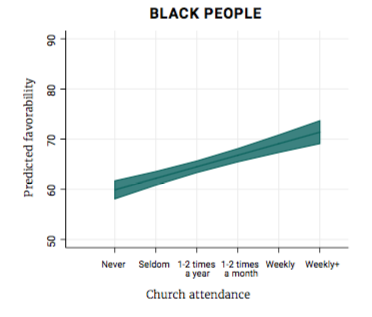
Ekins notes that Trump performed best in the 2016 GOP primaries among Republican voters who never attend church (getting 69% of their vote). Examining Trump voters during 2018, she finds correlations between regularity of church attendance and positive attitudes toward racial and religious minorities, acceptance of diversity, approval of immigration (and opposition to the border wall), and concern about poverty.

Here I illustrate that pattern with attitudes toward Black people as the dependent variable. The trend line controls for race, gender, income, education, and age. All the data come from Trump voters. Because the correlation between church attendance and racial attitudes among Trump voters holds with these controls, Ekins suggests that it is causal.

This might not be a case of cause-and-effect. A third factor might underlie both tolerance and church attendance. However, I posited a similar causal hypothesis early in 2017, after I’d met with a conservative Southern pastor who despised Trump’s leadership style and attitudes. This pastor blamed Trump’s support on coach-potato “Christians,” those for whom Christianity is an identity rather than an actual faith, those who get their ideas from Fox News or Breitbart, not from fellow congregants.

Some colleagues and I tried to test this hypothesis using survey data and failed to find it, which is a null result worth noting. Still, I’d like to think that Ekins is right—perhaps more so in 2018 than in 2016.

Why would this pattern hold?

First, Ekins shows that church-attending Trump supporters volunteer and trust other people much more than Trump supporters who rarely or never attend Church. It may be that people who help others and feel they can rely on others are less likely to despise and fear strangers. In turn, church-attendance may promote volunteering and trust, or it may manifest a broader form of social capital that explains both tolerance and church-attendance.

Robert Putnam introduced a distinction between “bridging” and “bonding” social capital. The bridging kind connects people who are diverse in some respects; the bonding kind may increase solidarity in opposition to outsiders. One could imagine that churches enhance bonding social capital. America is said to be most segregated on Sunday mornings, and churches distinguish insiders from outsiders. But volunteering and trusting generic others are measures of bridging, not bonding, social capital. Insofar as churches encourage volunteering, they are trying to create bridging social capital.

Another mechanism could be leadership. Real churches have leaders, both clergy and laypeople. Church leaders are expected to be responsive and responsible and to hold the group together. In contrast, Trump just says whatever comes into his mind, usually makes no effort to deliver what he promises, and is happy to divide. I have hypothesized that people who are familiar with real leadership in local voluntary associations would despise Trump’s style. Although we were unable to show that pattern using survey data, Ekins’ new results may suggest that it holds.

A third mechanism could be the content of the faith. I happen not to be religious, and I could criticize the specific content of many sermons and texts on ethical grounds. I am aware that there are mega-churches that show huge audiences jingoistic videos of American military might; there are clerics who praise Trump or cite Romans 13 to defend the administration’s policies. In my opinion, these examples are idolatrous as well as unjust, but my argument does not depend on romanticizing the content of religious expression.

I would argue, instead, that real faith is demanding. You can find passages and examples that reinforce bigotry, but you will also encounter texts that challenge you. Faith may be consistent with almost any policy position—as we can see from the enormous range of political opinions among clergy—yet participation in a deep and complex religious community is inconsistent with all simplistic attitudes about other people. Cable news and propagandistic websites reinforce what their audiences want to hear, but scripture is strange and demanding. Since religious texts are very hard to figure out by oneself, they require discussion and debate. In turn, the people in any given discussion usually turn out to have idiosyncratic and incompatible interpretations. This is why Martin Luther, despite his break with The Church, believed that we all need a church to keep us honest. Even if the content of preaching and liturgy doesn’t turn us into people who understand and care for others, the decision to attend a service may reflect a desire to become such a person.

In short, religion as a pure identity: bad. Religion as a community of people who struggle to address issues of moral and existential importance: good. Voters who actually attend church are more likely to experience the good form of religion, compared to those who identify as Christians without showing up on Sunday.

See also: the prospects for an evangelical turn against Trumpthe Hollowing Out of US Democracywhy Trump fans aren’t holding him accountable (yet); and why Trump fans aren’t holding him accountable (yet)

undergraduate Introduction to Civic Studies Course

PHIL-0020-01-Intro to Civic Studies at Tufts University (Fall 2018)

  • Ioannis D. Evrigenis, Professor of Political Science
  • Erin I. Kelly, Professor of Philosophy
  • Peter Levine, Lincoln-Filene Professor and Academic Dean, Tisch College

Civic Studies is an interdisciplinary field of study that focuses on critical reflection, ethical thinking, and action for social change. People who think and act together to improve society must address problems of collective action (how to get members to work together) and deliberation (how to reason together about contested values). They must understand how power is organized and how it operates within and between societies. They must grapple with social conflict, violence, and other obstacles to peaceful cooperation. When tensions arise within a group, people face questions of justice and fairness, and they must confront questions about appropriate relationships to outsiders of all types. This introductory course explores ethical, political, and theological frameworks for understanding how people can and should organize themselves to improve societies. Readings are drawn from philosophy and political theory, economics, the history of social movements, and other disciplines. This course provides theoretical grounding for Civic Studies majors and for other students interested in social change.

Continue reading