Category Archives: Uncategorized

Moral Foundations theory and political processes

Moral Foundations theory is an important body of research that has generated significant findings. It belongs to a somewhat larger category of research about morality that has these features:

  • Many individuals are asked for their moral judgments of hypothetical or historical cases. (See this test, for example.)
  • The data from these individuals is analyzed to identify latent factors that statistically predict many people’s specific answers. Respondents may not be aware of the latent factors or even endorse them when they hear them, yet these factors are said to explain (statistically, and maybe causally) their actual judgments.
  • Some factors are found to be common across cultures and to have adaptive value for human beings as a species that evolved through natural selection. These factors are named “foundations.”
  • Variation among human beings depends on which of the foundations are more important for different groups. This is a structuralist theory, akin to Claude Levi-Strauss or Noam Chomsky. For structuralists, surface-level diversity results from variation in a finite set of underpinnings.
  • In ambitious versions of this method, morality is the list of foundations. Morality is what we think it is because of how we evolved. To debate the value of the various foundations or to argue for a different principle is pointless. There is no way to know the truth of moral claims, but science can reveal the foundations of our moral psychology, so those alone are real.

Despite my interest in learning from the specific findings of Moral Foundations research, I harbor many objections, summarized here. In this post, I would like to elaborate on one concern.

We human beings make individual judgments about cases and decisions. That’s what the data-collection of Moral Foundations Theory models. But we do many other things that also shape values. For instance, we buy things, which causes more of those things to be made and sold. We participate in bureaucratic institutions that manage themselves through chains of command, policies, and files. We join and quit groups. And we govern by making laws and policies at all levels.

As Owen Flanagan writes in The Geography of Morals (2016), “Moral stage theory conceives moral decision-making individualistically. The dilemmas are to be solved by singleton agents. This is ecologically unrealistic. Committees at hospitals decide policies on organ allocation; government agencies deliberate about monetary policy; officers deliberate about costs and benefits of military operations; and friends talk to friends about tough decisions.”

I’ll focus on political decisions, although we should also consider markets, bureaucracies, friendships, scientific disciplines, and other social forms.

People make laws and other rules to prohibit, regulate, tax, subsidize, and mandate various behaviors. These rules directly influence how we act and may also affect our values, if only because many of us display the Moral Foundation of “Authority.”

One might think that rules and laws are made by people who implement their moral judgments, which are influenced by their individual Moral Foundations. Laws would then simply be aggregated Moral Foundations.

Not so, for these reasons:

  1. An important determinant of the actual law is the choice of who gets to make it. That choice is often made by people other than those who do the governing. Millions of voters choose a president. A president plus 51 US Senators decides who sits on the Supreme Court (one opening at a time, spread over decades). In making these choices, people are not focused on the specific cases or controversies that come before the Court. Top of mind for a president may be finding a justice who can be confirmed, who impresses the electorate, and who is young enough to serve for a long time. These are different considerations from moral judgments about cases, but they shape the actual law. (Here I use a democratic example, but a dictator is also chosen, often by a military junta or by party cadres.)
  2. When multiple people make laws, they don’t do so by judging in isolation and then aggregating their votes. A secret vote may mark an important moment in a political process, but it is almost never the only moment. It usually follows argument, persuasion, and mobilization; and sometimes groups decide without voting at all. Communication plays an important role. But when we communicate, we are not merely expressing our moral judgments of concrete cases. We may be doing many other things: trying to go along with the group, trying to stand out, trying to look (or be) impartial or moderate, trying to waste time on a point of disagreement to prevent attention to a different topic that we fear (filibustering), trying to set a precedent for other topics, supporting someone else so she’ll help us later (logrolling), saying something to irk someone in particular, enjoying the sound of our own voices, and so on. Our moral judgment of concrete issues may be an input, but only one among many.
  3. The procedures for making collective decisions influence the outcomes. For instance, almost all procedures favor the status quo because it takes energy and agreement to shift it. Therefore, a group can live with a law or policy that every individual would prefer to change. This is common and it implies that law often fails to reflect the private opinions of the majority–even when everyone has an equal say, which is vanishingly rare.
  4. One way that laws and policies shift is that subgroups successfully advocate for changes, based not on abstract judgments but self-interest. I don’t think that attitudes toward sexual orientation changed over the past half century because the broad public decided to reconsider their views. I think sexual minorities felt compelled to take their struggles into the streets, the ballot booth, and the courts and won some significant victories. The resulting policies then began to change attitudes. (A different kind of example: girls’/women’s sports got a huge boost from Title IX, which originated when Congress rejected a mischievous amendment to exclude sports from civil rights legislation–a backdoor way to enact a policy that has changed everyday attitudes toward gender.)
  5. Often the subject of political or legal debate is not whether individuals should do specific things: marry, steal, take drugs. It is about our collective stance toward social constructs: the United States (or Russia), Christianity, the family, a forest. These things have histories, they are complex and internally inconsistent, and they reflect laws or norms that people have formed over time. Often we are not asked to assess concrete actions but big abstractions that embody, among other things, many previous concrete actions taken by many people for many reasons. A major question is what story we should tell about a large construct.

For these reasons, empirical moral psychology cannot stand on its own without institutional/political analysis. Moral Foundations Theory is strongest when it aims to predict how people will individually react to a situation that raises issues so general that it resembles the problems that confronted our prehistoric ancestors on the savanna. The theory is least helpful for explaining why the same group of people might change its stance toward a specific topic, as we see with sexual orientation since 1969.

See also Jonathan Haidt’s six foundations of morality; an alternative to Moral Foundations Theory; moral thinking is a network, not a foundation with a superstructure; and against methodological individualism.
forecasting the UK parliamentary elections

The celestial bodies have aligned to put British politics in that rare situation: a first-past-the-post electoral system with multiple viable parties.

Usually, when a legislature consists of the top vote-getters in all the districts, it evolves (or degenerates?) into a two-party system, because supporters of any other party worry that their votes would be “wasted.” However, due to the turmoil of Brexit, plus the strength of regional parties, several parties will be competitive in the next UK election if it happens soon.

That makes the result extraordinarily difficult to predict. In theory, a party with well under 50% support could come in first in more than half the constituencies and dominate the Commons. You can’t tell how any party will perform just by examining national polls, because it depends on where its votes are concentrated. Britain could have the most socialist government since 1979, the most Thatcherite government since 1990, the first English-nationalist party in its history, or the first Liberal-led parliament since 1922, all depending on the quasi-random question of where the votes lie.

I cannot assess Max Baxter’s Electoral Calculus site, but I don’t see an alternative, and it seems sophisticated. The change that he finds over recent months certainly seems plausible.

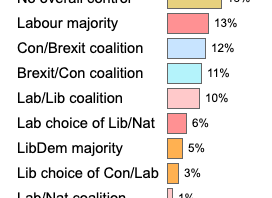
In May, many divergent outcomes had fairly similar probabilities. The most likely outcome was a Brexit Party majority, but that was less than a 4-1 bet. The combined odds of either a Labour government or a Labour/Liberal coalition were a bit higher, at 23%.

(“Nat” refers to the Scottish Nationalists plus Plaid Cymru from Wales)

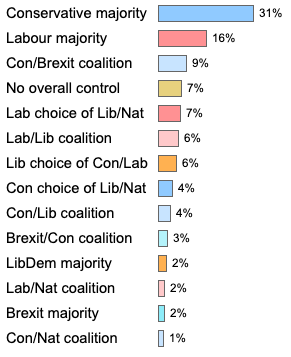
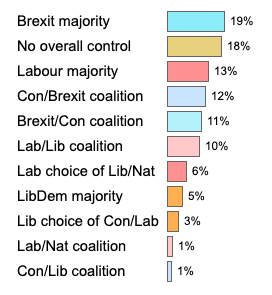
Since then, Brexit voters have shifted to the Tories because Boris Johnson is now the PM. That makes a Conservative government considerably more likely and almost wipes out the chance of a Brexit Party government. (Why vote for them when you can have Boris?) Since the Brexit Party was the most likely to form a government in May, the Tory leadership contest has been very consequential. Here are the current odds, again per Max Baxter:

In national polls, the Tories lead Labour by only about 4-5 percentage points and don’t reach 30% support. But they could still capture a majority of seats in a four-way contest.

I think Boris Johnson faces a bit of a dilemma. If he calls a snap election, he has a 31% chance of being able to govern without any coalition partners, an attractive option considering that 60% of voters are against him. He also has a 52% chance of being able to form some kind of government, with or without partners. To maximize his odds, he must continue to take all the votes away from the Brexit Party, which means a hard-line stance on Europe.

On the other hand, he already leads a government, and if he calls a snap election, he faces about a 48% chance of losing control to the opposition. That makes an election a pretty big risk, a coin-toss. But if he steams ahead with the current parliament, I can only see things getting much, much worse as Brexit hits. A 51% chance of forming a new government now is better than his likely odds any time after October.

On that basis, I think he will call an election and not budge an inch on Brexit until it’s over.

the oscillation between dictatorship and parliamentary institutions (a game theory model)

Abstract: Sometimes despots have incentives to convene representative bodies that govern with them. And sometimes the leaders of republics have incentives to rule unilaterally. Changes in the incentives explain the oscillation between authoritarianism and republicanism. Today’s incentives are pushing in the wrong direction.

Imagine that a leader (a king, tyrant, dictator, general) possesses the only effective, loyal, well equipped military force in an area. That person—Mancur Olson called him a “stationary bandit”—can use the threat of violence to extract money from the population to pay for and motivate the army plus a bureaucracy that identifies, counts, and organizes the society’s wealth.

It may help if the ruler has some perceived legitimacy (an anointed monarch instead of a usurper or dictator, for example) and offers benefits to the people, such as safety from foreign enemies. Those factors may reduce dissatisfaction that can breed resistance. But the main pattern is a monopoly of power that serves to extract resources to fund the power itself. This situation can be self-reinforcing.

But how to get to that situation if you don’t start with a loyal and effective army and bureaucracy? And how to get back to that situation if you lose it due to defections or diffuse resistance?

One way is to convene many of the leaders of the society who already have the capacity to collect resources: nobles or other great landlords who are succeeding at extracting rents, senior clergy who collect tithes or control endowments, and municipal leaders who represent commercial interests. These people can agree to generate the resources to pay for the state if they see advantages for themselves. Someone with a claim to leadership (say, a king) can convene them, negotiate with them, and end up as a ruler who shares power.

This is a way for parliamentary institutions to emerge from despotism, as they did across Europe in the middle ages. A medieval parliament almost always represented the nobility, the church, and the towns in separate houses or estates.

Now let’s say that the system is rolling along, and the monarch actually has a well-equipped, loyal military force and a bureaucracy funded by taxes. It becomes possible for that monarch to dismiss the parliament and use the state to extract taxes, rents, military service, and labor by force, perhaps legitimized by some theory of divine right.

This is a way for parliamentary government to shift into monarchical absolutism, as occurred in many European countries around the 17th century (plus or minus).

But let’s say the king gets into debt, or faces insubordination, or is attacked by a powerful foreign threat, or simply sees low levels of compliance. He may need to call a parliament again so that key stakeholders can voluntarily agree to coordinate their efforts to raise money. And if the parliament can organize itself effectively, it can threaten the monarch’s power and even his safety.

This is how the English parliament gained the authority, after 1688, to make all laws. The monarch still embodied the executive branch and could make many discretionary decisions of a broadly managerial type. Since that was too big a job for any individual to do alone, monarchs governed through ministers, often holders of offices that dated back to the middle ages.

Technically, the monarch could place anyone in these offices and could intervene in any issue directly by proclamation. However, since the power of the purse had shifted to parliament (and money can buy an army), the monarch was vulnerable. Charles I has lost his head; James II, his throne. Many subsequent British monarchs preferred to govern through ministers supported by parliament. And once parliament had divided into parties, this meant selecting ministers acceptable to the majority party. George I even discovered that it was convenient to make the leader of the majority–the Whig MP Robert Walpole—an effective chief minister who would chair a cabinet that he (Walpole) chose. Walpole served in this role for 20 years, resigning only when he no longer led a majority in the House of Commons.

In this way, parliamentary cabinet government and the office that we now know as the Prime Minister evolved from the underlying situation. The premiership was not created, like the US presidency, when a person or group conceived the idea and wrote it down in a constitution or law. It emerged from Walpole’s experience serving the King with the Commons’ support. But one could explain both the British premiership and the US presidency as a result of the same underlying needs.

Some subsequent monarchs pushed back by naming ministers of their own choice who lacked parliamentary support. There was not always a prime minister all. In 1783, the politician Charles James Fox reacted to the prospect that George III might name a prime minister without the confidence of parliament:

[If] a change must take place, and a new ministry is to be formed and supported, not by the confidence of this House or the public, but the sole authority of the Crown, I, for one, should not envy that hon. gentleman his situation. From that moment I put in my claim for a monopoly of Whig principles.

The last sentence simply means that Fox would seek to legislate a requirement that the cabinet receive parliamentary support. But the first sentence is more interesting. A prime minister who couldn’t win a majority in the House would stand in an unenviable situation even if he continued to serve, because he could not govern effectively without the parliament behind him.

Meanwhile, the governments of the Netherlands and England (at least) had learned that they did not have to rely solely on taxes, rents, and loans from bankers. They could also borrow from their own people, who would voluntarily buy state securities as long as they trusted the government to spend the money in what they considered the public interest. The middle class gained that confidence because they dominated the parliaments of these countries (versus the weakened nobility and the disenfranchised poor). As a result, these countries could raise huge sums and field substantial navies and armies, which, in turn, created economic benefits for the middle classes.

As a result, governments with parliaments became far more powerful on the international stage than absolute monarchies. Republican France could field an army of 1.5 million based on taxation, conscription, and bond sales. Although Napoleon overstepped, France threatened to dominate all of Europe. Absolutism recurred after 1815 and held on in places like Russia a lot longer, but it was the long-term loser in the Darwinian struggle for fitness among nations.

In this way, republican forms of government tended to prevail, except that the vast systems of state power that republics underwrote could also break free of parliamentary oversight. I don’t think that Germany could have built a massive state apparatus between 1871 and 1932 without a Reichstag to represent the public and make taxation and conscription reasonably popular. But once that apparatus existed and Hitler controlled it, he could dismiss the parliament and rule by fear. The story was perhaps a bit different in the USSR and China, both of which had long traditions of monarchical despotism and only brief parliamentary rule before their communist dictatorships. But all twentieth-century authoritarianism echoed baroque-era absolutism (with a larger dose of terror).

Then, around 1989, most of the authoritarian regimes crumbled in the face of republican popular movements. I think this was simply a recurrence of the despot’s traditional vulnerability, his need for widespread compliance. Authoritarian regimes sagged under the weight of corruption, stagnation, and obsolescence and couldn’t draw on their publics for resources—money, talent, or enthusiasm–to fix their problems. The reasons for the original rise of parliamentary government recurred.

The problem now is that the cost of dominating a population and extracting resources from the people has fallen. You don’t need a vast conscript army if you have drones and cruise missiles. You don’t need an army of bureaucrats if you can scrape data from electronic records. If you have a monopoly on the legitimate use of force within your territory, you can rule with just a few supporters.

William the Conqueror destroyed the Anglo-Saxon elite and governed England (with a population of at least 1.1 million) with about 8,000 men. Thanks to his victory on the battlefield and the dread power of knights, he was not forced to share authority but could keep 8,000 people behind them by distributing plunder. That is an example of a single leader possessing the resources to dominate, much as modern authoritarian states do. William’s descendants saw that advantage slip away and were forced to convene parliaments–but the road to democracy was long and slow.

Dewey was wrong that “the current has set steadily in one direction: toward democratic forms.” Instead democracy and despotism have oscillated, depending, in part, on how easy and affordable it is for a small number of people to dominate the population. Unfortunately, domination has lately grown cheaper and more effective.

See also: Dewey and the current toward democracy; why post-modern nation states do not need mass support; why autocrats are winning (right now); Dubai, Uganda, and today’s global political economy; and what does it mean to say democracy is in retreat?

less than a penny a year for grassroots civic organizing

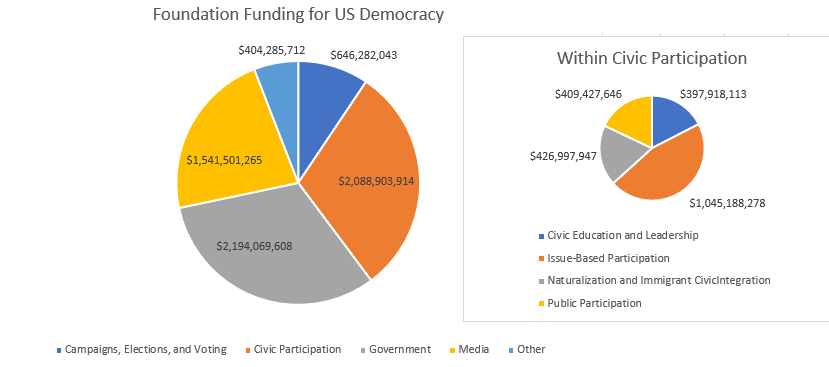
(DC) The Foundation Center’s database and analytic website entitled Foundation Funding for US Democracy is full of interesting information and worth detailed exploration.

Drawing on tax forms, the site categorizes $5.5 billion in grants made to strengthen democracy in the USA since 2011.

The ideological range is wide: the DeVos and Mercer foundations are in the database, along with Open Society and many more.

This is the distribution of grants by very broad categories, with a somewhat more detailed look at the pie slice devoted to “civic participation” (which interests me most).

My graphs based on Foundation Center data

I estimate that $1.73 billion of the $5.5 billion (31%) has gone to nonprofits headquartered in DC or the surrounding counties in Maryland and Virginia. With some exceptions, these are professional organizations without a grassroots membership base.

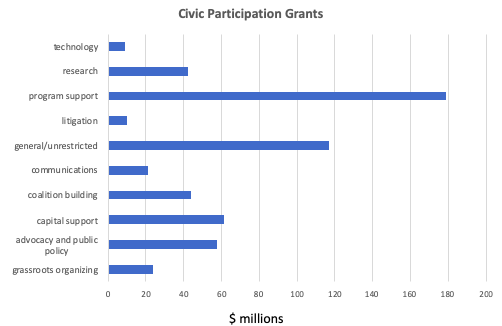
Within the category of “civic participation,” $2.1 billion has been distributed for the following purposes. These categories are non-exclusive; a grant can serve more than one purpose.

A total of $23 million–.0.43% of all democracy funding and a little less than one cent per American per year–has been spent on grassroots organizing for civic participation. I think that marks a major deficit.

new opening: Service Year Program Administrator at Tisch College

This is a one-year limited-term position.

There are currently about 67,000 annual positions for young Americans who choose to conduct service for a whole year. These positions are supported by national programs like AmeriCorps (such as Teach for America, Habitat for Humanity, YouthBuild, and City Year), Peace Corps, and the Commonwealth Corps in Massachusetts, and by many other organizations, including Tufts University’s 1+4 Bridge Year program, which offers credit and financial aid for a year of service before Tufts. Americans serve at many ages (from pre-college to retirement) and in many settings, from their own communities to countries around the world. 

The Jonathan M. Tisch College of Civic Life seeks to hire an administrator to expand the prevalence and visibility of service years in Massachusetts. Service Year Alliance and Tisch College are partnering to support this role. The Administrator will also be expected to collaborate with stakeholders in Massachusetts, particularly the Massachusetts Service Alliance. The Administrator will be expected to consult closely with Service Year Alliance and the Massachusetts Service Alliance and to engage other stakeholders across the Commonwealth. Sectors that the organizer may engage include k-12 education, higher education, local and state governments, nonprofits, and private sector employers. The administrator will assess opportunities to sustain and build in based work in East Boston and/or other geographical communities in Massachusetts. Provides specialized, subject matter knowledge to develop, implement, review and evaluate a university Program or Project in collaboration with Manager or Director. May participate in development of goals and strategies; creates data management and filing systems; develops, analyzes and monitors budgets, grants and contracts; and participates in development and implements marketing and advertising efforts including writing content for website and social media material. May design and represent program externally at conferences, meetings and events. 

Basic Requirements:

  • 1-3 years of service experience.
  • Experience with organizing and network-building.
  • Knowledge, skills and experience typically acquired through the attainment of a bachelor’s degree and 3 years of experience.
  • Skills for conducting reliable and independent research.
  • Excellent communications skills.
  • Ability to work independently and to collaborate well with diverse stakeholders.

Preferred Qualifications:

  • Knowledge of or experience in subject matter preferred.
  • Personal experience with a service year.
  • Understanding of the service sector nationally.
  • Understanding the nonprofit sector in Massachusetts Master’s degree in related discipline and 3+ years of experience in related field of study.
  • Experience ensuring compliance of web page content with W3C and Section 508 (ADA) accessibility standards preferred. Ongoing training will be provided to help keep up with current trends and requirements. 

An employee in this position must complete all appropriate background checks at the time of hire, promotion, or transfer.

Equal Opportunity Employer – minority/females/veterans/disability/sexual orientation/gender identity.

Apply here.