Author Archives: Peter Levine

newspapers vs. websites

(Still from Camden): If you compare a newspaper website to

a conventional newspaper page, I think the results are a little

surprising. We’re used to seeing the Internet as a great expansion of

possibilities, compared to print. But news websites only display about

15 words on each line, plus advertising and navigation bars. That means

that a reader must essentially scroll down one vertical column of text

at a time. A traditional sheet of newsprint, by contrast, is very wide

and can contain an elaborate array of stories (some linked together),

diagrams, and photographs. The reader can spread out a newspaper, scan

it quickly, and select what to read and in what order.

As a result, news sites are perhaps more like broadcast programs than

they are like conventional newspapers. A broadcaster can only transmit

one stream of content at a time. There is always a danger that listeners

will switch channels if they don’t like what they see and/or hear. Thus

broadcasters feel pressure to cater to as large an audience as possible

with each of their programs. In contrast, a traditional newspaper is

a diverse bundle of material, which readers can navigate and read selectively.

The more diversity of content, the better, at least to a point. One

would think that Internet sources would be more interactive and diverse

than newspapers, not less so. But I think that the width of

our current screens may actually make websites more like broadcast channels.

They have to emphasize a few headline stories and try to keep their

visitors from "clicking" away to other sites.

Of course, there are other differences between newspapers and news

websites. (To name just a few: the lack of any final edition on websites;

visitors’ ability to search current and archived editions; and the prevalence

of links to sites beyond the newspaper’s control.) Still, the difference

in width deserves mention.
what’s wrong with the California recall

(Written in Camden, Maine) On August 16, the Washington lawyer Robert

F. Bauer wrote an interesting opinion piece on the California

Recall election. He noted that the recall is competitive, largely

non-partisan, short, and intensely engaging to the public and the media.

These are the very qualities that reformers usually find lacking in

our long, partisan, low-turnout elections. Thus, Bauer says, reformers

should be delighted with the recall as an alternative to "politics

as usual." Instead, they rail against it as a "circus"

or even a "tragedy." That is because it is not "the controlled,

tidy, deliberative politics that some of them profess to care about:

‘serious’ candidates engaged in ‘serious’ debate mediated by political

‘experts,’ such as themselves, in an established, familiar setting."

Bauer thinks that reformers are sanctimonious and also impractical;

normal politics is much better than they believe. The specific progressive

reform that led to this election—allowing governors to be recalled—was

really an attempt to banish "politics." That is what progressive

reformers always want, Bauer thinks, and the results always

backfire.

Implication: progressives should rethink their support for campaign

finance reform, regulation of lobbying, and other "anti-political"

ideas that will, like recall elections, create disasters.

I think Bauer’s criticism applies to Ross Perot and some Nader-type

reformers, who really are anti-political and therefore would like to

see less campaigning, weaker parties, less campaign spending, and less

ideological mobilization. Hence their support for term limits, initiative

and referendum, and spending limits. I have never belonged to this camp,

and neither do some of the leading reform groups, such as Common Cause.

I think parties are good, and that it is helpful for them to

mobilize mass support. I don’t believe that elections last too long;

in fact, I think the presidential primary season may soon become too

short. And I don’t think that too much money is spent on elections.

Last time I checked, the total amount was not more than $16 per capita,

which is not much to communicate to a mass public.

However, we do not have just two alternatives: the California "circus,"

and politics-as-usual. We could have a political system that was less

influenced by private money, more "serious" (in the sense

of being more closely connected to weighty choices that we need to make),

fairer, more competitive, and more engaging to all people, including

those with less money and education.

To me, the California election is a fiasco, because it represents a

failure of Californians to control their own futures. If Arnold Schwartzenegger

wins, it will not be because a plurality of Californians are moderate

Republicans (which would be a tolerably democratic result). Instead,

he will win because a plurality of Californians don’t have any idea

what is going on in state government, so they imagine that a macho new

leader can simply banish all their fiscal problems. This will show that

they have no grasp of the ideological differences that have led to a

budget impasse. Democrats oppose deep budget cuts, and Republicans oppose

tax increases—principled positions that create huge deficits when

put together. Citizens need to choose one position or the other (or

split the difference). But Schwartzenegger claims that he can just clean

up the mess: a totally unprincipled position that sounds impressive

only to people who have never seriously considered the difficult choices

implied by a budget crisis. Thus, if Arnold wins, it will show that

many Californians feel no personal responsibility for the way their

own government has acted in the past.

state taxes and personal wealth

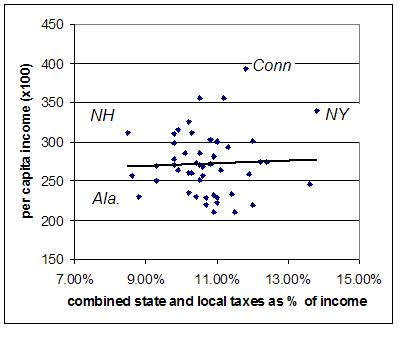
I was wondering whether the states that tax their residents

at high rates tend to have higher or lower income levels. I

suppose a crude form of free-market economics would predict that states

with lower taxes would tend to generate more personal income. This is

not the case. Although the relationship between tax rates and per capita

income is not significant, generally the states that take the biggest

portion of income in state and local taxes also have the most per

capita wealth. States like Alabama have been low-tax zones for at least

a hundred years, yet they remain among the poorest of all states.

This isn’t "social science." It’s just playing with a computer

to get a quick answer to a simplistic question. Still, the graph poses

a real question for supporters of laissez-faire economics: if low taxes

create wealth, what explains Alabama? (Sources for the tax

rates and the per

capita income stats.)

my expectations were too low

On the day after the UN building in Baghdad was blown up, the US press is rushing to say that the occupation of Iraq is perilously close to failure. I am a card-carrying dove who opposed the war, as this collection of blog entries shows. However, I was wrong about the aftermath, which I thought would be considerably worse than it has turned out to be. The current situation may actually be closer to what the Bush Administration predicted than to what I expected. I thought that there would be massive communual violence, pitting Shiites against Sunnis and Arabs against Kurds. I thought there would be a civil war over important assets like the oil-rich city of Kirkuk, which is disputed between Kurds and Arabs. I thought that neighboring countries would be dragged into the war before Saddam was deposed–including Israel, which I thought Saddam would attack. I thought that the (putative?) illegality of the operation would cause us more trouble with Europe than it has. And I thought that large segments of the Iraqi public might well oppose our invasion violently, mainly because they would hold us responsible for the sanctions regime. None of these awful scenarios has come to pass. That doesn’t mean that the Iraqi occupation/liberation is going especially well, but hope certainly remains that it will turn out to be a blessing rather than a curse for both us and the Iraqi people.