Author Archives: Peter Levine

cliches of civic engagement

I’m on my way to Texas Christian University in Fort Worth, where I’ll be speaking about–what else?–youth civic engagement. I’m happy to support the launch of TCU’s Center for Civic Literacy.

I hope that my speech does not sound like this article by Douglas Brinkley from 1994, entitled “Educating the Generation Called ‘X.'” The links are to Cosma Shazili’s commentary:

But all in all, to paraphrase Gertrude Stein, a “young person is a young person is a young person.” They are essentially no different from their predecessors; they simply want to be regarded as individuals. By 1988, those born between 1961 and 1981 will comprise the largest voting bloc ever in American history, numbering 80 million strong. They will soon step up to the plate to try to clean up the mess. Their teacher should strive to do what education has traditionally done for the young: Bring out their best, encourage hope and nourish their imaginations.

talking about “social justice” in education

In conversations about civic education, service-learning, and youth civic engagement, people often ask whether the purpose of what we’re doing is “social justice.” Lately I’ve been responding as follows:

1. The phrase social justice (which has roots in Catholic thought) has been claimed by the Left. In politics, phrases are often seized by one side or the other–occasionally, they even switch their valence over time. At the moment, “social justice” has a lefty ring. Therefore, there will be a predictable consequence if you say that your service-learning program or civics class “promotes social justice.” You will attract leftish students, and perhaps alienate conservatives. If you speak on behalf of a public school or state university, I think you should avoid that outcome. Individual adults who work with young people are free to promote ideologies; but state institutions should be leery of doing so.

2. Although the left has claimed the phrase “social justice,” true conservatives seek social justice. They just define it somewhat differently, they endorse alternative strategies for obtaining it, and they tend to call it by other names. It’s important that the students who sign up for service-learning be exposed to serious conservative arguments about justice. One of the risks of using the phrase “social justice” is to narrow the range of debate about justice by keeping conservatives out from the beginning.

I often hear a (probably apocryphal) story about a student who so enjoys volunteering in a soup kitchen that he blurts out, “I hope this place still exists when my kids come along, so that they can serve, too.” The standard rejoinder is that the student should investigate the “root causes” of hunger and advocate solutions.

True, but the root causes may not necessarily be capitalism or discrimination, and the best solutions may not include Food Stamps or a higher minimum wage. I’d like to see students grapple with root causes but be challenged to consider whether government intervention is the basic problem and freer markets could help. That’s not usually my own view, but it’s educational to consider it.

the sincerest form of flattery

So, I’m ego-surfing as usual, and what do I come across? A term paper about an article (pdf) that I wrote–for sale at $31.95. The summary and excerpt of the term paper are poorly written and highly inaccurate. Can I sue? Should I write a better paper about myself and sell it? If a wildly inaccurate summary of my article is worth $31.95 on the open market, can I start selling the actual article for, say, $40? (Right now, it’s free.) Should I be offended that people are willing to pay $31.95 not to have to read and write about my article? Does a plagiarized term paper count as a citation of my work? Why does my own article rank lower on Google than a site that sells a lousy term paper about it?

overcoming polarization?

Dan Yankelovich (chairman and co-founder of Public Agenda) has published a new book on polarization, which is excerpted online. The excerpt argues that Americans aren’t all that deeply divided between liberals and conservatives. According to Yankelovich’s polls, we Americans share eleven “core values that blend traditional and progressive attitudes into a new social morality.” This social morality is “centrist”; “both liberals and conservatives have something positive to contribute.”

However, look at the list:

  • Patriotism
  • Self-confidence
  • Individualism
  • Belief in hard work and productivity
  • Religious beliefs
  • Child-centeredness
  • Community and charity
  • Pragmatism and compromise
  • Acceptance of diversity
  • Cooperation with other countries
  • Hunger for common ground
  • To me, the first seven items look basically conservative. I don’t see “equity,” “peace,” “freedom from want,” “saving nature,” “civil liberties,” or “fairness” on the list. The American majority prefers patriotism, individualism, faith, and family. However, as the last four items show, they’d rather not fight about such matters. They dislike sharp disagreement (that’s well documented in other studies), preferring compromise, acceptance, and cooperation. Thus, while their own views are conservative, they’re hoping that everyone will agree to some practical, “common-sense” ideas.

    I wish the list of core values were somewhat different, although I suspect it’s an accurate picture of public opinion. “Acceptance of diversity” and “child-centeredness” are the most promising items for progressives. As we know, Americans support spending for education and some diversity in corporate employment and the media. However, those beliefs are perfectly consistent with mainstream modern conservatism.

    Despite the majority’s hope for “common ground,” the conservative 25-30% of the population actually disagrees pretty sharply with the liberal 17-20%. The middle holds the balance. They are the ones who most consistently endorse Yankelovich’s eleven “core values.” While they may identify themselves as moderates, I would call them conservatives without an angry edge.
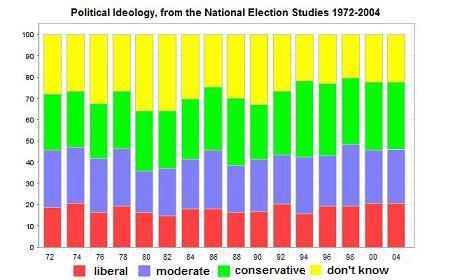
    [Note: This is my graph, not Yankelovich’s.]

    opportunity for youth work in New Orleans

    Common Cents is offering grants up to $20,000 for projects that will contribute to an inclusive and just recovery from Hurricane Katrina. Preference will be given to service or advocacy projects that either involve young people meaningfully in the recovery, or that address the specific needs of children and youth. … All winners will …

  • Receive up to $20,000 in cash awards
  • Showcase their project at a student conference in New York City in May 2006
  • “Preference will be given for projects that …

  • Increase youth decision-making in the recovery and rebuilding
  • Build relationships between people within and outside the region
  • Strengthen infrastructure for sustainable services for young people
  • Contribute to our understanding of youth as a resource for recovery
  • … DEADLINE: FEBRUARY 1″