Author Archives: Peter Levine

Facebook and politics

(In Cambridge, MA) Students don’t give a lot of money to political candidates; they don’t have enough to give. In 2004, according to the American National Election Study, just 1.3% of young people (ages 18-25) said they had given money to any political candidate. In contrast, 10.1% of people over the age of 25 had made financial contributions.

However, the independent group Students for Obama (which started on FaceBook and now has 50,000 members) has figured out a way to have an impact. They write, “We understand that money is not exactly something we all have a lot of to spare; that’s why we put together a list of some of the things you can skip or pass on once–and donate the amount you saved. Next time you are going to spend money on one of these items, think of instead helping break the stereotype that students do not donate and do not care about the political process.” They suggest, for example, that you give up your next Starbucks Caramel Macchiato and give the $3.21 to Obama. It will be interesting to see whether this practice spreads as the ’08 campaign unfolds.

[Update: see Jose Antonio Vargas’ good article in the Washington Post, which cites our work. He says that the Obama Facebook site now has 279,000 members and rising.]

citizen media update

(en route to Boston) My colleague Jan Shaffer has issued a report entitled “Citizen Media: Fad or the Future of News? The Rise and Prospects of Hyperlocal Journalism.” Her conclusions are based on detailed interviews with the people involved in 31 citizen news ventures, plus a survey of 191 other projects. “Hyper-local” news media represent alternatives to the increasingly homogeneous news business and provide opportunities (like nothing we have seen since the 19th century) for great numbers of people to produce news. These projects encompass websites, but also low-powered radio stations, email lists, and even some printed publications. They serve neighborhoods and small towns and dispersed affinity groups. They tend to combine some original information, some news selected from commercial sources, and some opinion and analysis.

I haven’t had the chance to read Jan’s important report all the way through, but I have skimmed it and highly recommend it.

three forms of populism in the 2008 campaign

It appears that the next presidential campaign will offer several strong but contrasting flavors of populism:

Sam Brownback asserts that Americans’ traditional, popular, moral values are threatened by the “violence, obscenity, and indecency in today’s media,” by “activist judges,” by “foreign suppliers” of oil, and by the federal government. I happen to disagree with almost all his positions, but the Senator does share the majority’s view of several issues, such as prayer in schools.

John Edwards makes the case that we all belong to one economic community, one commonwealth, and inherit our national prosperity not because of what we do as individuals but because of others’ sacrifices, past and present. “We are only strong because our people work hard.” “We are made strong by our longshoremen and autoworkers, our computer programmers and janitors, and disrespect to any of them is disrespect to the values that allowed for America’s greatness in the first place.” Since we belong to one commonwealth, gross disparities in opportunities are unfair.

I used to believe that this position–while morally valid–was a political dead end. Although we had left many Americans in poverty, more than half of all voters were affluent enough that they didn’t need government except for purposes that are always well funded, such as roads and suburban schools. “Redistribution” meant “welfare,” and the welfare system that had developed since the 1930s was justifiably unpopular. Finally, Americans’ were strongly committed to markets and mistrustful of governments.

But several factors make Edwards’ version of populism more promising today. Federal welfare has been deeply cut; the remaining safety-net programs serve large majorities of Americans. The issue has shifted from income inequalities (which Americans tend to tolerate) to huge inequalities in risk. Most people must finance their own retirements while some get huge golden parachutes, exemplifying a new kind of unfairness. Meanwhile, the latest generation of super-rich people has behaved very badly: Paris Hilton is a potent symbol. Not least, John Edwards is a skillful persuader, a litigator who knows how to read a jury and marshal effective evidence and arguments.

Barack Obama so far represents a different strain of populism. He says that we American citizens should play a central role in defining and solving our common problems. We are in a “serious mood, we’re in a sober mood,” and we are ready to work together. “We are going to re-engage in our democracy in a way that we haven’t done for some time, …. we are going to take hold of our collective lives together and reassert our values and our ideals on our politics. … All of us have a stake in this government, all of us have responsibilities, all of us have to step up to the plate.”

For Senator Brownback, the way to assert our values is to pass laws that he favors and that have majority support. For John Edwards, “the great moral imperatives of our time” are to fight poverty and get out of Iraq. For Senator Obama, asserting our values means deliberating together as a diverse population and developing ideas that may be new and unexpected.

In philosopher’s terms, this is civic republicanism, and it’s truly different from mainstream recent liberal politics. To make it work, Obama will have to overcome two challenges. First, he will have to develop an answer for grassroots Democratic activists who are furious at Republicans and consider the Bush administration to be our nation’s central problem. Obama believes that both parties are responsible for marginalizing citizens, and what we need are broader public coalitions. The Senator will have to find a way to talk to Democratic primary voters who are not in the mood right now for non-partisanship and cooperation. Second, Obama will have to find a way to respect the voice of American citizens while also saying something concrete about issues such as health care and taxes. He needs to respect the public’s voice but also perform the main duty of a candidate, which is to put ideas on the table.
the federal budget

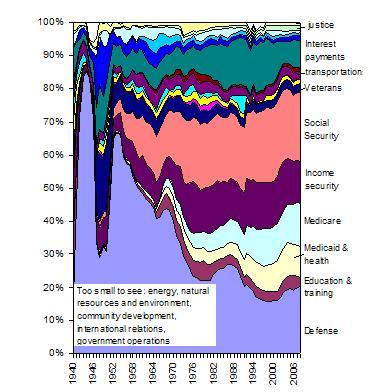
On the day after the president released his 2008 budget, it might be helpful to take a longer view. Below I show the percentage of the total budget (also known as “your tax dollar”) that is devoted to each major category of federal spending. I’ve set the total for every year to 100%, but of course the actual size of the budget has grown enormously. The last year (2008) is the president’s proposal, which will not be implemented as he wishes. On the other hand, his proposal will not be changed enough to make a visible difference on a graph at this scale.

The graph is helpful in making a few points that I don’t think most citizens realize. First, you cannot cut spending appreciably without touching defense, Social Security, Medicare, and Medicaid. (Interest payments are automatic.) Second, Medicare and defense are the two items that have expanded rapidly of late. Third, some categories that provoke opposition, such as foreign aid and grants to artists and scholars, are far too small even to be illustrated. Finally, despite all the storm and stress over important details, both of our major parties are basically committed to the same kind of budget.

sunlight, the best disinfectant

In 2006, Senator Jon Tester (D-MT) and Rep. Kirsten Gillibrand (D-NY) defeated incumbents who were tied to Jack Abramoff–our latest exemplar of a corrupt lobbyist. In an effort to demonstrate their own commitment to “transparency,” Tester and Gillibrand pledged to disclose their daily schedules for all to see. See Tester’s schedule here and Gillibrand’s here.

Lindsey Layton (who met with Tester at 2:15 pm on January 30, according to the Senator’s public schedule) describes these online diaries in The Washington Post. Layton writes, “Richard A. Baker, the Senate historian, cannot find a precedent for what Tester and Gillibrand are doing.” But there is precedent for the underlying principle. In 1905, as governor of Wisconsin, Robert M. LaFollette signed a bill of which he was particularly proud:

The statute prohibits such lobby agents or counsel from having any private communication with members of the legislature upon any subject of legislation. The lobby is given the widest opportunity to present publicly to legislative committees, or to either branch of the legislature, any oral argument; or to present to legislative committees or to individual members of the legislature written or printed arguments in favor of or opposed to any proposed legislation; provided, however, that copies of such written or printed arguments shall be first filed in the office of the secretary of state. This law rests upon the principle that legislation is public business and that the public has a right to know what arguments are presented to members of the legislature to induce them to enact or defeat legislation, so that any citizen or body of citizens shall have opportunity, if they desire, to answer such arguments.

Since I came to the United States Senate I have steadfastly maintained the same position. Again and again I have protested against secret hearings before Congressional committees upon the public business. I have protested against the business of Congress being taken into a secret party caucus and there disposed of by party rule; I have asserted and maintained at all times my right as a public servant to discuss in open Senate, and everywhere publicly, all legislative proceedings, whether originating in the executive sessions of committees or behind closed doors of caucus conferences.

I can imagine two rebuttals to LaFollette’s argument. One is that people ought to be able to petition elected officials secretly, because disclosure can have a chilling effect. For example, in the present climate, Members of Congress might be less likely to meet with Muslim groups if they had to reveal every meeting. But Muslim groups, like all groups, have a constitutional right to petition the government for redress of grievances.

Tester’s schedule shows meetings with many mom-and-apple-pie associations, such as “parents of children with disabilities” and the “Inter-Tribal Bison Cooperative.” It is conceivable that he wouldn’t want to show contacts with more controversial organizations and would therefore refuse to see them at all.

The second argument is that secrecy actually protects elected officials from undue pressure from lobbyists. Senator William Packwood (R-OR) once said:

Common Cause simply has everything upside down when they advocate ‘sunshine’ laws. When we’re in the sunshine, as soon as we vote, every trade association in the country gets out their mailgrams and their phone calls in twelve hours, and complains about the members’ votes. But when we’re in the back room, the senators can vote their conscience. They vote for what they think is the good of the country. Then they can go out to the lobbyists and say: ‘God, I fought for you. I did everything I could. But Packwood just wouldn’t give in, you know. It’s so damn horrible’.” (Quoted in Birnbaum and Murray, p. 260)

Both rebuttals presume that politicians are well-intentioned and will behave better in secret than they do in public. In fact, that is occassionally true. But on balance, I think we’d be better off if Members of Congress felt they had to disclose all their meetings. Requiring such disclosure would probably violate the First Amendment. But making a habit of it would be a good thing. Tester and Gillibrand have, at the least, launched a worthy experiment.