Author Archives: Peter Levine

managing risk

In an age of weak family structures and communities–and unstable employment–individuals and nuclear families are on their own; they need to be able to manage risk so that they can bounce back from adversity. To help people to hedge risk is different from guaranteeing their welfare or reducing social inequality. It probably isn’t adequate, but it is important in the current era of high volatility.

What are the big economic risks for Americans, especially for the working class? Being laid off or seeing one’s salary drop dramatically, perhaps because of a reduction in paid hours. Sickness or injury, including injury caused by crime. Divorce and widowhood. Kids who are sick or in trouble. Business failure, including the failure of very small enterprises such as trading pages on e-Bay. Loss of property (such as homes and vehicles) due to robbery, fire, or accidents. Steep declines in the value of one’s home or land, such as we see in Rust Belt cities and the Farm Belt.

There are financial instruments designed for some of these risks–for example, home insurance. But sometimes such instruments are too expensive for people whose property is particularly modest. Other risks do not seem to be covered at all by available insurance (divorce, for instance; or the delinquency of one’s child). The government covers some people’s medical care, but many are not eligible for Medicare or Medicaid and cannot afford private packages. The state is supposed to prevent crime in the first place and can sometimes order restitution. But crime can devastate its victims.

It’s interesting to envision a comprehensive set of mechanisms for managing these risks. Some mechanisms could be provided by the state or state-subsidized. Others might be developed by private organizations.

building alternative intellectual establishments

Think back to the year 1970. ….

  • Almost all university professors are men. They seem to be interested only in male historical figures and male issues. They select their own advanced students and colleagues and decide which manuscripts are published. They defend their profession as rigorous, objective, and politically neutral. Feminists respond by criticizing those claims; some also try to create a parallel set of academic institutions (women’s studies departments, feminist journals) that can confer degrees and tenure and publish.
  • Certain academic disciplines, including law, history, and political science, are seen as predominantly liberal. They seem to support a liberal political establishment that has considerable power. For example, law professors are gatekeepers to the legal profession, which produces all judges. Professors in these fields choose their own successors and claim to be guardians of professionalism, expertise, independence, and ethics. Conservatives–disputing these claims–decide to build a parallel set of research institutions, including the right-wing think tanks and organizations like the Federalist Society (founded 1982).
  • The National Endowment for the Arts gives competitive grants to individual artists. NEA peer-review committees are composed of artists, critics, and curators. They are said to be insulated from politics and capable of choosing only the best works. The artists they support tend to come from the “Art World” to which they also belong: a constellation of galleries, art schools, small theaters, and magazines, many based in New York City. Most of the funded work is avant-garde. It is usually politically-correct, aiming to “shake the bourgeoisie.” Critics complain about some particularly controversial artists, and ultimately the individual grants program is canceled.
  • Almost all professional biologists are Darwinians. They assert the legitimacy of science; but their religious critics believe that they depend on false metaphysical assumptions. Biologists use peer-review to select their students, to hire colleagues, to disperse research funds, and to choose articles for publication. Religious critics cannot get through this system, so they build a parallel one composed of the Institute for Creation Research, Students for Origins Research, and the like.
  • The most influential news organs in the country (some national newspapers and the nightly television news programs) claim neutrality, objectivity, accuracy, and comprehensiveness: in a phrase, “all the news that’s fit to print.” Critics from both the left and right detect all sorts of bias. They try (not for the first time in history) to construct alternative forms of media, including NPR (founded in 1970) and right-wing talk radio.
  • If you are influenced by Nietzsche’s Genealogy of Morals and Foucault, you may see all knowledge as constructed by institutions to serve their own wills to power. Then you must view all of the efforts mentioned above with equanimity–or perhaps with satisfaction, since they have unmasked pretentious claims to Truth. If you believe in separate spheres of human excellence, then you may lament the way that various disciplines and fields have been enlisted for political organizing. You may concede that all thought has a political dimension, but you may be sorry that scholarly and artistic institutions have been used as strategic resources in battles between the organized left and right. (I owe this idea to Steven Teles.)

    I guess my own response is ad hoc and mixed. For example, I think that conservative ideas about law, history, and political science are interesting and challenging and should be represented in academia. I’m sorry that some legal conservatives have found their way to the Supreme Court, but the solution is to win the public debate about the meaning of the Constitution–not to wish that conservatives would go away. The Federalist Society provides liberals with a valuable intellectual challenge.

    I suspect that the NEA’s peer-review committees of the 1970s and 1980s often identified the best artists: meaning those who were most innovative, sophisticated, and likely to figure in the history of art as it is written a century from now. (Although who can tell for sure?) But I’m not convinced that taxpayers’ money should be devoted to the “best” artists. Other criteria, such as geographical dispersion, various sorts of diversity, and public involvement, should perhaps also count. If it’s fair to say that the New York Art World dispersed public money to itself, that sounds like a special-interest takeover of a public agency.

    Finally, “creation science” and “intelligent design theory” strike me as both scientific and theological embarrassments, destined to disappear but not before they have done some damage. Nevertheless, the anti-Darwinian organizations reflect freedom of association and freedom of speech and must certainly be tolerated.

    (These ad hoc judgments are probably not consistent or coherent at a theoretical level.)

    was Velazquez left-handed?

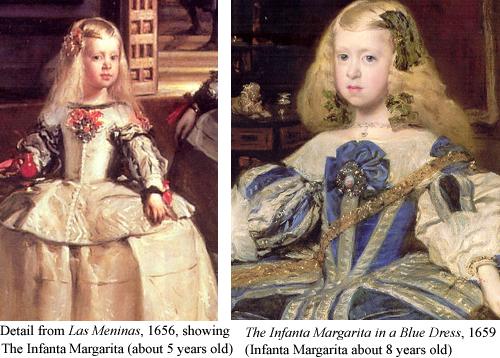
    My post from 2005 on Las Meninas, Velazquez’ masterpiece, has drawn some very interesting and original comments. The latest contribution comes from Barbara Robinson of London Ireland who, like Colin Dixon, believes that the whole painting is a mirror image. Ms. Robinson adds some evidence. These two paintings are both by Velazquez and they show the same girl, the Infanta Margarita, three years apart. The image on the right is a detail from Las Meninas; the one on the left is part of a freestanding portrait.

    Barbara Robinson (who sent me these images) emphasizes the parting of the hair and “the decorative hair slide,” which are reversed in these two pictures. Her son adds that if Las Meninas is an image in a mirror, then Velazquez is shown holding his paintbrush in his left hand, which makes him what we Americans call a “southpaw.” (Note that there were very large mirrors in Valazquez’ day.)

    protest, now and then

    A reporter recently asked me how much protest and other activism is going on among today’s youth, compared to their predecessors during the Vietnam era.

    In 1973, the General Social Survey asked about five specific forms of protest (prowar, antiwar, civil rights, labor-related strikes, and school events). About 28 percent of the young people in that survey (ages 18-25) said they had participated in one or more of those types of protest.

    In 2006, we found that 11.5% of 15-25-year-olds had attended any protest, march, or demonstration (regardless of topic).

    Given the different questions, the comparison is not perfect. Still, these results suggest some decline in the rate of physical protest by young people. That trend has to be set against a lot of volunteering and online activism, which Jennifer Earl described recently in the Washington Post. (Her article was entitled, “Where Have All the Protests Gone? Online.”) In our 2006 survey, 15% of the young respondents said they had signed email petitions–less than the 21% rate among older Americans, but still a large number. And if we added other formats, such as social networking sites, we would see even more online activism.

    the “fit” between cultures and the labor market

    Poverty and privilege reproduce themselves. If you are an American boy born in the poorest tenth of the population, you have only a 1.3 percent chance of reaching the top ten percent during your lifetime, and just a 3.7 percent chance of becoming at all wealthy (in the top fifth). If you are a male born in the bottom tenth, the odds are more than even that you will never make it out of the bottom fifth.

    It’s not only that people from wealthy background have more capital and better contacts and receive more economic investments (for example, more money is spent on their schools). In addition to those factors, their relatives and peers make sure that they are ready to flourish in the white-collar work world. There is, in other words, an excellent “fit” between their background culture and the labor market. That fit is much worse for kids from working-class homes.

    At least three reasonable objections can be made when people mention this problem: (A) It seems to let the government off the hook for providing poor schools and public services. (B) It seems to criticize people for not preparing their children well for the workforce. And (C) it can be viewed as a coded way of making a point–probably a hostile point–about racial minorities in America.

    Therefore, let me say: (A) Inequitable public policies make matters considerably worse than they would be if our problems were simply cultural. (B) When there is a poor fit between a particular culture’s norms and the demands of the white-collar workplace, I do not automatically assume that the norms ought to change. Often I admire groups that resist the dominant economy. (C) I don’t think race is the issue in this case. Annette Lareau set out to explore differences in parenting by race and class, expecting to find that both factors would matter (as they often do). But what she actually observed were striking similarities in the parenting of African American and White children of similar economic classes. Her work is a vivid depiction of the cultural norms of our two biggest classes and how they reproduce themselves. The differences among smaller cultural groups (e.g., scientists, evangelicals, Chicagoans) may also matter, but they don’t map onto racial categories.

    Some specificity is useful here. The question is not which cultures fit well with “capitalism,” because capitalism is an old, varied, and flexible phenomenon. The question is which cultures prepare young people best for a particular life that is characterized by meetings and conference calls, schedules and budgets, offices, suits, emails that read like memos, businesses lunches, handshakes, thank-you notes and holiday cards, business travel, interviews, proposals and bids, job descriptions, mission statements, PowerPoints, and websites. This world envelops people who are not straightforwardly involved in “capitalism.” For example, it is my world, even though I am a philosopher at a public university. But it leaves out the working class and the unemployed, stay-at-home parents and retirees–and any true bohemians we have left.

    The “field” of white-collar work is saturated with norms and expectations. Children whose parents belong to it are raised from an early age to succeed in it. They are taught to speak as if at a business meeting, to analyze their own interests, and to negotiate on their own behalf. Modern middle-class childhood has some unattractive features. These kids are often competitive with siblings, unable to handle unstructured time, quick to quit situations that seem unprofitable or uninteresting, and over-conscious of their own entitlements. But those attitudes pay off in the labor market.

    Schools try to compensate for the differences in home cultures. In fact, they may overlook the talents of working-class kids–such as their ability to fill free time with self-organized activities–because they are so eager to prepare everyone for the white-collar work world. But schools cannot fully compensate for the cultural advantages of the middle class. They cannot provide enough one-on-one interactions between adults and students to train kids for situations that will involve bilateral communication, negotiation, and self-presentation. Besides, on average, teachers are themselves a little marginal to the “field” of white-collar work. Of all professionals, teachers are some of the least experienced in negotiating contracts, making business trips, or participating in conference calls. Their daily interactions are mostly with groups of children, not with peers behind desks or on the phone.

    The most radical response to this problem would not be to reform educational institutions so that they better prepare all children for the white-collar workforce, nor to compensate for inequalities in the labor market by providing better social insurance. The most radical response would be to enlarge the supply of stable and rewarding jobs that embody different values and skills from those of the white-collar world.