Associate Dean for Faculty and the Lincoln Filene Professor of Citizenship and Public Affairs at Tufts University's Tisch College of Civic Life. Concerned about civic education, civic engagement, and democratic reform in the United States and elsewhere.
The Jonathan M. Tisch College of Civic Life is a national leader in civic education, whose teaching, research and community partnerships are setting the standard for higher education’s role in civic engagement. As the only university-wide college of its kind, Tisch engages Tufts students in transformational learning opportunities via hands-on field-based experiences, community building, and public service. These engagements prepare them to become active citizens and community leaders. Tisch research centers conduct groundbreaking research on young people’s civic and political participation and forge innovative participatory action research partnerships with communities.
Tisch College’s North Star—building robust, inclusive democracy for an increasingly multiracial society—seeks to cultivate knowledge, leaders and living experiments that expand possibilities for democratic development in the context of increasing risks to democracy worldwide. Our work supports the University’s efforts to become an anti-racist institution. Our programs and research centers focus on strengthening the political participation and voices of historically marginalized people, especially youth, and on addressing the challenges of building and reviving democratic institutions needed for multiracial/ethnic societies.
The College develops innovative projects and programs to make field-based community knowledge co-creation, practical community-based problem-solving and civic learning opportunities more accessible and impactful for students and communities. Serving as an innovator and incubator, Tisch College collaborates closely with Tufts schools, departments, and student groups to generate an enduring culture of active citizenship across the university.
What You’ll Do
The Generous Listening and Dialogue Center’s mission is to help develop a culture of generous listening and authentic dialogue at Tufts University and to make Tufts a laboratory for research that also benefits external constituencies. The newly re-launched GLAD Center will apply research and test innovative methods, theoretical frameworks, and measures as part of events at Tufts and will educate faculty, staff, and students in the practices of generous listening and deep dialogue, which they can apply in their courses and other programs.
Responsible for all aspects of work related to reframing and growing the Generous Listening and Dialogue (GLAD) Center at Tisch College and directing its daily operations, the Program Director will shape and lead implementation of a strategic plan that positions the Center as a global center of excellence for generous listening and dialogue research and practice by conducting and disseminating cutting-edge research on generous listening and dialogue via summits, convenings, speaker series and professional gatherings. The Program Director is responsible for developing and managing relationships with key stakeholders including but not limited to convening an advisory group, identifying collaborators, and further refining the Center’s brand identity. The Program Director is responsible for coordinating agendas and logistics for meetings, seminars, lectures, and other special events, coordinating marketing and advertising efforts for programs and projects, guiding program evaluations and reports to stakeholders, monitoring budgets, and executing financial transactions.
The Program Director is responsible for supervising Center staff including a Senior Researcher and student workers.
This is a hybrid position where you are expected to be in the office 3 days per week.
What We’re Looking For
Basic Requirements:
Knowledge and skills as typically acquired through completion of a Master’s degree in a related field with 5-7 years of related experience.
Demonstrated potential to establish and supervise a research agenda.
Strong interpersonal, management and leadership skills to interact with individuals at all levels.
Experience with administration and budgeting.
Excellent writing skills including the ability to draft and present program materials and publish in peer reviewed outlets.
Unwavering commitment to diversity, equity and inclusion and ability to apply these principles to the Center’s work directly.
Preferred Qualifications:
Ph.D. in a related field.
Quantitative, qualitative, and mixed methods research experience in designing tools, conducting studies, and conducting data analyses.
Outstanding attention to detail, strong organizational skills, and the ability to anticipate programmatic needs. Ability to lead and direct others by setting priorities for completing multiple tasks.
Strong publication record in peer-reviewed journals, special interest publications and conferences.
Experience with donor relations and stewardship.
Ability to work collaboratively with research colleagues from varied backgrounds and to interact with practitioners of diverse backgrounds, views, and positions.
Demonstrated ability to develop dialogue programs.
A colleague points out that new state laws that allow parents to use public money to purchase education may represent the biggest US policy trend of 2023–basically, since the Republicans won the US House and stopped further federal progressive legislation. As Libby Stanford wrote in EdWeek last June,
So far this year, lawmakers in 14 states have passed bills establishing school choice programs or expanding existing ones, and lawmakers in 42 states have introduced such bills … Six of the 14 states—Arkansas, Florida, Indiana, Iowa, Oklahoma, and Utah—have passed school choice policies making programs universal or near-universal over the next three years. They join Arizona and West Virginia, which in recent years either established or expanded education savings accounts and made them available to virtually all students. That brings the total number of states where virtually all students will be able to use public funds for private schools to eight.
I hold some principled skepticism about school choice, yet I believe it is a valid policy debate–in fact, I have sometimes chosen it as the leading topic in my undergraduate course on public policy, because there are arguments on both (or many) sides.
It’s mainly in the USA that school choice is seen as a conservative cause; many social democracies allow parents to choose among publicly funded and licensed schools. And there have been progressive proponents of school choice in America.
On a political level, the passage of these new state laws is interesting for several reasons.
First, it is happening without a great deal of national attention, which I suspect reflects the national media’s basic lack of interest in state policies, especially in the South.
Second, it challenges the premise (which, I admit, I sometimes share) that the modern conservative movement has run out of policy ideas and is obsessed with performative politics–denouncing “woke” companies and universities without actually passing laws. A wave of school-choice bills reflects a policy agenda.
Third, it challenges the premise that today’s GOP is shifting from quasi-libertarian to quasi-authoritarian. A law that enforces particular ways of addressing contested social issues in public schools verges on authoritarian. But a law that allows parents to opt out of public schools is libertarian–for better or worse.
(However, many parents may seek schools that have authoritarian climates for their own students, somewhat like private homeowners’ associations that enact meticulous rules to control their own residents’ behavior.)
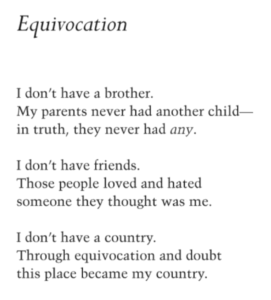
(Translated by Kareem James Abu-Zeid, from Najwan Darwish, Exhausted on the Cross, NYRB Books 2021.)
I don’t know the Arabic word that is the title of this poem. The English word can mean a logical fallacy–changing the meaning of a term between one part of an argument and another–or a deliberate trick. Macbeth calls a promise “that lies like truth” “th’Equiuocation of the Fiend.”
Deceit is a fault, but equivocation can also imply an inability to decide, or even a choice to remain undecided, like Keats’ “capab[ility] of being in uncertainties, Mysteries, doubts. …” One can equivocate because several options seem attractive, or because all seem terrible.
I read Darwish as self-critical. He is confessing his equivocation, his failure (sometimes) to take a stand, much as, in “In Shatila,” he asks himself how he could have turned smilingly away from an old refugee:
How could you smile, indifferent
to the brackish water of the sea
while barbed wire wrapped around your heart?

How could you,
you son of a bitch?
But what should be expected of him? At a time when everyone is supposed to take one side, to state one truth–when we are all our own communications departments, and silence is called complicity–I resonate with the poet’s equivocation. His uncertainty becomes a doubt about who he is, and that doubt becomes the country he dwells in, wherever he goes. It’s the only country he has.
(By the way, I have no idea whether Darwish feels equivocal today, and I don’t mean to attribute any stance to him in this moment. The poem is several years old. It does speak to me today.)
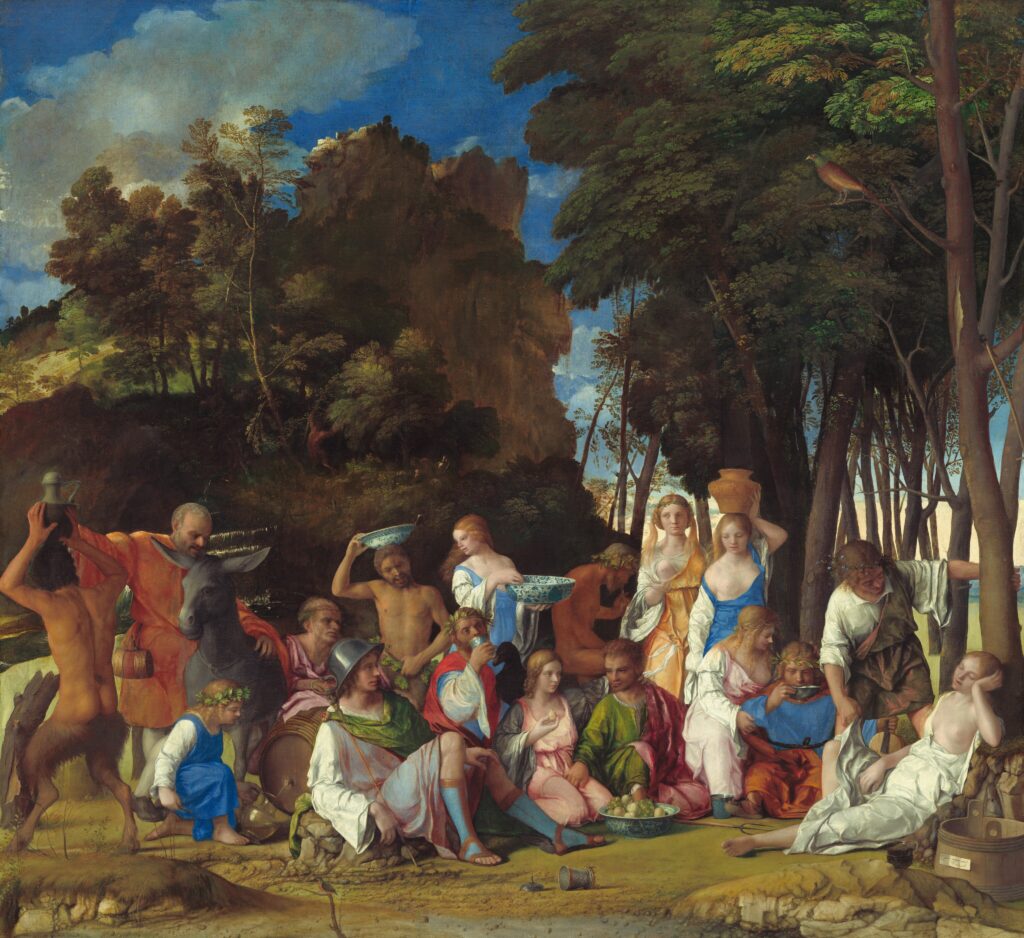
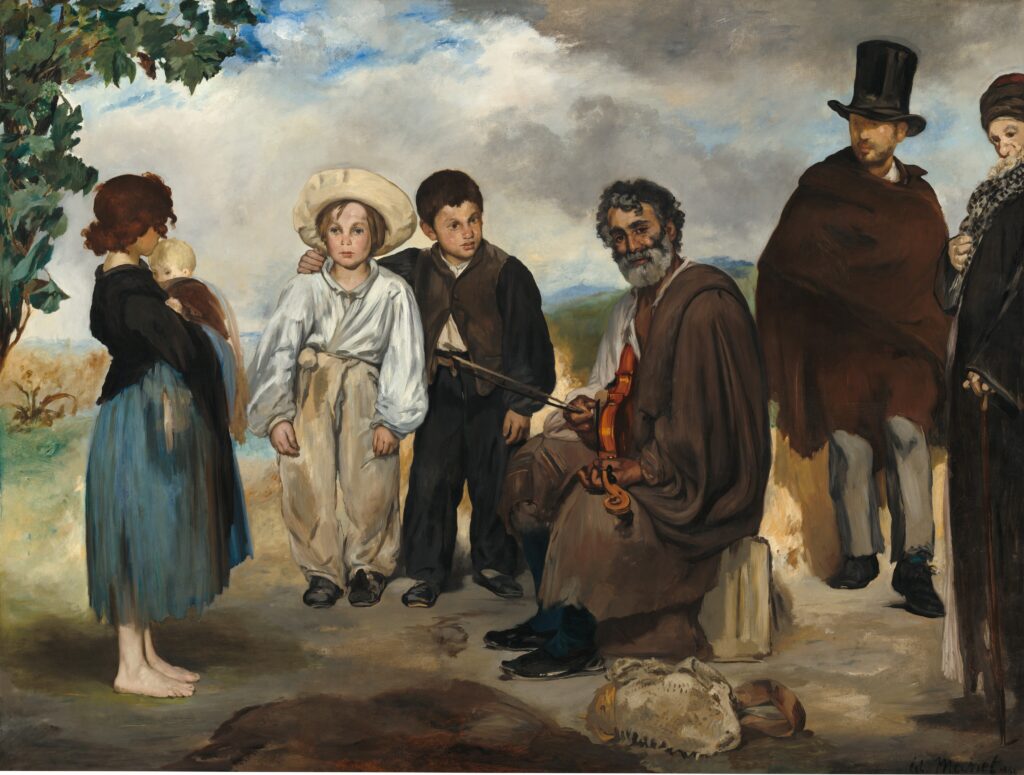
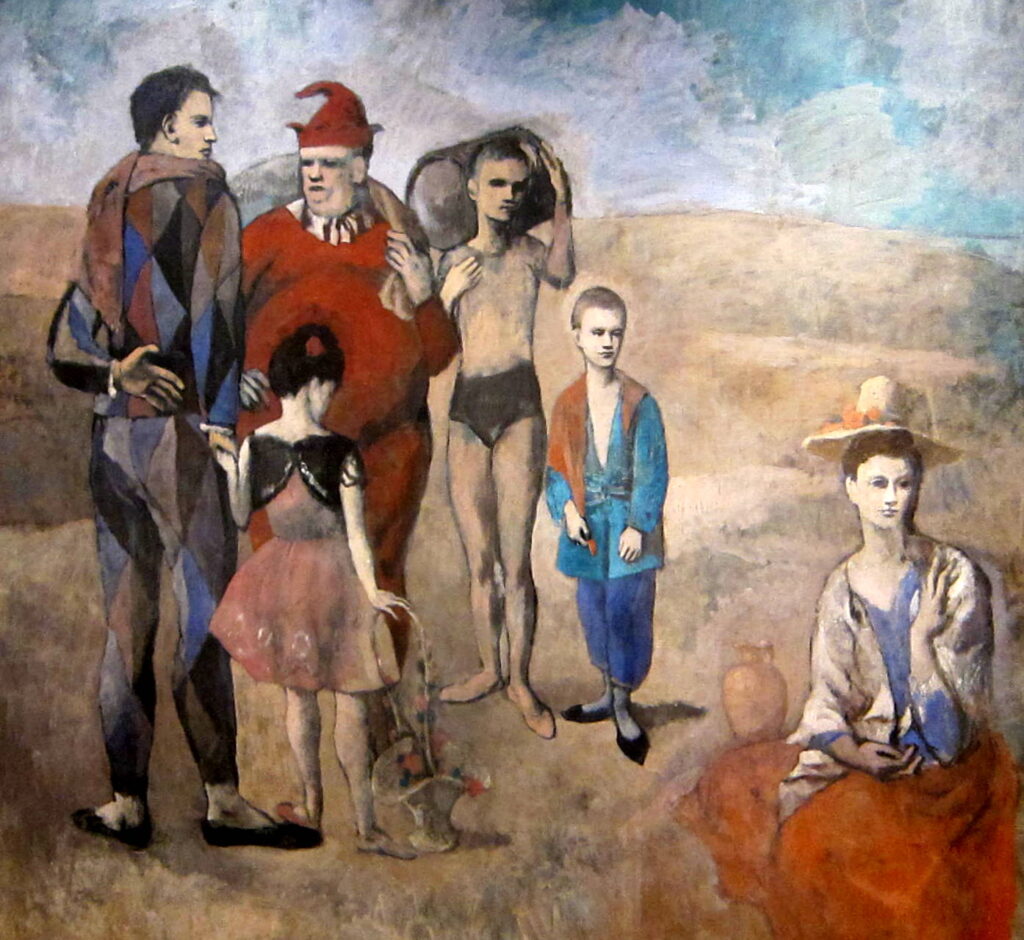
The National Gallery of Art in Washington, DC displays The Feast of the Gods by Giovanni Bellini with additions by Titian (1514/1529), The Old Musician by Edouard Manet (1862), and The Family of Saltimbanques by Pablo Picasso (1905). These major works talk to each other.* We might say that the Bellini is a work of art, the Manet is a work about art, and the Picasso is about the artist.
Bellini’s painting illustrates a story from Ovid (Fasti I:415ff.). Mario Equicola, a courtier in service to the Duke of Ferrara, had given Bellini detailed and learned instructions about how to represent the original passage (Colantuono 1991). Equicola argued that poetry was the greater art; painting was merely derivative. Some contemporaries disagreed with this assessment, but all expected art to represent classic texts: usually Scripture, but in this case a pagan myth.
Bellini creates a kind of set for the gods, a flat area with a backdrop (which is now mostly Titian’s work). The characters are shown frozen in the midst of action.
Giovanni Bellini and Titian, The Feast of the Gods, 1514/1529, oil on canvas, Widener Collection, 1942.9.1
The artist counts on certain expectations that make the image easily legible. As usual in Renaissance art, light comes from a sun behind the viewer’s left shoulder. Space is reserved between the major objects and the edges of the canvas, so that the scene is “framed” both aesthetically and literally. Objects that are further away are not only smaller but blurrier and lit differently from those at center-stage (sfumato). Although the characters are Greco-Roman gods, they wear costumes and hold props from Bellini’s own time. Their bodies and other objects are represented with glowing detail; for example, the ceramics represent the earliest depictions of Chinese porcelain in European art.
If this is what we expect from art, then it is hard to see how anyone could surpass Bellini. He knows all the tools and techniques. He can represent round objects and faces rotated on all axes; light reflecting on metal, glass, porcelain, and liquid; water flowing through space; shadows and highlights; and naked and clothed bodies with discernible weight. But once this kind of painting has been produced at a high level for several centuries, the whole approach could become tired–especially once artists become enthusiastic about radically different styles from other cultures and times.
Detail, showing water flowing into a glass vessel
Manet’s The Old Musician bears some similarities to Bellini’s work. Again, several characters are presented on a flat stage with a tree and the sky behind them and light coming from the upper-left. However, the edges of this image cut right through one human figure and the tree, reminding us that we are looking at a painted canvas. Especially in the foreground and around the boy’s silhouette, the paint strokes are easily legible (another reminder that this is a painting). A horizon is visible, but the background is ambiguous. Flat ground behind the boy seems to morph into a low wall behind the young man. The sun casts shadows to the right of the violinist but to the left of the man in the tall hat. Perhaps the setting is the outskirts of Paris or another great city, but the location is obscure.
And there is no story. Maybe the people will move later on, but they are not evidently in the midst of doing anything now. The musician has stopped playing his violin, which might have animated them before. No character looks at any other, except that the musician stares at us.
You need a guide, such as Charles Fried (Fried 1969) or David Luban (Luban 1994) to tell you that the figures here are quoted from previous works of art, including an ancient statue of the philosopher Chrysippus, Watteau’s Pierrot (1718-19), and Manet’s own Absinthe Drinker (1858-9). The subject of this painting is not any story but art itself. The tradition within which Bellini painted has come to an end, like a tune previously played by a musician who is now “old.”
The figures in Manet’s painting are timeless and may combine costumes from diverse periods, but it’s safe to say that they are socially marginal. The young girl is barefoot and responsible for a baby. This is not a conventional family or a respectable organization but perhaps a band of homeless people. One of them, the violinist, is clearly a kind of artist, and the painting implies that artists in general are outsiders. In contrast, Bellini had painted his work for the private study of Duke Alfonso d’Este. From Bellini to Manet, successful artists have evolved from well-placed courtiers to bohemians.
Picasso was a spiritual heir to Manet. A young migrant from Spain, living in bohemian Paris among poets and artists, he embraced a marginal and critical role. He and such friends as the poet Guillaume Apollinaire regularly visited the circus, where they felt (or at least claimed) an affinity with the performers. In The Family of Saltimbanques, Picasso depicts a group of acrobats from the lowest tier of that profession. The landscape is even emptier than in the Manet.
By Pablo Picasso – Digital reproduction or scan of original painting: https://en.wikipedia.org/w/index.php?curid=27675009
The harlequin figure may be a self-portrait, the large jester is probably Apollinaire, the woman may be Picasso’s lover and model Fernande Olivier, and the girl may represent an orphan whom Olivier and Picasso had recently adopted, only to return her–rejected–to an orphanage. This image, then, is self-referential and confessional, in contrast to the outward stance of both Bellini and Manet. It exemplifies Picasso’s Rose Period, which had recently succeeded his Blue Period, and it can be understood as an objective correlative of the painter’s evolving mood.
These three paintings share several motifs. For instance, the feet. The Naiads in the Bellini are barefoot, per Ovid:
Naides effusis aliae sine pectinis usu,               405
     pars aderant positis arte manuque comis;
illa super suras tunicam collecta ministrat,
     altera dissuto pectus aperta sinu;
exserit haec umerum, vestes trahit illa per herbas,
     impediunt teneros vincula nulla pedes.

There were Naiads, some whose hair flowed down without a comb,
   others having arranged it by hand with skill.
This one serves with her tunic gathered above her calf,
   another opens the robe to reveal her breast:
This one uncovers a shoulder, another drags her hem in the grass
   No tender foot is shackled with a shoe.
These naked feet are meant to be mildly erotic. Not so with Manet, whose shoeless young girl is poor and encumbered with an infant. With her dirty feet, she may refer to Caravaggio’s Madonna of Loreto (1604-6). And Picasso’s saltimbanques wear slippers for acrobatics.
All three paintings relate in important ways to poems. I’ve mentioned that Bellini’s work illustrates a passage from Ovid’s Fasti. This is a somewhat distasteful story. Priapus (whom Bellini shows erect under his tunic) is about to rape a Naiad named Lotis while she sleeps, but a donkey brays, awakening the whole company and subjecting Priapus to ridicule. He then kills the donkey with his scythe. (In Bellini’s version, it looks as if Mercury was already watching before the donkey brayed.)
Manet’s friend Baudelaire encouraged him to paint modern society. These lines of Baudelaire’s can be compared with The Old Musician:
À une Mendiante rousse

Blanche fille aux cheveux roux,
Dont la robe par ses trous
Laisse voir la pauvreté
Et la beauté ...,

To a Redhead Beggar Girl

Pale girl with auburn hair
Whose clothes though their holes
Let your poverty show
And beauty ...
Most of all, the fifth of Rilke’s great Duino Elegies is entirely about Picasso’s Family of Saltimbanques, with which he lived (in the Munich home of Hertha Koenig) for several months in 1915, after having seen the same painting in Paris. The poem addresses each character in turn.
Rilke begins:
Wer aber sind sie, sag mir, die Fahrenden, diese ein wenig
Flüchtigern noch als wir selbst, die dringend von früh an
wringt ein wem, wem zu Liebe
niemals zufriedener Wille? Sondern er wringt sie,
biegt sie, schlingt sie und schwingt sie,
wirft sie und fängt sie zurück; wie aus geölter,
glatterer Luft kommen sie nieder
auf dem verzehrten, von ihrem ewigen
Aufsprung dünneren Teppich, diesem verlorenen
Teppich im Weltall.
[...]

But who are they, tell me, these drifters, just a bit
More fleeting than ourselves, wrung out from early on--
by whom, for whose desire, by what insatiable will? Instead, it wrestles them,
bends them, loops them and swings them,
throws them and catches them again; as if through oiled,
slippery air, they come down
on the worn-out mat, worn ever thinner by their constant
leaping, this carpet that is spent in space.
[...]
Rilke takes Picasso’s static image and gives it a story, a before-and-after, much as Bellini had turned Ovid’s narrative into a snapshot. Not only does Rilke imagine that the acrobats were jumping before the calm moment captured in paint, but he discusses how they gradually learned to leap.
He begins a later stanza:
Ach und um diese
Mitte, die Rose des Zuschauns:
blüht und entblättert.

Oh and about this
center, the rose of onlooking:
it blooms and sheds its leaves.
Most translations (collected by Martin Travers) presume that the acrobats form the rose. That is probably correct. However, I suspect that Picasso is also the “rose of onlooking.” During his Rose Period, his pink-ish mood suffuses his work. The painting is a kind of self-portrait as well as an answer to Manet and the tradition of narrative art that preceded them both.
*Picasso definitely knew The Old Musician. Manet may not have known The Feast of the Gods, which was in England in his day. He’s responding to the overall tradition of European painting. References: Anthony Colantuono (1991) “Dies Alcyoniae: The Invention of Bellini’s Feast of the Gods,” The Art Bulletin, 73:2, 237-256; Michael Fried (1969), “Manet’s Sources: Aspects of His Art, 1859-1865,” ArtForum, vol. 7 no. 7; David Luban (1994) Legal Modernism, University of Michigan Press. See also: Velazquez, The Spinners; an accelerating cascade of pearls (on Galileo and Tintoretto); Manet’s “Old Musician” (from 2004).
We owe it to ourselves to develop an explicit model of any situation that concerns us. Whether we choose to share our model with other people is a choice, but we should always be ready to describe it to ourselves.
A good model simplifies reality in a way that enables wise judgments. It should include the most significant components of the situation and link them together. It will certainly not be complete or conclusive; in fact, an important reason to make our model explicit is to help think about what it may omit, what it assumes without sufficient evidence, how it may appear wrong to people who’ve had different experiences, and how it would change if the world changed.
In our Introduction to Civic Studies course so far this fall, we have already explored various models. For instance, Elinor Ostrom and her colleagues developed a template for modeling almost any institution, the Institutional Analysis and Design (IAD) framework. I discuss that framework in this 11-minute recorded lecture. (I also offer an introductory lecture about Ostrom). Later, we examined the social theory of Jürgen Habermas, which I presented as a model involving the Lifeworld, Public Sphere, and Systems in this 29-minute lecture. Both examples can be represented in the form of flow charts. But we also unpacked Robert Putnam’s model of social capital, in which the main construct–composed of numerous elements–causes good social outcomes (see this 18-minute lecture). And we discussed the mental model that guided the leaders of the Montgomery Bus Boycott when they chose to target the city’s bus company.
As these examples suggest, models can come in many forms. They need not be presented visually; Putnam’s model is an equation, and narratives also work. (We read a little of Pierre Bourdieu, who presented a model in the form of an emblematic story.) The components can be many kinds of things, from actors to psychological constructs to ideals. And the connections can be equally various. One component may cause or influence another, or it may exemplify, help to compose, encompass, intend, ground, block, explain, or evolve into another part of the model.
I would go so far as to describe making and critically assessing one’s own models as a fundamental civic skill.