Author Archives: Peter

About Peter

Associate Dean for Faculty and the Lincoln Filene Professor of Citizenship and Public Affairs at Tufts University's Tisch College of Civic Life. Concerned about civic education, civic engagement, and democratic reform in the United States and elsewhere.

opening remarks at Frontiers of Democracy 2016

We meet at a sobering moment. This conference is a descendent of a meeting organized in 2008 called No Better Time. Today does not seem like “no better time.”

The most thoughtful predictions give a man who has been called a fascist by senior members of his own party a 30% chance of becoming president. If the doctor gave you a 30% chance of succumbing to a deadly disease within the next five months, you wouldn’t draw a lot of comfort from the thought that you’re more likely to survive. Like that patient, our republic is in danger.

Meanwhile, fascist candidate Marianne Le Pen leads French polls for president, drawing twice as much support as the incumbent. Strongly paternalistic and antidemocratic nationalist leaders—all strong men—already dominate most of the nations in an arc from China and Russia to Hungry. Venezuelans are fighting in supermarkets for loaves of bread for their children because of a crisis of governance. The Arab Spring has turned into five consecutive years of repression in the whole region and slaughter in Syria, where 400,000 have died with no end in sight. And here in the United States, a man can murder 49 human beings because they are gay. Some are inspired by the sit-in in Congress, but hardly anyone really expects the government to make changes that will reduce the chances of the same thing happening again.

Bertold Brecht wrote a poem in 1939 entitled “To Future Generations”:

Truly I live in dark times!
A sincere word is folly. A smooth forehead
Indicates insensitivity. If you’re laughing,
You haven’t heard
The bad news yet.
What are these times, when
A conversation about trees is almost a crime
Because it implies silence about so many misdeeds,
When, if you’re calmly crossing the street,
It means your friends can’t reach you
Who are in need?
…

This we knew:
Even hatred of humiliation
Distorts the features.
Even anger against injustice
Makes the voice hoarse. Oh, we
Who wanted to prepare the ground for friendliness
Could not ourselves be kind.
But you, when
one can help another,
Think of us
Forgivingly.

This is the context in which we gather for Frontiers. Indeed, it could be said that there is no better time to meet

We are hardly alone, of course. We have many allies around the world. In fact, right at this minute, by sheer coincidence, a conference has begun at the Central European University in Budapest entitled “Frontiers of Democracy.” Seeing a photo of their sign, texted by a friend, I thought of another poem written in 1939.

Defenceless under the night
Our world in stupor lies;
Yet, dotted everywhere,
Ironic points of light
Flash out wherever the Just
Exchange their messages …

Perhaps we can send some light in the direction of Budapest and many other places around the world.

I have given a dark picture, albeit with some ironic lights. None of that implies that we can’t have fun. Working together to build a better world is a source of satisfaction, even joy. We can exemplify the pleasure and humor that comes from civic life at its best. I hope you will enjoy every aspect of Frontiers, especially your interactions with one another. If we let civic life turn dreary, few will chose to participate, and politics will be left to the ruthless.

At the same time, we must be profoundly serious. The stakes couldn’t be much higher. We must squarely face unresolved problems, such as how to expand civic values and practices to the scale of nations and the globe, how to tap the power of social movements, and how to define and confront evil.

We must do more and better, and we must change fast. We have a lot to accomplish in the next 48 hours. Let’s get to work.
pragmatism and the problem of evil

Discussing Dewey in the Summer Institute of Civic Studies yesterday, I (and, I think, several colleagues) had the sudden recognition that American pragmatists tend not to deal with evil very persuasively. In The Public and its Problems, Dewey writes:

Nevertheless, the current has set steadily in one direction: toward democratic forms. That government exists to serve its community, and that this purpose cannot be achieved unless the community itself shares in selecting its governors and determining their policies, are a deposit of fact left, as far as we can see, permanently in the wake of doctrines and forms, however transitory the latter. They are not the whole of the democratic idea, but they express it in its political phase. Belief in this political aspect … marks a well-attested conclusion from historic facts. (p. 146)

Dewey’s idea is that we can’t justify processes like electing leaders a priori. There is no natural right to vote; it doesn’t depend on a social contract. Rather, it’s a “deposit of fact” left from human learning over many centuries. Voting exists because we have learned to vote. Fortunately, that process is progressive and beneficial: the current has steadily flowed toward democracy. It is crucial not to fetishize any given process or right, because we will come up with better ones later. When we think of documents like the Constitution, Dewey says, “the words ‘sacred’ and sanctity’ come readily to our lips” (pp. 169-70), interfering with our critical reasoning and our ability to learn from experience.

These words were published in 1927. About 14 million people were sentenced to the Gulag from 1929 to 1953. Auschwitz opened in 1940. The current was not exactly steady in the direction of democracy. Robert Zaretsky has a beautiful piece in today’s Times about how not being occupied during World War II made Americans–probably white Americans more than others–“stupid.”  According to Zaretsky, Czeslaw Milosz was fairly indulgent of our stupidity, although he diagnosed it clearly. It is precisely the kind of foolishness suggested by the first sentence in Dewey’s quotation above.

What if we said the following instead? Human beings torture each other, enslave each other, carpet-bomb each other, and intentionally wipe out whole communities. This happens often. Enough: it has to stop. Translated into constitutional terms, “thou shalt not torture people” turns into a right to due process and rule of law. We must do our best to make such rights sacred and nonnegotiable. They are not literally sacred, in the sense that God or nature decreed them. But they are bulwarks against cruelty, which is the worst of us, to paraphrase Judith Shklar’s Liberalism of Fear. When everything is left open to experimentation and learning, people may spend hundreds of years “learning” that they can own other people or that Jews are blood-sucking parasites. We should rather treat as sacred and unamendable such passages as Article One of the German Constitution:

(1) Human dignity shall be inviolable. To respect and protect it shall be the duty of all state authority. (2) The German people therefore acknowledge inviolable and inalienable human rights as the basis of every community, of peace and of justice in the world.

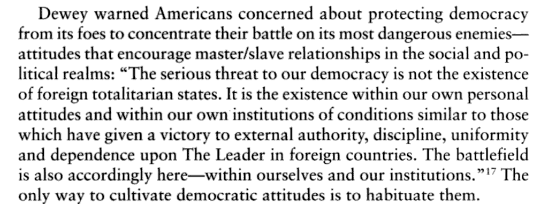
I think that there are pragmatist replies to this kind of liberalism, but I can’t be satisfied with them unless they explicitly invoke and address the problem of evil. I’m worried about this kind of theme in Dewey (ably summarized by John M. Savage in John Dewey’s Liberalism):

Dewey

I’m all for cultivating democratic habits, but that’s not the only bulwark against tyranny. It’s also helpful to ban tyranny and to make that prohibition permanent.

CIRCLE briefing on Donald Trump and the Youth Vote

Medford/Somerville, MA – Young people have turned out in record numbers for the 2016 GOP primaries and caucuses. Now that Donald Trump is the presumptive Republican nominee, researchers at the Center for Information and Research on Civic Learning & Engagement (CIRCLE) – the preeminent, non-partisan research center on youth engagement at Tufts University’s Jonathan M. Tisch College of Civic Life – today released an analysis of his level of support from young people during this primary election cycle. This briefing examines how Mr. Trump’s support from young voters stacks up with previous Republican nominees, as well as implications for the general election.

The briefing offers findings in response to several key questions:

How did Donald Trump do among young people who voted in the primaries?

  • Generally, Donald Trump has received a lower level of support from youth, ages 17-29, than from older voters, particularly those over 45: averaging roughly one-third of the youth vote vs. 43 percent of older voters.
  • In the first 21 states for which youth data are available, Mr. Trump won 17 overall and received a plurality of youth votes in just 11.
  • As the Republican field narrowed, young people who identified as or with Republicans showed greater levels of support for Mr. Trump in states like Pennsylvania and Indiana.

How does Trump’s youth support compare to that of previous Republican nominees?

  • Mr. Trump has received a slightly larger proportion of estimated youth votes in the primary season than previous Republican nominees Senator John McCain (2008) and Governor Mitt Romney (2012).
  • In 2016, both parties’ nominating contests remained competitive for many months, which may have driven youth turnout.
  • While Republican youth have been underrepresented in recent primary and general elections, this year youth participation in the Democratic and Republican contests has been rather evenly split. Currently, in the states for which data are available for both parties, 55% of young primary participants have voted in Democratic contests, while 45% have voted in GOP contests.

How do young people overall view Donald Trump?

  • As a whole, young people view Mr. Trump unfavorably, with young women and non-white youth, who together make up roughly 70 percent of the youth electorate, viewing him even more unfavorably; young people with less formal education have shown greater levels of support in the primaries.
  • Our analysis shows that among “solid Republican” youth, 8 out of 10 are non-Hispanic Whites; and this group skews slightly male.
  • Among all young eligible voters, 78% do not have a four-year college degree—whether because they have no college experience or because they are in college but have not yet graduated.
  • Mr. Trump also performs well with young people who are disillusioned with the overall state of the country.

What are the potential implications for the general election?

  • Two major factors may affect Donald Trump’s performance with young voters in November: education and ideology/party affiliation.
  • Young people without a four-year college degree—one of Mr. Trump’s strongest constituencies among youth—tend to vote at higher rates in general elections than in primaries. However, their overall turnout is still fairly low. This could inform Mr. Trump’s campaign outreach strategy and suggests a need to mobilize a great deal of non-college youth to move the overall youth electorate in his favor.
  • Consistent with the political polarization of the general electorate, about two-thirds of young people who participated in the Republican primaries identified as conservatives rather than moderates.  However, like many young voters today, young Republican primary participants were less likely than older voters to identify with the Republican Party.

For CIRCLE’s full briefing, please see here. CIRCLE’s 2016 Election Center will continue to offer new data products and analyses providing a comprehensive picture of the youth vote, including a forthcoming analysis of the presumptive Democratic nominee Secretary Hillary Clinton. CIRCLE researchers also will provide insight into key states where young people have the potential to shape the 2016 general election, as rated in CIRCLE’s Youth Electoral Significance Index.

communities saving coral reefs: an illustration of Elinor Ostrom’s findings

A new Nature article by Joshua E. Cinner and many coauthors entitled “Bright spots among the world’s coral reefs” is getting a lot of play in mass media. The authors find that, despite grievous damage to coral reefs around the world, some reefs are doing much better than predicted. Among the causes of their success are local institutions and norms:

Our initial exploration revealed that bright spots were more likely to have high levels of local engagement in the management process, high dependence on coastal resources, and the presence of sociocultural governance institutions such as customary tenure or taboos. … For example, in one bright spot, Karkar Island, Papua New Guinea, resource use is restricted through an adaptive rotational harvest system based on ecological feedbacks, marine tenure that allows for the exclusion of fishers from outside the local village, and initiation rights that limit individuals’ entry into certain fisheries

According to economics before Elinor Ostrom, an unowned and unregulated resource is doomed because individuals will exploit it. A coral reef is a perfect example of an unowned resource; thus it must be enclosed and controlled by a private owner or a state to save it from the Tragedy of the Commons. But Ostrom found that communities around the world have developed durable means of protecting such resources for their own use. They apply tacit design principles for the successful management of what she called common pool resources, including clearly defined boundaries, rules for appropriating resources that are congruent with the local biological and cultural circumstances, practical means of monitoring the resource, and procedures that most people in the community have some capacity to influence.* Although the above description of Karkar Island is brief, it seems to manifest these principles.

Ostrom’s findings are profoundly significant, because all over the world, local institutions for protecting common pool resources have been bulldozed (metaphorically or literally) by states and markets. That form of modernization is one cause of our global ecological crisis. If more people were permitted–or even supported–to manage local resources as the Karkar Islanders do, the world would be in better condition.

It is also true–as the Nature authors emphasize–that deadly external threats beset local resources (in this case, coral reefs). As long as we heat the earth at a global scale, it’s virtually inevitable that many or most reefs will be destroyed, regardless of how local people manage them. But it’s a mistake to read Elinor Ostrom as a “Small-is-Beautiful” romantic. Her insight is that collective action problems are omnipresent, but they are not inexorable tragedies. They are “dramas” that can turn out either tragically or happily, depending on how we organize ourselves. The moral of her work is not that indigenous people can save the earth if left alone, but that institutions at all scales must learn to manage resources using the principles that happen to be traditional in places like Karkar Island.

*Ostrom et al., “Covenants, Collective Action, and Common-Pool Resources,” in The Constitution of  the Good Society, ed. Karol Edward Soltan and Stephen L. Elkin, 1996, pp. 23–38.

See also: Peter Levine, “Seeing Like a Citizen: The Contributions of Elinor Ostrom to ‘Civic Studies’” (The Good Society, 2011); Elinor Ostrom, 1933-2012; on the contributions of Vincent and Elinor Ostrom; and the cultural change we would need for climate justice.

register now for the National Conference on Citizenship


Strengthening America’s Civic Health: Developing Strategies for Enhancing Civic Life and Improving Communities 

Peter, 

Please join us for this working convening in Washington DC, co-hosted by the National Conference on Citizenship (NCoC) and Tufts University’s Tisch College of Civic Life. For more information and to take advantage of our early bird registration, please follow this link.

We think of civic health as the way that communities are organized to define and address public problems. This convening will focus on how to strengthen civic health to aid the efforts of those working everyday on their communities’ most pressing challenges.

This working convening will be informed by you—individuals, agencies, and institutions who are working to support engaged, resilient communities. With a focus on equity, diversity, and inclusion, we are inviting your feedback to help shape this important discussion in October through the following avenues:

  • Connecting the Dots: The Role of Civic Health in Community Problem Solving: You are invited to join a webinar conversation to provide input on how best to enhance consideration of the relationship between civic health and the challenging issues you face. Webinars will be held July 11th and 14th at 2pm Eastern. Register here.
  • Community Conversations on Civic Life: Together with the Corporation for National and Community Service (CNCS), NCoC will support a series of community conversations on civic life. More details will be available soon.
  • Pre-Convening Survey: Together with our partners at the Tisch College of Civic Life, we will gather feedback from registrants that will help inform content and shape the discussion in October. All registrants will receive an invitation to offer their input.

Register now to receive the early bird registration rate of $150.