Author Archives: Peter

About Peter

Associate Dean for Faculty and the Lincoln Filene Professor of Citizenship and Public Affairs at Tufts University's Tisch College of Civic Life. Concerned about civic education, civic engagement, and democratic reform in the United States and elsewhere.

should civic educators modify their neutral stance?

(Washington, DC) I’m here for the National Council for the Social Studies annual convention. Right after the election, the NCSS sent a “post-election message” that talked generally about the importance of teaching about government and civic engagement:

As social studies educators, we teach and learn about our system of government, about controversial and timely issues, and about making informed decisions as active participants and defenders of our democracy. Our civic duty did not end at the voting booth; in fact, it has just begun. We can share instructional practices about the electoral process, the upcoming transition plans for newly elected leaders at all levels, and the new teams that will play a central role in our conversations for the next several years. We teach the principles of our U.S. Constitution.

This message could have been sent after any presidential election in the past century. There was no mention of Donald Trump or anything unusual about the campaign or the condition of the republic. I am not necessarily critical of this stance, which reflects a deep-seated and well-grounded commitment to a certain form of political neutrality. Many other schools, districts, universities, and nonprofits have taken a similar stance. However, civic educators must at least consider whether a different set of principles should apply in 2016.

Here are some arguments for neutrality:

  1. It’s dangerous for an arm of the state, a public school, ever to take sides on political issues. Citizens are forced to pay for public education and face considerable pressure to turn their kids over to these institutions. Children form an impressionable, captive audience in the classroom. Teachers have great power over students’ life-prospects. It’s unethical for them to use that power to change children’s political views.
  2. If teachers take–or imply–critical positions about any particular party or leader, elected officials and electoral majorities can press them to take different positions. Neutrality is no longer a shield.
  3. We are all subject to bias. Teachers split their votes between Clinton and Trump, but a majority preferred Clinton, and in big city districts on the coasts, the ratio was no doubt very high. Like everyone, Trump opponents need to remember that they could be wrong. Lots of people believe that Barack Obama is a dangerous enemy of American values. I heartily disagree, but this disagreement shows that judgment is fallible. A critical estimate of Donald Trump is a judgment, not a simple matter of fact. The “text” that we must interpret is the vast quantity of his statements over many months. People hear different points and take different messages from all this verbiage. Those of us who think Donald Trump is a profound threat to the republic could be wrong; and teachers shouldn’t communicate uncertain ideas as if they were truths.
  4. One of our worst problems is political polarization, a failure to interact with and understand people who disagree with us. We don’t learn or practice deliberation enough in the US today. But there is always some ideological diversity in a social studies classrooms, and teachers can advance deliberative values by creating spaces for open conversations. Further, if a particular group (such as Trump voters–or Trump opponents) happens to be missing from a given classroom, teachers can help students to understand the absent perspective. However, if the teacher takes a position, that can chill deliberation.
  5. Schools teach civics and social studies in the first place because elected officials tolerate it. Civics is rarely a high priority and is often on the list to be cut. Yet students benefit from civics. Therefore, the responsible course is for educators–and especially associations like NCSS–to keep their heads down. The last thing they should do is appear to oppose the incumbent administration, because it will be easy for federal and state governments to eliminate civics entirely.
  6. Since individual teachers will bear the brunt of any criticism and retribution, administrators and nonprofit organizational leaders should adopt a tone of complete neutrality to protect them.

But here is the opposite argument:

  1. We teach civics to instill republican, liberal, democratic, and humane values. We ask our students to preserve the republic against threats, both domestic and foreign. The acid test of good civic education is whether every graduate would “stand up” instead of “standing by” when a would-be dictator appeared on the scene.
  2. Yes, it is a matter of judgment, not a demonstrable fact, that Trump poses a threat to republican values. But some major Republican intellectuals and GOP political opponents have called Trump an authoritarian and a racist. One can give reasons, evidence, and arguments for these conclusions. Uncertainty remains, but uncertainty does not excuse us from having to decide. As Hannah Arendt would have said, “Ven zee cheeps are down, ve must make yudgments.” Judgment under uncertainty is exactly what citizenship demands. If we’re wrong, we pay the consequences, because–as Arendt would say–“politics is not a nursery.” Incidentally, Trump needn’t be remotely like a Mussolini or a Franco to pose a real danger. A Putin or a Berlusconi would be bad enough.
  3. To teach “standing up” or (as postwar Germans call it, Civil Courage) needn’t be partisan. In fact, if you think that the price of liberty is eternal vigilance, then most of us liberals should have been more vigilant during the Obama years. We should have stood up when the current president executed people extra-judicially by drone strike. In other words, Civil Courage would support criticism of Trump, but it would extend far beyond him.
  4. Schools aren’t and shouldn’t be neutral, anyway. Among the values that they must defend are pursuit of truth and basic decency for all. Any political leader who exhibits a lack of regard for truth or bullying behavior violates principles that schools must uphold. They can’t give kids bad grades for using false information, or make them stay after school for bullying, and yet ignore such behavior by the president.
  5. Many teachers have students who are directly threatened by Trump–or feel that they are–and it is wrong for adults to ignore their sentiment by treating the President Elect as a normal leader. By extension, in a class where everyone feels safe, the students should be made aware of how others feel.
  6. If we refrain from exercising Civil Courage because of possible budget cuts or other political consequences, we are abandoning free speech. That is exactly how republics fall.

I actually think the the choice between these two approaches is fairly hard. Individuals and groups can reasonably reach various conclusions. I write only on my own behalf and do not know what I would say if I represented something like the NCSS or a school district. But, at a minimum, everyone involved in educating the next generation should consider this choice.
being young and evaluating democracy in 2016

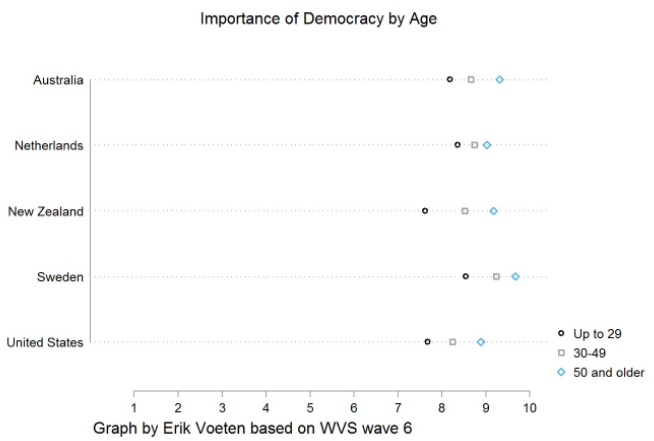
The claim that support for democracy is falling in most countries–and falling quickest among the young–has caused much consternation this week. One datapoint that supports this argument: “In 2011, 24 percent of U.S. millennials (then in their late teens or early twenties) considered democracy to be a ‘bad’ or ‘very bad’ way of running the country.” Erik Voeten and others have argued that this survey is being presented in an alarmist way by focusing on the minority who chose the extreme responses to key questions. Voeten shows that this is how support for democracy looks if you display the mean responses on a scale from 1-10:

screen-shot-2016-11-30-at-7-29-25-pm

Most people are still in favor, and the gaps by age are not huge.

But it is natural to be a bit uninspired by democracy if you’re encountering it for the first time right now. In my freshman philosophy seminar, democracy has been our topic this week. We’ve been reading:

My questions include the following:

Is democracy a reliable means to achieve such (possibly) valuable ends as human happiness/welfare, liberty and rights, or equality? Is it a process that yields such outcomes? Or is it a good in itself? (To see it as an intrinsic good may require the belief that involvement in self-government is dignified or worthy in some way.) Does democracy mean “voting equality at the decisive stage” (Dahl), or a search for consensus (Wiredu), or an opportunity for discussion that enlarges people’s knowledge and empathy (Dewey et al, not assigned)? Is democracy necessarily adversarial (Eze) or can it be unitary (Wiredu), and if the latter, is unity a good thing, perhaps a sign of fraternité? Finally, is democracy a process or set of rules, or rather a culture and set of norms and practices?

My students are thoughtful, open-minded, and quick to understand various perspectives and arguments. But I think their current views are colored by what they regard as the debacle of the 2016 election–both its outcome and the campaign season that preceded it. I asked them whether they thought the election had changed their views of democracy, and they tended to think it had. They are unlikely to see democracy as an intrinsic good, because it rather seems like an undignified and disappointing spectacle. They are attuned to the dangers of communication (propaganda, group-think, polarization, selective use of evidence) and pessimistic about the potential of communication for learning and consensus-building.

I don’t necessarily disagree. And I certainly don’t play the advocate for any philosophical view in the classroom. But I think that those who hope to engage such young people must make the struggle against forms of politics that they despise seem intrinsically rewarding, and must demonstrate that responsible and responsive communication is possible.

what activist movements will look like in the Trump era

Dave Karpf has a great piece entitled, “Cyclical patterns in activist politics: what do we know about the politics of opposition”? Karpf argues that opposing a government looks very different from the “politics of articulation” (trying to develop and promote an agenda). These are some key differences:

  1. Opposition unites. As Karpf notes, the Tea Party formed to oppose Obama before he had made any policy decisions. Its original rhetoric–and its very name–implied opposition to tax increases. But Obama mainly cut taxes. That was no problem for the Tea Party, which shifted to opposing the Affordable Care Act. It was nimble about policies because its raison d’etre was opposition to a person, his core values, and the institution he controlled.
  2. Rapid response becomes more valuable. Especially in the age of social media, activist networks are good at getting people out quickly. They are much worse at sustaining pressure, negotiating, and achieving new policies. When your side shares formal power, rapid response is relatively unimportant. But when the main goal is to block policies coming from the other side, rapid response pays.
  3. By the same token, it becomes harder to advance a positive agenda when a movement must spend all its time blocking new initiatives from the government.

I would add two hypotheses:

  1. I think activists on the left will shift from soft, proximate targets to confront their main ideological opponents. The global justice movement of the Clinton era criticized transnational corporations and the governments that supported them, yet it gained attention for protests outside the World Bank, which funds development projects. Occupy Wall Street claimed to target Wall Street, yet it got the most traction in conflicts with Democratic big city mayors and state universities that were simultaneously facing budget cuts from conservative legislatures. The environmental movement focuses on massive destruction caused by fossil fuels but achieved a notable victory by pressuring a Democratic president to block a specific pipeline that could be easily bypassed. The left tends to confront near-allies for showing hypocrisy or weakness, but that impulse fades when explicit opponents take control. (See Bayard Rustin’s absolutely indispensable and totally timely 1965 article “From Protest to Politics” for a similar point.)
  2. Maintaining political discipline will be an enormous challenge. As Rustin reminded his fellow Civil Rights leaders in 1965, the point is to win. That requires mobilizing and inspiring a majority of Americans, not just fellow travelers. National Review’s Jim Geraghty tweeted earlier today, “Anti-Trump protesters are gonna take the bait, aren’t they? They’re gonna burn flags, thinking they’re irking him, but alienating majority.” It’s very hard for any large, loose network to remember what the majority of people value, let alone maintain message-discipline. Whether anti-Trump movements can manage that task is enormously important.

See also: we need SPUD (scale, pluralism, unity, depth); to beat Trump, invest in organizing; building grassroots power in and beyond the election; and democracy in the digital age.

pluralist populism

The leaders of China, India, Russia, Turkey, Venezuela, and Hungary–plus the President Elect of the USA and major political actors in Britain, France, and Austria (among other countries)–are called “populists.” A populist in this sense is one who views The People as homogeneous on important dimensions–for instance, race, culture, occupation, or ancestry–and as distinct from both foreigners and elites. Indeed, foreigners and elites are often seen as collaborating against The People. A populist leader represents The People, speaking for them and serving their interests. Therefore, it is wise to entrust power in the leader, who talks directly to and for each citizen. Majority rule is an attractive process, but majority votes that do not support the populist leader are suspect. Obstacles to populist government–rule of law, checks and balances, an independent press and civic society–are problematic at best.

There is, however, another sense of the word “populist” that deserves attention. In this conception, The People are not only heterogeneous; they are defined by being more pluralistic than the straight-laced elites, who promote one way of life as best for all. Furthermore, The People are not interested in surrendering their power to any leader. Their populist activity is all about building direct, grassroots, horizontal, participatory power. They are proud of their democratic innovations, whether those are letters of correspondence, Grange halls, sit-ins, salt marches, or flashmobs.

Eli Rosenberg, Jennifer Medina, and John Eligon began a recent New York Times article about anti-Trump protests:

They came in the thousands — the children of immigrants, transgender individuals, women and men of all different ages and races — to demonstrate against President-elect Donald J. Trump on Saturday in New York.

Some held handwritten signs like, “Show the world what the popular vote looks like.” The throng chanted, “Not our president!”

Showing the world that the popular vote looks heterogeneous is a traditional populist gambit, familiar from social movements and popular uprisings since time immemorial. It’s a way of demonstrating SPUD (scale, pluralism, unity, depth). I emphasize it because I fear we face three unsatisfactory alternatives:

  1. Trump-style populism, which defines The People as homogeneous, excludes everyone who doesn’t fit, and disempowers the actual people by centralizing political authority in a leader.
  2. Technocratic progressivism, which defers to a highly educated global elite whose norms and range of experiences are actually quite exclusive and narrow.
  3. Thin versions of diversity politics, which celebrate heterogeneity within existing institutions (e.g., racial diversity within a university) but which lack a political vision that can unify broad coalitions in favor of new institutional arrangements.

We need a dose of populism that neither delivers power to a leader nor merely promises fair economic outcomes to citizens as beneficiaries. In this form of populism, diverse people create actual power that they use to change the world together.

See also: two kinds of populism, with some comments on Jan-Werner Müller and Laura Grattan, and why the white working class must organize.

Trump’s rhetorical style and deliberation

Donald Trump’s speaking style is extraordinarily paratactic. That is, he utters declarative sentences without any of the explicit transitional words that can explain why sentences fit together. No “therefore’s,” “on the other hand’s,” or even “well, I think’s.” He just plunges in. Many listeners perceive the content of his various sentences to be logically unrelated. However, he is remarkably repetitive when he speaks at any length, so the unity of his speech derives from his returning to the same phrases. Finally, he uses “I” sentences overwhelmingly, plus “you” when he’s talking to someone in particular. He makes relatively rare use of the third person. We could name his style “paratactic/egocentric.”

I’ve been arguing that the way we organize our thoughts affects our ability to deliberate with others (to listen responsively to what they say). As I note in this video, some people hold such scattered thoughts that you can’t grab onto their argument in order to understand and engage it. Others have such centralized networks of ideas that all you can do is assess their one core principle (which might be individual freedom, equity, or God). If you happen to disagree with it, there’s no way to route around it. A better structure is connected, complex, and not overly centralized.

By this standard, Trump’s rhetoric is disastrous for deliberation. The network formed by his sentences manages to be disconnected except insofar as he repeats a few nodes and connects all his ideas to Donald Trump (which one cannot take as one’s own idea without becoming personally subservient to him).

My notion of what counts as good talk could be biased by class. After all, one of the things you learn as you accumulate years of education and pile on degrees is parataxis: connecting ideas by using explicit transitional words. That is either a sign of superior reasoning or a way for a white-collar elite to identify its own superiority. (Paging doctors Habermas and Bourdieu for a consult on that question.) Likewise, talking in the third person about ideas and institutions is either essential to deliberation or an evasion of personal authenticity. Some read Trump as honest and view more objective speakers as evasive.

I’ve been developing this view of deliberative rhetoric since long before I cared about Donald Trump. It’s in We Are the Ones We Have Been Waiting For, pp. 50-2. I oppose and reject Trump for many reasons other than his rhetorical style. Therefore, I don’t think I’m just criticizing his style to score political points against him. But it’s worth thinking about whether the rhetorical standards suggested by my theory are class-biased.

See also: tracking change in a group that discusses issues; assessing a discussion; 10 theses about ethics, in network terms; structured moral pluralism (a proposal).