Author Archives: Peter

About Peter

Associate Dean for Faculty and the Lincoln Filene Professor of Citizenship and Public Affairs at Tufts University's Tisch College of Civic Life. Concerned about civic education, civic engagement, and democratic reform in the United States and elsewhere.

assessment criteria for participation in a seminar

Thinking that I should be explicit about how I define good participation in a seminar that I’m teaching, I circulated these eight criteria:

  • Being responsive to other students. (Responsiveness needn’t always be immediate, verbal, or occur within the class discussion itself.)
  • Building on others’ contributions, and sometimes making links among different people’s contributions or between what they have said and the text.
  • Demonstrating genuine respect for the others, where respect does not require agreement. (In fact, sometimes respect requires explicit disagreement because you take the other person’s ideas seriously.)
  • Focusing on the topic and the texts, which does not preclude drawing unexpected connections beyond them.
  • Taking risks, trying out ideas that you don’t necessarily endorse, and asking questions that might be perceived as naive or uninformed.
  • Seeking truth or clarity or insight (instead of other objectives).
  • Exercising freedom of speech along with a degree of tact and concern for the other people.
  • Demonstrating responsibility for the other students’ learning in what you say (and occasionally by a decision not to speak).

Students also privately wrote how they will assess themselves. Their assessments will be for their reflection alone–I won’t ever see them.

See also: responsiveness as a virtue; what makes conversation go well (a network model); and network dynamics in conversation.
my fall philosophy class on the question: How should I live?

This introductory course will emphasize one of the great philosophical questions: “How should I live?” The readings will specifically consider whether truthfulness, happiness, and justice are important aspects of a good life, and how each should be defined. …

Moral Mapping Exercise: With colleagues, I have been developing a method for moral introspection that involves making and revising a network diagram (or map) of your moral ideas and the connections among them. I will ask you to make a private map early on and to revise it regularly. I will ask you to bring a copy to class that you are comfortable sharing: it should omit any ideas that you prefer to keep private. At the end, I will collect your final map and a 2-page reflection on it. Instructions are here.

Syllabus: Subject to Change

Continue reading →

the Obama Foundation Fellowship

The Obama Foundation is recruiting their first cohort of Fellows. This inaugural class will have a special opportunity to shape the program for the future. The fellowship takes the form of four face-to-face gatherings over two years, plus a lot of opportunities for professional development. The Foundation is looking for a “diverse set of community-minded rising stars – organizers, inventors, artists, entrepreneurs, journalists, and more – who are altering the civic engagement landscape. By engaging their fellow citizens to work together in new and meaningful ways, Obama Foundation Fellows will model how any individual can become an active citizen in their community.” More here.
anxieties about American exceptionalism

In our century, a major fault line in US politics has been the question of “American exceptionalism,” meaning the unique excellence or mission of the USA–“the notion that America is freer and more democratic than any other nation, and for that reason, a model, vindicator, and at times the chief defender of ordered liberty and self-government in the world” (Stanley Kurtz).

As I observed in 2010, “Newt Gingrich, Sarah Palin, Mike Huckabee, Mitt Romney, and Rick Santorum agree: the president and his allies in Washington deny ‘American exceptionalism’ in a way that is unprecedented (Huckabee), ‘truly alarming’ (Gingrich), or ‘misguided and bankrupt’ (Romney).”

This was ironic, since Barack Obama had come to national attention with a riveting speech at the 2004 Democratic convention in defense of nothing other than … American exceptionalism. “Tonight,” Senator Obama had said, “we gather to affirm the greatness of our nation.” Throughout his presidency, he often spoke on the same theme. In 2014, he said, “I believe in American exceptionalism with every fiber of my being.” And yet accusing him of failing to understand–or of actively undermining–America’s unique excellence became a competitive sport on the right.

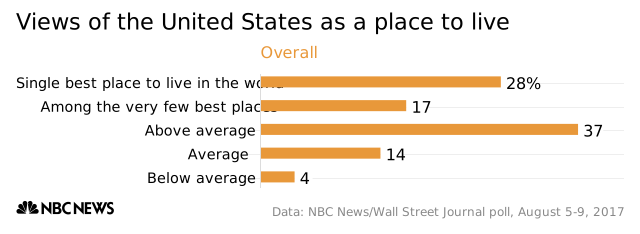
But there is an important group that doesn’t really believe in American exceptionalism: the American public. Here is a result from this week’s Wall Street Journal/NBC poll:

It looks as if most Americans think the US is above average as a place to live (I agree, by the way), but that just over a quarter think it’s the single best place in the world. Asked to rate the “national character,” the median respondent gives us a score of 5 out of 10, down from 6 out of 10 in 1998. This survey question makes no explicit mention of other countries, and it’s possible that people would rate every other nation’s character lower than ours–but that seems unlikely for the people who rate us 5 or lower.

The claim that America is “is freer and more democratic than any other nation” is empirical. It begs for comparative statistics. Freedom House rates the US 89 on freedom, a good score but 11 points below Sweden’s perfect 100. Maybe they’re wrong, but ranking the US number one in the world certainly requires evidence. It’s not a test of patriotism but a hypothesis about the world.

One might focus instead on prosperity and economic dynamism. But the enormous comparative advantages that we held as result of the Second World War have faded away, and we now represent just 4% of the population of a competitive world in which lots of nations, small and large, inevitably score economic successes.

This gap between a rhetoric of unique superiority and the facts seems to cause profound anxiety. In 2016, Trump positioned himself as the candidate who believed that the US should be better than every other nation but had lost that status due to feckless politicians. He often asserts that we are worse off today than anyone else–for example, that our tax rates are uniquely high, as if we were the socialist exception in a neoliberal world. Clinton took the view that we were “already great.”

Both positions could be seen as responses to anxiety. Valid criticisms of the American past (slavery and segregation, especially) have perhaps fueled this anxiety by suggesting that we were never exceptionally great to start with. That’s a raw point for people who think that our exceptionalism is threatened.

Three issues to think about:

  • To what extent is the US actually “exceptional”–not in the sense of better, but different? We are unusual (but not actually unique) in our degree of racial diversity. We have the oldest constitution in the world. We have no way to call an early election to end a failing administration. We have never had a socialist government, but our left has a robust alternative tradition of pluralist populism. We are the birthplace of the Civil Rights Movement and its philosophy of politics. We fought a civil war over the question of slavery in which 750,000 died. We tend to think of ourselves as a commercial republic instead of, for example, a social democracy, a social market economy, or a consensus model. We may once have had a high degree of economic mobility, but now we do not. We once had a very strong voluntary sector, but it, too, is now probably weaker than those in other nations. We are a Petri dish for new religions, some messianic in nature; and we are more religious than other advanced economies. These are just examples of ways that we are, or once were, unusual.
  • Underlying most claims of exceptionalism are normative positions: assertions that some aspects of our society are not just unusual, but valuable. What values that are plausibly associated with the US are worthy of praise? Should we be proud because we have a tradition of laissez-faire economic policies? Or because of the New Deal and its legacies?
  • What attitude should an American citizen hold toward the US Republic? Favoritism over other countries? An even-handed and detached stance toward the US as just one of many countries? For myself, I would say: a special, focused responsibility for awakening the better angels of our nature.

See also: the new history wars; American exceptionalism; British exceptionalism: how the UK is different from Europe; should we teach patriotism?; and a palindrome (a poem on America).

Glendalough

St Kevin had the gift of talking with beasts.
It came naturally to him, a hermit,
Living amongst them in his hollow tree
In Glendalough, long vale of icy lakes.

But just because he and they could converse
Doesn’t mean that everything went smoothly.
“Let me milk you,” he said, “so that I can
Subsist on a diet of doe’s milk and sage.”

She sprang latterally up the heathered hill.
“Absolutely not; never. That’s invasive,
Embarrassing, probably painful, strange.
Find something else to drink, or go back to your kind.”

“Modesty forbids,” he said, “that I
Should apply the word to myself, yet ‘saintly,’
Surely, is the term that simple truth demands.
Didn’t you see how, when they’d gnawed bare the bones

And longed for more–my human multitude–
I had only to pray; then juicy meat reclothed
Each rib that they had stripped to white? I am
listened to; you’d be wise to do what I say.”

But she was gone, her dappled flanks just shimmers
In the fluttering lushness, the cool dampness,
The extravagant, multitudinous greenness
Of the breezy glen with its two clear lakes.

A red fox spoke up. “Large mammals are warned,”
Said he, “to be in their dens or burrows
By nightfall and to avoid all noises
That might disturb or fright the smaller kind.

“Also: no kindling fires or leaving picked bones
In piles, no uncovered waste, odd chanting,
Spitting in the loughs, marching right though nests,
Shouting, shooting, or walking on the grass.”

St Kevin understood where this was headed.
It wasn’t just his personal repute
He had to worry about. There was also
His ministry to pagans and sinners.

He gathered the wary beasts in a ring.
“I’ll live humbly in my hollow tree, making
No demands, restricting my human flock
To the upper vale and ringing their buildings

“With stone walls, as much to hem them in
As your kind out. Let’s just keep today amongst
Ourselves, shall we? Let the story be that Kevin,
Renouncing the world, spoke the tongues of beasts

In Glendalough, that broad, still vale, where leaves
Of every green tremble when the soft rain falls.”

(See also: the scholar and his dog ; for Gerard Manley Hopkins; and The Cliff-Top Monastery by A.B. Jackson)