Author Archives: Peter

About Peter

Associate Dean for Research and the Lincoln Filene Professor of Citizenship and Public Affairs at Tufts University's Tisch College of Civic Life. Concerned about civic education, civic engagement, and democratic reform in the United States and elsewhere.

Sessions and the fate of Herod

In case you missed it, Jeff Sessions defended his policy of seizing children at the border with the words, “I would cite you to the Apostle Paul and his clear and wise command in Romans 13, to obey the laws of the government because God has ordained the government for his purposes.” Sarah Huckabee Sanders then added: “I can say it is very biblical to enforce the law, that is repeated a number of times throughout the bible.”

She was right about that. Characters in the Bible do frequently enforce the law. For example,

Then Herod, when he saw that he was mocked of the wise men, was exceeding wroth, and sent forth, and slew all the children that were in Bethlehem, and in all the coasts thereof, from two years old and under, according to the time which he had diligently inquired of the wise men (Matthew 2:16)

This was the governmental action that made Joseph, Mary, and Jesus into refugees who needed asylum in Egypt.

Herod’s fault was not that he obeyed the law, as Paul advised a small, powerless community to do in Romans 13. Herod’s problem was that he was the law, and he saw his status as the king as the guarantee that his discretionary decrees must be right.

This was a habit that didn’t end well for him:

Now about that time Herod the king stretched forth his hands to vex certain of the church.

And he killed James the brother of John with the sword. …

And when Herod had sought for [Peter], and found him not, he examined the keepers, and commanded that they should be put to death. And he went down from Judaea to Caesarea, and there abode.

And Herod was highly displeased with them of Tyre and Sidon: but they came with one accord to him, and, having made Blastus the king’s chamberlain their friend, desired peace; because their country was nourished by the king’s country.

And upon a set day Herod, arrayed in royal apparel, sat upon his throne, and made an oration unto them.

And the people gave a shout, saying, It is the voice of a god, and not of a man.

And immediately the angel of the Lord smote him, because he gave not God the glory: and he was eaten of worms, and gave up the ghost. (Acts 12: 1-2, 20-23)

This situation also raises issues of church and state. The US government should not cite a biblical verse as justification for a policy, because that “establishes” one religion. Arguably, that means that a reporter shouldn’t ask Sarah Sanders whether the Bible justifies seizing children at the border. It’s an irrelevant question to direct at a representative of the US government. If Sanders is asked that question, her answer should be, “I speak for the White House, and we don’t address questions of religious doctrine.” Sessions shouldn’t cite Rom. 13 to justify his policy, even if that were a good reading of the Bible. Finally, I shouldn’t take his religious claim seriously enough to attempt to rebut it on religious grounds.

My view of church and state is a little less stringent than the above. Sessions cited Romans in response to an eloquent letter by members of his own religious community that denounced his policy on theological grounds. I think citizens are entitled to petition the government in religious language, and if an employee of the government disagrees with a theological claim, he or she may address it. Thus Sessions was not wrong to cite the Bible in the particular context he did, as a response to a religious petition directed at him. But his reading of the Bible opened him to theological charges of blasphemy and idolatry.

See also a plea to conservatives and why Donald Trump is anti-conservative.

call for papers: New England Philosophy of Education Society

The New England Philosophy of Education Society will meet at Tufts on Oct. 20, co-sponsored by Tisch College. Proposals are due on July 15, emailed to nepes2018submissions@gmail.com. More details here.

The theme is the “Self in Relation: Ways of Knowing, Naming, and Acting.”

NEPES seeks papers that respond to the theme as it speaks to specific or broad interpretations. Alternatively, you are welcome to submit any work that deepens our studies of philosophy and education. Finally, an unusual component of [Sheri] Leafgren’s work is that it engages with philosophical questions qualitatively and draws on philosophy to make sense of the author’s own experience as a teacher in a school. With this in mind, we welcome proposals that play with the intersections between philosophy and practice as well as papers that explore philosophy and education from a range of sub-disciplines.

The keynote is by my friend Larry Blum, author of “I’m Not a Racist, But …”: The Moral Quandary of Race (Cornell UP), High Schools, Race, and America’s Future (Harvard Education Press, 2012), and many other works.

can the arts mitigate the harms of gentrification? A project in Boston’s Chinatown

I’m working with an interdisciplinary team* on a project that’s investigating whether an arts center in Boston’s Chinatown can mitigate the negative effects of gentrification in that neighborhood. This research is funded by the NEA and by Tufts (through a “Tufts Collaborates” grant). Here are some preliminary notes, with which my colleagues may not necessarily agree. We have much more data to collect, analyze, and discuss.

The setting is Boston’s Chinatown. The Asian population of the neighborhood has declined, the median income of Whites in the neighborhood has more than doubled, but the percentage of Asian households living in poverty has increased. These could be seen as signs of gentrification.

The Pao Arts Center is a new “multi-functional arts space with a performance theater, an art gallery, classrooms, an artist-in-residence studio, and other public meeting space[s].” It has been created within a very large, multipurpose new building that includes affordable housing along with expensive apartments (which have a separate entrance). The building reflects the shift toward more expensive, modernist, large-scale development in Chinatown. It also belongs to a community-based nonprofit, the BCNC [correction: the Asian Community Development Corp. was the community developer; BCNC leases the space for Pao] that offers programs to about 2,000 families and is committed to retaining the cultural heritage of the neighborhood and combating dislocation, isolation, and conflict.

You might begin thinking about this project with the following model in mind:

  1. Gentrification disrupts community connections, which causes harmful social outcomes (apart from any other outcomes that gentrication may have). But
  2. The arts can strengthen community connections, thus mitigating the damage done by gentrification.

But the emerging data complicate this model.

The neighborhood is dynamic. People move in and out as both a cause and a consequence of economic change. It’s possible for an individual to remain in Chinatown and move on a trajectory of upward (or downward) mobility, while assimilating (or not assimilating) to the dominant culture. It’s also possible for an individual to leave in order to take advantage of a desired opportunity–or as a matter of necessity, due to rising rents.

The whole neighborhood could be characterized as historically Chinese-American. It was never like a traditional community in China; it was an enclave of Victorian tenement buildings, manufacturing plants, and restaurants catering to outsiders in an East Coast US city. One evident change is that it’s becoming much more pan-Asian. Does that preserve its heritage as an ethnic enclave or spell the end of “Chinatown” per se?

By no means everyone in Chinatown embraces the concept of “gentrification.” I think that word is almost always defined as a negative trend, a process of disruption or displacement caused by outside forces and suffered by residents of a neighborhood. In We Were Eight Years in Power, Ta-Nehisi Coates calls gentrification “a more pleasing name for white supremacy.” (But see also his nuanced piece on the same topic from 2011). However, there is a different discourse that emphasizes economic growth and development and upward-mobility. Some people in Chinatown see rising rents and residents moving out to suburbs as signs of progress, attributable to their own success rather than outside forces.

The neighborhood is certainly changing its physical form. Even presuming that most tenants of the new BCNC high-rise are Chinese-American former residents of other Chinatown buildings, the sheer design and aesthetic of their home are new. There are similar buildings in modern Shanghai (and in modern Dubai and Mexico City), but not in a traditional Chinese-American neighborhood in a Northeastern city like Boston. Is this preservation? Development?

Likewise, the Pao Arts center is devoted to Asian arts, but its minimalist and functionalist architecture could be seen as modernist, cosmopolitan, placeless, or specifically “Western,” depending on your interpretive frame. Pao probably feels different to people of different backgrounds.

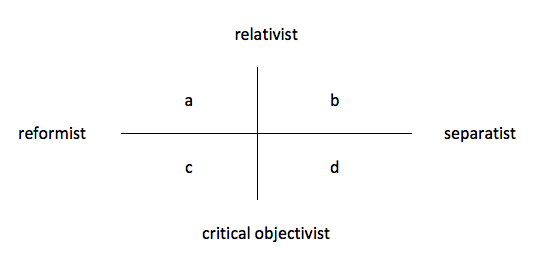
There may also be differences between groups that I will call (with some concerns about these labels) preservationists and integrationists. Preservationists see value in an historic Chinese urban enclave, whereas integrationists may celebrate the arrival of other Asians and non-Asians in Chinatown and the positive effects that occur when Chinatown residents move to suburbs.

These two distinctions produce four possible stances, but in real life, many more options are possible.

To further complicate the model, it’s not a simple case of “the arts” affecting a neighborhood. The Pao Arts Center hosts many events and exhibitions. Our team has been attending the events and conducting surveys, and it seems clear that various events draw different demographic groups and have different purposes and impact. Some performances raise consciousness of social injustice; some are sheer fun. Also, these are not exactly Pao Arts Center productions: Pao is a space that various artists and organizations use.

A series of events at Pao could reconnect people who have moved away from Chinatown to their former neighborhood, give local Chinese residents a reason to stay in Chinatown or mitigate the stress caused by changes in the area, connect people of different Asian backgrounds or of different races to one conversation and one affective community, or serve a diverse set of audiences from the Boston metro area without really having much to do with connections or the immediate vicinity. Pao could contribute to neighborhood economic development, thus accelerating gentrification, or it could consolidate Chinatown’s function as an ethnic enclave. It could do more than one of these things for different people at different times.

We have survey data from audiences, interviews with artists and other key stakeholders, pending surveys of community-members, and expert analysis of the events. We still have to put it all together.

*Cynthia Woo (Pao Arts Center), Ginny Chomitz (Tufts Department of Public Health and Community Medicine), Carolyn Rubin (Public Health and Community Medicine), Susan Koch-Weser (Public Health and Community Medicine), Annie Chin-Louie (Tufts Clinical and Translational Sciences Institute), Noe Montez (Tufts Department of Drama & Dance), Yizhou Huang (Drama and Dance), Yang He (Tufts Department of Urban and Environmental Policy and Planning), and Joyce Chen and Kaiyan Jew (community researchers).

See also changes in how we talk about citiesagainst methodological individualism or why neighborhoods are not like broccoliwhy the Jews left Boston, why the Catholics stayed, and what that teaches us about organizing.

starting the 10th annual Summer Institute of Civic Studies

Today begins the 10th annual Summer Institute of Civic Studies at Tufts’ Tisch College of Civic Life. The draft syllabus–which will be slightly modified in reality–is here. We spend four hours each day discussing the readings and two hours with a daily visitor. Participants come this year from Chile, Ethiopia, Mexico, Pakistan, Spain, the US and Ukraine (not counting US participants of immigrant origin). They include professors, organizers, graduate students, artists, and educators. Their disciplines range from design and English to economics and philosophy, to name just a few–everyone has a unique background. The sister institute in Eastern Europe begins in early July, and I’ll also be there to kick it off. The 20 people coming to Tufts today for the Institute join an alumni body of about 240 people, many of whom are making careers in academia or civil society in about 20 countries.

And here are some of the topics we’re interested in  …

why didn’t the internet save democracy?

I don’t always like this format, but Dylan Matthews’ short interviews with Clay Shirky, Jeff Jarvis, David Weinberger, and Alec Ross add up to a useful overview of the question that Matthews poses to all four: “The internet was supposed to save democracy. … What went wrong”?

The only interviewee who really objects to the framing is Ross, who asserts that his predictions were always value-neutral. He didn’t predict that the good guys would win, only that the weak would chasten the strong. So when Putin’s Russia took Obama’s America down a peg, that fulfilled his prophesy (Russian being weaker).

Some highlights, for me:

Clay Shirky:

I underestimated two things, and both of them make pessimism more warranted. The first is the near-total victory of the “social graph” as the ideal organizational form for social media, to the point that we now use “social media” to mean “media that links you to your friends’ friends,” rather than the broader 2000s use of “media that supports group interaction.”

The second thing I underestimated was the explosive improvement in the effectiveness of behavioral economics and its real-world consequences of making advertising work as advertised.

Taken together, these forces have marginalized the earlier model of the public sphere characterized by voluntary association (which is to say a public sphere that followed [Jürgen] Habermas’s conception), rather than as a more loosely knit fabric for viral ideas to flow through.

Shirky adds that he wrote (in 2008) much more about Meetup than Facebook, when both were still startups. Facebook rules the world and Meetup is marginal. Meetup would better embody a Habermasian theory of the public sphere. (See my post Habermas and critical theory: a primer but also saving Habermas from the deliberative democrats.)

Jarvis:

I was rather a dogmatist about the value of openness. I still value openness. But as Twitter, Blogger, and Medium co-founder Ev Williams said at [South by Southwest] recently, he and we did not account for the extent of the bad behavior that would follow. These companies accounted and compensated for dark-hat SEO, spam, and other economically motivated behavior. They did not see the extent of the actions of political bad actors and trolls who would destroy for the sake of destruction.

Weinberger:

It’s a tragedy that while the web connects pages via an open protocol, the connections among people are managed by closed, for-profit corporations. A lot of our political problems come from that: The interests of those corporations and of its users and citizens are not always aligned.

Weinberger wants to emphasize the positive, as well, and to remind us that “applications can be adjusted so that they serve us better.”

See also the online world looks dark (2107) and democracy in the digital age.