young voters in Iowa

We’re working on a press release to report that young people (ages 18-29) quadrupled their turnout in the Iowa Caucuses, compared to 2000. They voted at considerably higher rates than the 30-44 age group and represened almost as big a proportion of Caucus goers (17%) as of adult Iowa citizens (20%). If youth always participated at this rate, the 40 million Americans between the ages of 18 and 30 would be a major voting bloc.

There’s another lesson for those of us who are interested in youth participation: young people may vote, but they aren’t predictable. Slate quotes one Dean precinct captain who said, “I think if we could blame [Dean’s loss] on anyone, blame it on the 18- to 25-year-olds, because they were nonexistent.” Actually, they existed, and they turned out, but 35% of them went for Kerry and only 25% for Dean.

What stories are worth reporting

Christopher Dickey, who covers Iraq for Newsweek, has decided against carrying a gun when he’s in Baghdad. He doesn’t think it would make him any safer. But he recognizes that reporters are in danger there; 19 have died so far. And he’s increasingly unsure that it’s worth risking journalists’ lives to report the news from Iraq to an indifferent public. The TV networks have already cut their daily Iraq report to just over five minutes a day; and the public also seems to be losing interest. Dickey writes: “As my friend the newspaperman told me on a brief visit back to the States, ‘You talk to people here about what’s happening in Iraq and their eyes glaze over after two seconds. I mean, even members of your own family!'”

Dickey mentions deaths (of American military personnel and Iraqis) as topics that reporters do and should cover. But do we need such directly observed reports of violence in Iraq? Perhaps–failure to report casualties might give the impression that things were going better than they are, and it would prevent the public from mourning the dead. On the other hand, some might say that Americans are rightly somewhat inured to such stories. Perhaps we need a different kind of reporting: journalism that discusses deeper and more lasting issues.

I personally am not interested in detailed accounts of the latest car-bombings, but I do want to know how well Americans are doing at nation-buildng. If our soldiers and officers are doing a great job “on the ground,” that is a story that should be celebrated as a model for civic work at home. If things are not going well, we should learn from their mistakes. Journalism about nation-building would be dangerous, and it might be overlooked by many Americans; but perhaps it would be more valuable than blow-by-blow descriptions of violence.

the publicity game

We succeeded in getting some publicity for the survey that we released yesterday: articles in Reuters, Yahoo News, Washingtonpost.com, UPI, and USA Today, and an interview on CBS radio news. I was glad, because we wanted to publicize the survey so that people would be aware of it. Besides, we are held accountable for getting press coverage. That is why we spend significant amounts of money on a professional public relations firm.

I recently posted several critical comments about the pursuit of fame. I am well aware of the irony that days after I wrote those posts, I struggled to craft press releases that would maximize attention.

Continue reading →

young people and Internet campaigns

We released a survey today that contains a lot of data about young people–their

civic and political behavior and attitudes, and specifically their reaction to

the ways political campaigns are using the Internet.

Campaigns are effectively using the Internet to reach young people, and will

continue to do so.
But is this because young people are computer-savvy and demand Internet based

campaigns? Or is it because campaigns see advantages to a cheap medium that

can reach and expand their base (more cost-effectively than broadcasts and

mass mailings)? Overall, our data show that young people are not particularly

favorable toward new, online campaigns techniques. They favor some approaches

but oppose others.

Despite a general lack of enthusiasm for many online campaign techniques,

however, there are some pools of young voters who do like the new technologies.

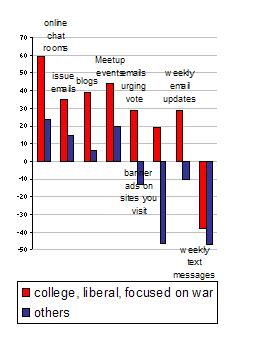
For example, those college students and college graduates who are liberal

and concerned about the War in Iraq are overwhelmingly aware of blogs and

favor their use in campaigns by 68%-32%. This group also likes “banner ads”and

weekly email updates, which are unpopular among youth in general.

The graph shows the percentage who like each campaign technique, minus those who don’t like it or call it a “turn-off.” We distinguish liberal college students who are concerned about the war (red bars) from other youth (blue).

These findings put the Dean phenomenon in context. The demographic group

that most likes his campaign themes is also most favorable toward electronic campaigning.

It is not at all clear that blogs and Meetup events would work nearly as well

for other candidates. Given that strong partisans and well-educated youth are most enthusiastic about the new technologies in politics, the Internet looks like a means to organize core voters, not a way to expand the franchise

do business schools belong in universities?

I often ask myself this question as I arrive at work, since my office is in a building dominated by a business school. I’m all for programs that train effective business executives. But should these programs be subsidized by state universities and nonprofit institutions? Should they use academic norms such as tenure and peer-review? Why not just have for-profit training academies? There may be a great case for academic business schools, but I’m not sure.

Continue reading →