two paths to abstraction

1. At first, artists depict the world as they think it actually is. They even show heaven and other eternal and transcendent scenes in terms of their own times, places, and styles. Then they realize that they have a manner, a method, and a style of representation; and many such styles are possible. They learn to imitate art from distant places and times, which requires a certain sympathy or compassion. Their ability to represent the world as depicted by others reduces their attachment to their own style, which begins to seem arbitrary. For example, it seems arbitrary that the center of a flat piece of art should always appear to recede into the distance, and that one side of each object should be visible. Why not show all the sides at once, as in cubism? Gradually, artists’ enthusiasm for any form of representative art diminishes. One important option becomes renunciation, in the form of minimalism and abstraction. Showing the world in any style means embodiment; but the mind can transcend the body. True art then becomes not the naive representation of the world, nor a sentimental imitation of someone else’s naive style, but just a field of color on a canvas. That seems the way to make the artist’s arbitrary will and narrow prejudices disappear, and beauty appear.

2. The Buddha’s “Karaniya Metta Sutta,” translated by the Amaravati Sangha:

Even as a mother protects with her life

Her child, her only child,

So with a boundless heart

Should one cherish all living beings;

Radiating kindness over the entire world:

Spreading upwards to the skies,

And downwards to the depths;

Outwards and unbounded,

Free from drowsiness,

One should sustain this recollection.

This is said to be the sublime abiding.

By not holding to fixed views,

The pure-hearted one, having clarity of vision,

Being freed from all sense desires,

Is not born again into this world.

The image is Ad Rheinhart, “Abstract Painting” (1951-2). (Rheinhart, influenced by Zen through his friend Thomas Merton, sought to make painting as “a free, unmanipulated, unmanipulatable, useless, unmarketable, irreducible, unphotographable, unreproducible, inexplicable icon.”)
what the Dickens?

“I don’t care whether I am a Minx or a Sphinx”

— Charles Dickens, Our Mutual Friend

Tired of those ugly and complicated web page addresses? This site will convert any URL into a random quotation from the works of Charles Dickens. For example, instead of using the awkward address of my blog, you can enter http://dickensurl.com/7e94/I_dont_care_whether_I_am_a_Minx_or_a_Sphinx and find yourself right back here. Bookmark it!

This is a silly example, but there are significant issues regarding domain names. When I first became interested in technology policy around 2000, I thought that simple, memorable names were going to be scarce resources that the rich and powerful would monopolize. I still think it is valuable to own, say, Boston.com (even though the current owner is the poor beleaguered Boston Globe). But it turns out that there are so many billions of web pages–often automatically generated from databases–that people can’t remember URLs or tell them to each other. Instead, we rely on tools to find sites, and the most influential tools are search engines. A high Google-ranking is more valuable than a catchy domain name. That means that the policies and algorithms used by the major search engines deserve constant scrutiny.

making the youth voting problem go away

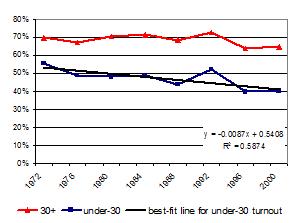
CIRCLE was founded in 2001 because of widespread concern that civic engagement was in decline, and a feeling that youth were the heart of the problem. Although everyone defined “civic engagement” as more than voting, the voting trend was a common symbol of the issue. The graph below shows turnout for young and older adults between 1972, when the voting age was lowered to 18, and 2000, just before CIRCLE was launched. Older adults’ turnout stayed pretty steady, but under-30s were in steady decline. A straight line would track the actual youth trend pretty closely and would decline by almost one point per year, or 3.58 points per election cycle. (If you discard 1992 as an outlier, the r-squared is .89.) We seemed to have a generational problem.

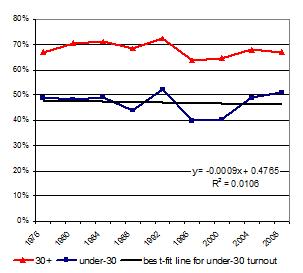
But 1972 could be considered an anomaly. Young people had just won the right to vote, with much hoopla. There was still a draft and the Vietnam War was deeply unpopular. So we might discard 1972 as a baseline year. Besides, we now have data from 2004 and 2008. This is how the trend looks if we chose to run it from 1976-2008.

Ipso presto, the youth voting decline has vanished! No straight line can track the youth trend very well, but the best-fit line hardly declines at all (one tenth of a point per year). It now looks as if the norm is a steady youth turnout rate of around 48%, and the late 1990s represented an unusually low period that could be attributed, perhaps, to the specific campaigns and politicians of that era.

Well, there are lies, damned lies, and statistics. We shouldn’t be allowed to make a problem appear or disappear by changing the parameters of a graph. But I would venture that declines and other changes over time are not nearly as striking as stability. We don’t seem to be able to get more than half of young people to vote. Just about half of young people attend college, and education and political activity correlate–not perfectly, but strongly. College attendance hasn’t risen; and within families, socioeconomic status tends to replicate itself. To me, the central issue is neither decline nor growth, but deep and persistent inequality.

(Another problem–harder to quantify but described in Harry Boyte’s editorial from yesterday–is a lack of civic opportunities other than voting.)

we’re the ones we’ve been waiting for

Harry Boyte wrote an op-ed for the Minneapolis Star-Tribune on Sunday entitled “The work before us is our work, not just his.” Boyte begins:

    Over the first 100 days of his presidency, Barack Obama changed his message from “we” to “I.” The challenge for the president, if he is to achieve his administration’s potential to unleash the energy of the nation, is to return to and flesh out “yes, we can” in the everyday work of addressing our common problems.

    Obama launched his campaign for president with the idea that “all of us have responsibilities, all of us have to step up to the plate.” He had learned a philosophy of civic agency — that we all must become agents of change — from his days as a community organizer in Chicago. And in extraordinary ways, he used the presidential campaign as a vehicle for taking the message of agency to the nation. … The message was expressed in campaign slogans such as “we are the ones we’ve been waiting for,” drawn from a song of the freedom movement of the 1960s. …

    On Wednesday night, at the news conference marking the first 100 days of his administration, Obama was asked what he intends to do as the chief shareholder of some of the largest U.S. companies. “I’ve got two wars I’ve got to run already,” he laughed. “I’ve got more than enough to do.”

    The change has partly reflected the administration’s adjustment to the fierce pressures of the Washington press corps. As Peter Levine noted as early as December 2006, reporters and pundits assumed that Obama’s words about citizenship and involvement “were just throat-clearing.” Journalists and pundits constantly demand that he explain what he is going to do to solve the problems facing the country.

    But the general citizenry outside of government is not composed of innocent bystanders. In our consumer-oriented society, we too easily assume that government’s role is to deliver the goods. Dominant models of civic action, as important as they are–deliberation, community service, advocacy–fit into the customer paradigm, as ways to make society more responsive and humane. The older concepts at the heart of productive citizenship–that democracy is the work of us all, that government is “us,” not “them”–have sharply eroded.

The Administration needs our help making a rhetorical shift back toward “we,” and matching that rhetoric with real programs and policies that will allow Americans to play more active and constructive roles. The Kennedy Serve America Act is a step in the right direction–although high-quality implementation will be a challenge. But much more ambitious initiatives are necessary, and they need to go beyond “service.”

what shape is a field of vision?

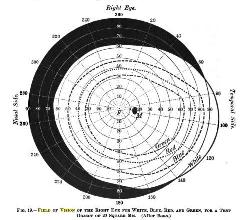
At an idle moment recently, I was wondering what shape my field of vision has. A quick Google search took me to Alexander Duane’s and Ernst Fuchs’s 1899 textbook of ophthalmology, which is online. I am sure there is much more recent work–both empirical and conceptual–but I didn’t explore it. Instead, I began to speculate that this is a fairly complicated question.

My first responses were in terms of two-dimensional spaces–for instance, I thought that perhaps my field of vision was an oval with a perturbation around my nose. It’s oval rather than round because I have two eyes, and each has a separate field like the one pictured here. Putting them together creates an oval. So if you wanted to represent what I can see, you would take a wide-angle photo from my vantage point and cut out a roughly oval shape.

But my retinas are three-dimensional, as is the world they see. So should we say that my field of vision is a section of an ovoid with some irregularities created by my nose, eyebrows, and hair? Even that that answer seems oversimplified, since my eyeballs are capable of focusing at different depths (and even rolling around, although that might be forbidden in a test of one’s field of vision); and the world itself is not pasted on the inside of an oval–it extends into the distance. If we said that the shape of my field of vision was roughly ovoid, how big would that ovoid be? The night sky that is sometimes part of it is awfully far away. And I haven’t even mentioned that we see moving things and bright colors more easily than stable, dull things. By now, it’s beginning to sound as if my field of vision has no shape. But surely that can’t be right; my vision has limits and moves as I change my orientation. We’ve begun talking about the world, not what I see of it.

By the way, it is interesting how easily we accept a photograph as a representation of vision, even though it is flat and rectangular, whereas our field of vision is–at the very least–irregular and vaguely bordered.

Wittgenstein seems to want us to dispense with the goal of analogizing inner experience to something else, as if everyday experience required some explanation on terms other than its own:

    And above all do not say ‘After all my visual impression isn’t the drawing; it is this–which I can’t shew to anyone.’–Of course it is not the drawing, but neither is it anything else of the same category, which I carry within myself. … If you put the ‘organization’ of a visual impression on a level with colours and shapes, you are proceeding from the idea of the visual impression as an inner object. Of course this makes this object into a chimera; a queerly shifting construction. For the similarity to a picture is now impaired. — Philosophical Investigations, translated by Anscombe, IIxi.

For Wittgenstein, I take it, a field of vision has no shape, and we only feel that that’s strange because we are in the grip of a model of vision as inner photography. It’s actually something else entirely. And yet I keep returning to my initial thought that what I see is an oval with my nose intruding from the bottom.