the evasive passive

(In Providence, RI, for a Civic Education Institute) Tony Judt recently wrote a New York Times op-ed decrying the Israeli settlements in the West Bank. Abraham Foxman of the Anti-Defamation League played his customary role by providing an angry letter of rebuttal. The substance of his letter begins, “Isrealis settled in the West Bank because it was deemed part of the historic home of the Jewish people. …”

I love “it was deemed.” That must have taken a while to come up with. Consider the alternatives. “The settlers deemed that the land was theirs”? That sounds a little imperialistic, doesn’t it? “The Israeli government deemed the land useful to them”? Not a helpful message for the ADL director to publish in the Times. “God gave the land to Jews forever”? Some people believe that–some Jews and some fundamentalist Protestants. It’s not, however, a line that Mr. Foxman wants to take, nor does it have a lot of force in international law or diplomacy.

Thus the passive–the great, responsibility-ducking passive–followed by a few strong active sentences with Arabs as the subjects. (“They rejected opportunities for peace.” “[T]hey rejected the United Nations resolution …”) So they did (those few with the power to make decisions); but the Isreali government also made choices, and now the mess is theirs.
service as a path to educational success

(San Francisco) I gave a presentation and moderated a session at the National Conference on Volunteering & Service yesterday. The topic was equity. But I’d rather describe a different panel, one that I attended as a member of the audience. The topic was service as a key to enhance student achievement. Angela Glover Blackwell was the moderator, and she started with an eloquent statement in favor of tapping students’ energies to address social problems and thereby give them skills and motivations for learning. She said that all the excellent social programs she knows include a dimension of civic engagement, because programs work best when people “own” them. She cited Harlem Children’s Zone as a model and referred to a new federal program, Promise Neighborhoods, that intends to replicate that model. Unfortunately, James Shelton III from the US Department of Education had to miss the panel at the last moment and so could not address that initiative.

Lisa Spinali, a friend of mine, talked about a large program that matches volunteers to schools in San Francisco (it is called San Francisco Volunteers, and she’s the executive director). There has been a gradual shift from placing anyone with an interest in a school to identifying real needs and finding the right skills. Early on, San Franciscans might offer to teach macrame and guitar and would be sent to a classroom. Today, a corps of bilingual volunteers translates at parent/teacher conferences.

Anthony Salcito works for Microsoft. He used the formula that I associate with the Gates Foundation: rigor, relevance, and relationships. These “three-r’s” are too often lacking in our schools. Salcito took the line that “service-learning” (combinations of academic study with community service) would help with rigor, relevance, and relationships.

Eric Schwartz from Citizen Schools made the case that the school day and school year are too short; there should be more learning opportunities for all kids during an expanded learning day. Citizen Schools creates a “second shift” of learning, with lots of interactive and fun projects. Volunteering comes into play in two ways. The “second shift” is substantially provided by unpaid volunteer adults and by AmeriCorps members. And the kids do, among many other activities, some service-learning.

state and local spending

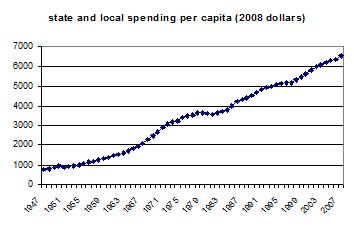
(San Francisco) There is a lot of talk about deep cuts in state and local government spending, only partly offset by the federal stimulus. Here is a historical graph of total state and local expenditures, adjusted for inflation and for population growth:

[revised, 10:30 am Eastern Time] The growth has been fairly continuous, apart from a dip in real spending in the Reagan years. Adjusted spending in 1982 was lower than in 1978, despite sharply increased need because of the recession. I don’t know for sure, but I suspect that at other times, the growth has been driven by: health entitlements, prison costs, and higher education (in descending order of magnitude). Spending for other purposes is probably close to flat.

Both the standard liberal and conservative narratives are a little off. Liberals are wrong to say that we’ve just lived through a period of conservative retrenchment in which local and state governments have shrunk. Expenditures are much bigger in real terms than they were in the liberal 60s. But conservatives are wrong to complain about a growing “welfare state.” If most expenditures cover prisons, education for relatively advantaged young adults who can attend college, and medical technology, this is hardly “welfare”–even broadly defined.

The data I could find ended in 2007. We’ll see what happens next.

in-flight nostalgia

(On a plane from Boston to San Francisco) I spent every childhood summer in England–in a different home almost each year–and have returned there repeatedly in adulthood. Whenever a long time passes without a visit, I feel subtle nostalgia growing. Here’s the kind of thing I miss:

A summer morning, cool enough to require a sweater and jacket outside. The sky has been light since 4 am. The bathroom window is almost always a frosted pane of glass on a hinge, set in a thick stone wall. There’s no screen, because there are hardly any mosquitoes. Open the hinge and damp air flows in, carrying strong smells of pollen, rich soil, and new growth–even in the heart of London, although there you can detect engine exhaust as well.

The hot and cold water flow from separate taps, the hot coming directly from a gas heater overhead. It steams in the sink. There’s never a shower, just an elaborate coil of metal pipes that hangs on the side of the tub along with a steel basket for the soap. Because of the high voltage, the electrical outlets are big plastic boxes with on/off switches. Layers of paint cover old wallpaper; wires are tacked to the baseboards. Cleansers give the room an ineffably British smell.

The staircase is long and narrow. Bacon is thick and intensely salty. Tea is strong. The insides of the mugs are tea-stained. The grass is luxuriously thick and green. Cumin wafts from restaurant doors, and the glittering cement pavements are sticky from last night’s spilled beer. An unmarked white delivery van rushes past, pinning you against a bowed stucco wall. Tattered music billboards, surveillance cameras, Oxfam and Barclay’s Bank on the High Street, black fences topped with spears, zebra crossings, beds of lavender and rosemary bushes.

people power in Iran

(Hartford, CT) I think the Iranian regime has doubled down, betting the very principle of clerical authority on the assumption that they can crush or outlast the protests. Ayatollah Khamenei denied that the election could have been rigged: “There is 11 million votes difference,” he said. “How can one rig 11 million votes?” He could have kept a low profile, called for negotiations, or tried to persuade one of the candidates to quit. Instead, he decided to force the issue. Evidently, either …

1. The election was rigged at a high level, not where the ballots were collected but where the results were announced. In that case, the whole regime is illegitimate on its own terms. Or …

2. President Mahmoud Ahmadinejad actually got the most votes, but there is still massive discontent, probably because the field of candidates and issues was sharply limited in the first place.

The two outcomes that I have seen discussed most are a victory for Khamenei, Ahmadinejad, and the militias, followed by further repression, or a victory for Mir Hossein Mousavi, whose policies would be incrementally less bellicose and more liberal. But I think there are several other possible outcomes, including a rapid drift in a more liberal direction (out of Mousavi’s control); a rapid drift in a different direction, such as toward some kind of left-populism; or a long period of conflict, including possibly a civil war. We should all wish the Iranian people the best in this critical, dangerous, hopeful moment.

Meanwhile, I continue to be moved by the self-discipline of their massive popular movement. According to a Mousavi supporter quoted by Juan Cole:

    … the dynamics of this movement are becoming more and more creative. From the moment everybody embraced silence as the best form of criticism, supporters from their cars switched from honking their horns to using their flasher. Last night, as I drove home, I noticed the blinkers in oncoming traffic (coming actually from the direction of Haft-e Tir Square). I didn’t take long to spread the message. Soon, everyone around was switching their flasher on, an act reflective of a truth that has been firmly established now after five consecutive days of protest: silence is speaking very loudly indeed. …

    The posters of Mousavi of day one have given way to posters expressing deeper themes, and the deeper problems that exist in this country. “Democracy does not equal Dead Student”, “Stop Killing Us”, “We are not rioters”, “Silence is not acceptance”, “The key to victory: Calmness, Hope and Patience”. …

    About the march: it was entirely silent and peaceful.