I’m at the University of New Hampshire for a conference entitled “No Better Time: Promising Opportunities in Deliberative Democracy for Educators and Practitioners.” By my unofficial count, more than 200 people [actually, 270] have convened here: college educators, grassroots community organizers, and scholars. The sponsors are the Deliberative Democracy Consortium and The Democracy Imperative, two organizations whose boards I serve on. We’re just starting but I am very excited by the group gathered here–its sheer size (considering that people had to pay their own way to get here) and its strength. Ten years ago, an open meeting with this framework would have drawn a much smaller and less experienced crowd.
a tendency to generic thinking
When we try to think seriously about what should be done, we have a tendency or temptation to think in generic terms–about categories rather than cases.
- In social science, quantitative research evidently requires categorization; it is the search for relationships among classes of things.
- In applied philosophy/ethics, most of the discussion is about categories that can be defined by necessary and sufficient conditions, e.g., abortion, war, marriage. Thinking about categories allows what Jonathan Dancy calls “switching arguments.” For instance, you decide what is good about heterosexual marriages, and if the same reasons apply to gay marriages, you should favor them as well. By thinking categorically, you can switch from one case to another.
- In policy analysis, lots of research is about generic policies: vouchers, foreign aid payments, prison sentences. I should, however, note the important exception that some scholars study major individual policies, such as the decision to invade Iraq or the No Child Left Behind Act.
- In ideological politics, the underlying values are strong general principles, e.g., “markets are good” or “there should be more equality.” Categories of policies are then used as wedges for advancing an ideology. For example, libertarians promote school choice in order to demonstrate that markets work better (in general) than governments.
I have a gut-level preference for particularism: the idea that, in each situation, general categories are “marinaded with others to give some holistic moral gestalt” (Simon Blackburn’s phrase). That implies that applying general categories will distort one’s judgment, which should rather be based on close attention to the case as a whole.
I will back off claims that I made early in my career that we should all be thorough-going particularists, concerned mainly with individual cases and reluctant to generalize at all. My view nowadays is that there are almost always several valid levels of analysis. You can think about choice in general, about choice in schooling, about charters as a form of choice, or about whether an individual school should become a charter. All are reasonable topics. But the links among them are complex and often loose. For instance, your views about “choice” (in general) may have very limited relevance to the question of whether your neighborhood school should become a charter. Maybe the key issue there is how best to retain a fine incumbent principal. Would she leave if the school turned into a charter? That might be a more important question than whether “choice” is good.
The tendency to generalize is enhanced by certain organizational imperatives. For instance, if you work for a national political party, you need to have generic policy ideas that reinforce even more generic ideological ideas. The situation is different if you are active in a PTA. Likewise, if you are paid to do professional policy research, you are likely to have more impact if your findings can generalize–even if your theory explains only a small proportion of the variance in the world–than if you concentrate on some idiosyncratic case. On the other hand, if you are paid to write nonfictional narratives (for instance, as a historian or reporter), you can focus on a particular case.
I’m inclined to think that we devote too much attention (research money, training efforts, press coverage) to generic thinking, and not enough to particular reasoning about complex situations and institutions in their immediate contexts. There is a populist undercurrent to my complaint, since generic reasoning seems to come with expertise and power, whereas lay citizens tend to think about concrete situations. But that’s not always true. Martha Nussbaum once noted that folk morality is composed of general rules, which academic philosophers love to complicate. Some humanists and ethnographers are experts who think in concrete, particularistic terms. Nevertheless, I think we should do more to celebrate, support, and enhance laypeople’s reasoning about particular situations as a counterweight to experts’ thinking about generic issues.
the new media literacies
The old “media literacy” meant being able to understand a news broadcast or a commercial; having some idea how it was constructed and how it might manipulate you; being able to choose reliable and relevant broadcasts and avoid junk. Those are still good skills to have. But the new “media literacies” include things like “digital storytelling”–being able to tell a story using words, images, and sound on a website–designing a digital game, or writing a text document online with lots of collaborators.
These are active skills, befitting a more active media environment. They are also highly challenging, and it is definitely not true that “young people today” know how to use them effectively. Quite the contrary–teenagers are less likely than some older groups to spend time doing these things, and I have often found them intimidated by the combination of tech skills and civic/political skills that you need to be effective.
But here are two amazing toolkits people of all ages can use to learn the new media literacies.
1. Puget Sound Off, a great social network for youth in the Seattle area, now has a set of “interactive videos to help you master blogging, digital storytelling, and other multimedia skills.”
2. The New Media Literacies Project at MIT has a large library of training videos and games that are designed to be combined, augmented, and amended by a community of users.
I think this field is in its infancy and we are just learning what skills are important and how to teach them. The best learning is experiential, and I’ve gained a lot from interactions with both of the projects listed above.
New Book: Engaging Young People in Civic Life
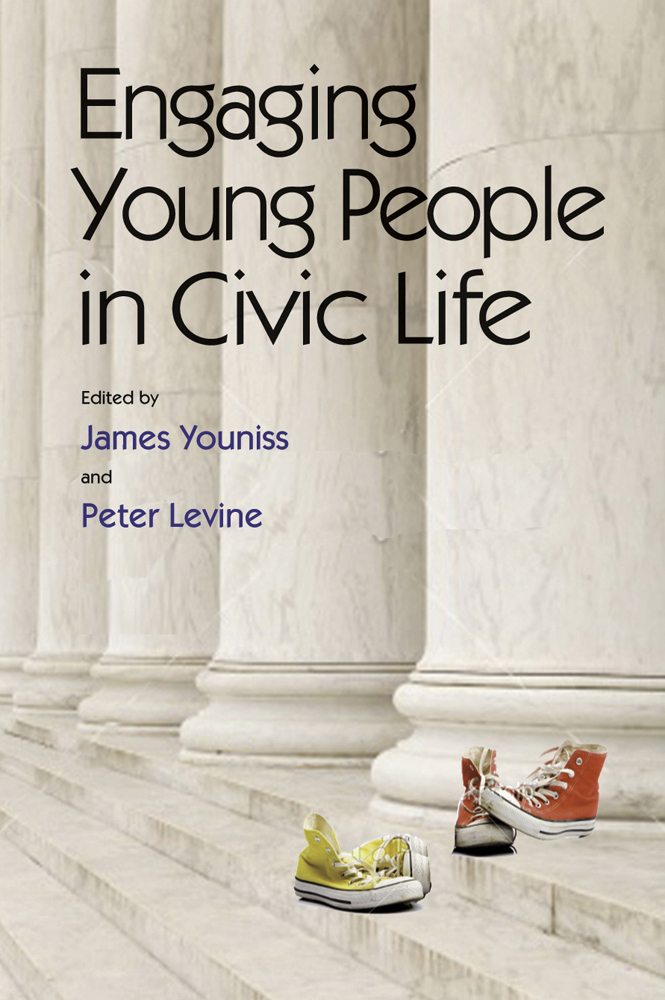
Vanderbilt University Press has published Engaging Young People in Civic Life, edited by James Youniss and me, with a forward by former United States Representative Lee Hamilton.
In the forward, Hamilton writes, “I can think of no task more important for the future of American democracy than teaching young people about our system of government and encouraging them to get involved in politics and community service. … Engaging Young People in Civic Life is tough-minded, data-driven, and unsentimental. It is full of concrete policy proposals for schools, municipalities, service programs, and political parties. It offers all the appropriate scholarly caveats and qualifications. But at its heart, it is a plea to revive American democracy by offering all our young people the civic opportunities they want and so richly deserve.”
Table of Contents
Foreword – Lee Hamilton
Introduction. Policy for Youth Civic Engagement – Peter Levine and James Youniss
Part I. Youth and Schools
Chapter 1. A “Younger Americans Act”: An Old Idea for a New Era – James Youniss and Peter Levine
Chapter 2. Democracy for Some: The Civic Opportunity Gap in High School – Joseph Kahne and Ellen Middaugh
Chapter 3. Principles That Promote Discussion of Controversial Political Issues – Diana Hess
Part II. Political Environments: Neighborhoods and Cities
Chapter 4. Policies for Civic Engagement Beyond the Schoolyard – James G. Gimpel and Shanna Pearson-Merkowitz
Chapter 5. Civic Participation and Development in Urban Adolescents – Daniel Hart and Ben Kirshner
Chapter 6. City Government As Enabler of Youth Civic Engagement: Policy Design and Implications – Carmen Sirianni and Diana Marginean Schor
Chapter 7. Local Political Parties and Young Voters: Context, Resources, and Policy Innovation – Daniel M. Shea
Part III. Policy Models from Other Nations
Chapter 8. Youth Electoral Participation in Canada and Scandinavia – Henry Milner
Chapter 9. Civic Education in Europe: Perspectives from the Netherlands, Belgium, and France – Marc Hooghe and Ellen Claes
Chapter 10. Strengthening Education for Citizenship and Democracy in the UK – David Kerr and Elizabeth Cleaver
Conclusion. The Way Forward – Peter Levine and James Youniss
Ward Just, City of Fear
I’ve taken a break recently from War and Peace (which is heavy to carry on planes), to read the much slimmer war novel City of Fear by Ward Just. This was my third Just novel, the others being Echo House and Forgetfulness. These three excellent books share some common themes. Just’s big story is the evolution of official Washington from Kennedy’s Camelot to the Reagan Era. The capital changes from a Cold War city–whose leaders were morally troubling but tough, ideological men on the federal payroll as soldiers, politicians, and spies–into a city of fixers: corporate lawyers who instead of litigating make phone calls and pull strings on behalf of clients. The main decline takes place during the Vietnam War, which Just covered and which is clearly a moral linchpin for him. Often the shift occurs within families, creating tensions between Cold-Warrior fathers and fixer sons. The fathers have Midwestern roots, usually in industrial Wisconsin or Downstate Illinois. The Midwest stands for America, in contrast to the “federal city”–which, however, Just evidently loves. Certain parts of DC receive particularly affectionate attention in his pages, especially a corner of Georgetown north of Q and east of Wisconsin that becomes a lofty refuge for several of his characters. Vietnam and France, where the author lives today, also figure repeatedly.
I have emphasized the commonalities, but these are wonderfully diverse novels, each intricately constructed even though a plot summary would retell a lot less action than you’d expect in a fictional book about spies and wars. (Marriages and father/son relations are central.) The narration involves frequent flashbacks, stories within stories, and ruminations told with implied indirect discourse. Sometimes I think the structure is contrived as well as simply complex, as when a character in City of Fear looks up from a conversation to see a relevant event playing on the TV. Then again, coincidences happen–especially to people near the center of power in media-saturated environments. Events really do revolve around them.