trust in government, trust in President Obama

President Obama took office during a terrible recession whose main scourge has been unemployment. He signed a $787 billion stimulus package, billed as a strategy for creating jobs. One year later, the unemployment rate is still almost 10%.

According to the CBS/New York Times poll conducted on Feb. 5-10, just six percent of Americans believe that the stimulus bill has created any jobs so far (although almost half think it ultimately will). Results in PDF are here. And according to Gallup, Americans believe that 50 cents of each dollar of federal spending is wasted. Since the federal government spends $3.7 trillion per year, that implies $1.85 trillion in total annual waste, or more than $6,000 of waste per person (adult or child).

You would think that a president who presided over a federal government that was understood to have spent three quarters of a billion dollars to create no jobs–a government that annually wastes $24,000 per family of four–would be profoundly unpopular. Yet the president’s average favorability rating remains at 52.5%, with 40.5% unfavorable. How can this be?

» Barack Obama’s personal style evidently appeals strongly to people. They are blaming Congress, not the president.

» They may show some tolerance for government waste because they also think that other sectors are profligate. (I would like to see a poll that asked what percentage of your power bill, your bank fees, your kid’s tuition, or your car’s sticker price was wasted.)

» Since the tax code is progressive, the median American is not spending $12,000 on federal taxes. The rich spend much more and pull the mean up. Perhaps people feel that they are wasting a few hundred dollars on ineffective new federal initiatives during the Obama years, and the president is not fully responsible for that cost.

Still, the fact that they observe all this waste explains the headwinds the Administration has encountered. No critique of their strategy or tactics is necessary.

(When I consider how I would answer these poll questions, I come up with the following responses. The stimulus has created jobs, as many as 2 million so far, but other trends are so bad as to leave us near 10% unemployment.

The government wastes money. Interest payments are basically waste, and that eats up 5% of federal spending. The government does not directly waste much money on health care, but it funds a wasteful private health care system to the tune of $829 billion, or 22% of the federal budget. If you assume some waste in other areas (such as defense, which consumes 24% of the budget), you can get to 25 cents of waste on the dollar. Fifty cents seems too high, however, since 26% of the federal budget is simply written as checks for Social Security and Unemployment benefits–and at least some federal medical and defense spending must be valuable. Popular areas like education are so small that they can hardly affect the level of waste.)

Hamatreya II

Emerson begins his poem “Hamatreya” with a list of names: Bulkeley, Hunt, Willard, and the other founders of Concord, Mass. They speak, telling how they made the land theirs, divided it into parcels, and left it to their heirs.

In the second stanza, the earth laughs as these men try to transform her. The narrator says, “The hot owner sees not Death, who adds / Him to his land, a lump of mould the more.” The earth then sings in her own voice: “Mine and yours; / Mine, not yours, Earth endures.” When her song is done, the narrator remarks, “I was no longer brave; / My avarice cooled / Like lust in the chill of the grave.”

That is how Emerson ends. Sixteen decades later, we live not far from Concord. The earth says,

Ralph Waldo is dead, turned to grit and mud.
Eight more generations have wriggled out,
Cried, drunk, grown, worked, shrunk, died since his voice stopped.
To me: a few smooth circuits round the sun.
I’ll still be turning when they all are gone,
When something new crawls on my skin, and then
When nothing stirs, and dawn means plain white light
On silent stone.
But they do swarm on me.
Their houses are like dust, but thick dust now.
My hills are hard to notice from their car
Windows as they fly down tarmac ribbons,
Burning carbon they draw from inside me.
I whose motion is endless, effortless
Salute their grim, relentless harvesting.
What are they to me? Just some of my mass,
Quivering briefly on my dry surface.
Yet when I ask what they are, what I am,
What each is for, I find I use their words.
They taught me my Concord was beautiful,
Its misty lowlands and its pale green hills.
If they asphyxiate or cook themselves,
Who will remember the Concord they found?
I am no longer brave.

talking with the adminstration

I will spend today in a meeting with representatives of the White House Office of Social Innovation and Civic Participation, the White House Office of Public Engagement, the White House Office of Faith-Based and Neighborhood Partnerships, the Corporation for National and Community Service, and various foundations. We are meeting in the White House’s conference center across the street from the main building.

I am on the record with a pretty sharp criticism of the administration’s civic engagement work so far. See the longer version; the Huff Post summary; and a relevant C-SPAN broadcast from last summer. But of course I will be listening with an open mind, learning, and trying to be helpful in the meeting today.

dispatches from the civic front

Detroit‘s population is about half what it was in 1950, the exodus compelled by a permanent closing of factories. Its official unemployment rate is currently 14%, highest of any large city. Its high school dropout rate is 75%. Michigan incarcerates five times as many people as it did in 1973 and spends 20% of its state’s general fund revenue on prisons.

But Detroit Declaration seizes the highest ground: “Cities are the greatest expression of civilization. Great cities are filled with people who exercise their talent and creativity as the catalytic risk-takers, doers, and leaders who forge the dynamic marketplace of ideas that grow places into prosperity. We are the people who believe in cities and pledge to align our energies for the benefit of Michigan’s largest and most storied city, Detroit.” The declaration proceeds to list 12 principles that are general and abstract, yet carefully constructed to acknowledge Detroit’s assets and uniqueness as well as the need to move forward. According to USA Today, 20,000 people have visited the website and 8,000 people have become “friends” of the Declaration’s Facebook page.

Providence, RI is a handsome and sophisticated city, but it has experienced deep corruption; its unemployment rate is the highest in New England; and its local news media–badly hit by budget cuts–can no longer create a common space for discussion and debate or hold politicians accountable.

Enter the UNCaucus, a group of Providence residents who aim to “hire” the next mayor by creating a new unofficial job description, stimulating debate and discussion, covering the candidates, and promoting civic engagement. Like the Detroit Declaration, UNCaucus makes heavy use of Facebook.

The Tea Party consists of fellow citizens whose participation is welcome. I reject treating them as dupes of shadowy corporate lobbies or as racists. (Since racism is intermingled with ideology and economics in the United States, no movement is simply innocent–but I would need a lot more evidence before I would uniquely indict the Tea Partiers on that score.) All that said, their brand of politics seems the opposite of what we need. They interpret standard economic policies–like a stimulus during a recession–as signs of immanent tyranny, thus turning our mainstream debate into a struggle for our national survival. That creates a very difficult environment for governance and problem-solving–even if one happens to favor a smaller role for government.

The Coffee Party responds in just the right way, it seems to me. Their manifesto starts: “The Coffee Party Movement gives voice to Americans who want to see cooperation in government. We recognize that the federal government is not the enemy of the people, but the expression of our collective will, and that we must participate in the democratic process in order to address the challenges that we face as Americans. As voters and grassroots volunteers, we will support leaders who work toward positive solutions, and hold accountable those who obstruct them.”

According to Katie Zernike in today’s Times, the “organizers said they would invite Tea Party members to join their Coffee counterparts in discussions. ‘We need to roll up our sleeves, put our heads together and work it out,’ [a leader said]. ‘That’s, to me, an American way of doing this.'” Thanks to Facebook, the Coffee Party is now 40,000 strong and growing fast.

in the crypt of the Medinaceli

A little more than a week ago, we were in Toledo, that ancient city where Muslim, Catholic, and Jewish faiths and cultures flourished and intermingled between the years 1000 and 1500. We spent the day wandering into cathedrals, mosques, and synagogues and along winding alleys that concealed lush patios. The driving wind carried wet snow.

My endurance for this kind of thing can be a bit greater than my family’s, so at dusk, I proceeded alone to the Hospital de San Juan Batista, a vast Renaissance structure on the outskirts of town.

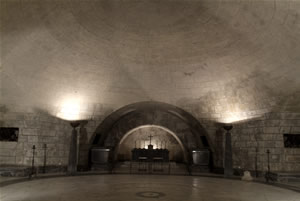
I turned out to be the hospital’s sole visitor. I found my way to the chapel and then down into the crypt. Here, several stories underground, are buried grandees from the Spanish ducal house of Medinaceli, one of the most ancient in Europe. They include a duke who was shot by Republican forces in Madrid in the 1930s and his widow who lived alone in the Hospital–in grim splendor–for many postwar decades.

I took three steps toward the marble sarcophagi. Someone else took three steps behind me. I turned, expecting to see a guard: no one. I took two more steps, and two more sounded as clearly behind. You know that it was an echo. I knew it, too, but it was quite hard to believe it, hundreds of feet beneath this city of inquisitors, heretics, martyrs, and ghosts. The hair stood on the back of my neck, and I retreated before I could read the names on those tombs.