fictional stories about collective agency

(In DC briefly, for a class at Georgetown Law School) Are there fictional stories–novels, movies, long poems, or works in other formats–that depict networks or other large groups of people who improve the world?

There are fictions about individuals improving the world: heroic teachers making their inner-city kids into academic stars, whistle-blowers overthrowing evil corporations, and good cops achieving justice in bad cities.

There are true stories about networks and associations that improve the world, like the excellent historical narratives of the abolitionist movement, the American Civil Rights Movement, and the Indian independence struggle. (The scholarly studies do not attribute excessive importance or originality to individual leaders, Martin Luther King or Gandhi. When the good side wins, it is always because of the whole network.)

There are fictions about groups of people in difficult and unjust circumstances. For example, The Wire is a brilliant depiction of a whole network of people trapped in a heartless system. It is realistic, but it is not a story of agency. Characters in The Wire who try to improve the world fail.

There could be realistic fictions about groups of people who succeed in changing institutions and systems. But are there any? Does the failure to envision such success tell us anything about our art, or our society?
classroom practice from an ethical perspective

(Madison, WI) I am here for one of a series of meetings organized by University of Wisconsin Professor Diana Hess and funded by the Spencer Foundation. Diana and her colleagues have assembled remarkable empirical data about high school students and their social studies classes. From their longitudinal surveys–which follow the students into their twenties–they can draw inferences about the effects of various school experiences. Their elaborate interviews of students and teachers and their classroom observation notes help to explain the quantitative data and also provide numerous interesting anecdotes. The interviews, in particular, draw attention to dilemmas. Should you deliberate issues in a classroom that may be offensive to some students? Should you allow students to deliberate issues that should be settled? Should a teacher disclose his or her personal views?

The empirical data are relevant to these questions. For instance, it might turn out that teachers’ disclosing their opinions affects students’ opinions. But the data cannot settle these questions, which also involve value judgments about both means and ends. The appropriate ends, in particular, are by no means clear.

Therefore, Diana and her colleagues have assembled professional philosophers to discuss the empirical data with the researchers. There are actually three kinds of background in the room. Almost all the participants have personal experience as teachers. The quantitative data is more general and systematic but less rich than personal experience. And everyone has some level of philosophical training or interest. This seems to me a model for how to think about thorny issues.

graphs of the day: health spending, health outcomes

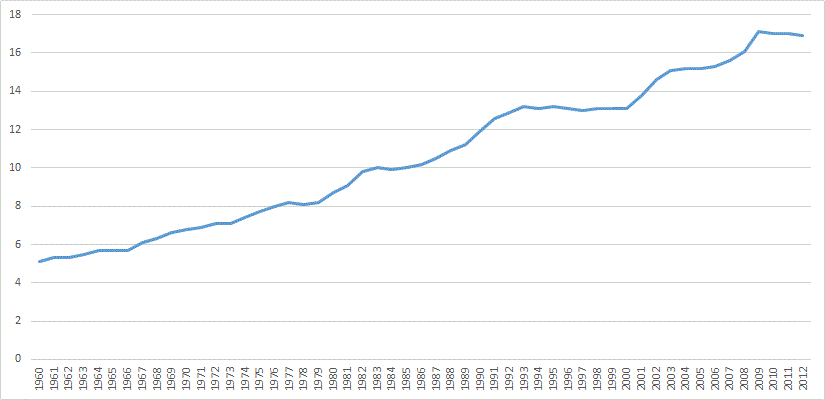
The total proportion of our economy devoted to health care has increased from 7 percent in 1972 to 16 percent in 2006:

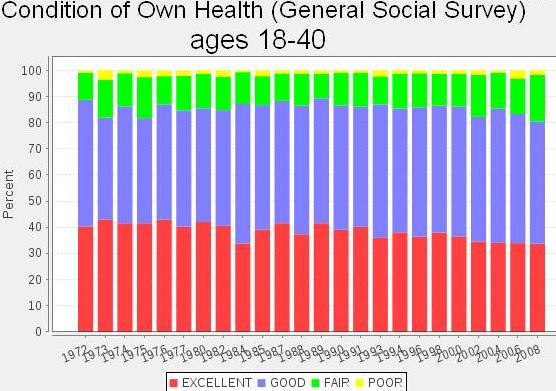
Yet the proportion of Americans who consider their own health to be “excellent” is slightly lower than it was in 1972:

You’d think the reason might be an aging population, but no dice. When you look at only people between the ages of 18 and 40, their self-reported health situation actually declines:

participatory budgeting in Chicago

Participatory budgeting started in Brazil, when residents of poor urban neighborhoods were given control over capital budgets. They now meet in large groups and decide how to spend government funds deliberatively. The outcomes of participatory budgeting in Brazil include better priorities, greater public trust in government, and much less corruption. The last benefit might seem surprising, but it appears that when people allocate public money, they will not tolerate its being wasted.

Participatory budgeting is one of many important innovations in governance that have originated overseas and that should be imported to the US. Now is a time of great creativity in democratic governance, with the US generally lagging behind. We suffer from too limited a sense of the options and possibilities.

I believe there has been some participatory budgeting in California cities. And now Chicago Alderman Joe Moore announces:

    As a Chicago alderman, I have embarked on an innovative alternative to the old style of decision-making. In an experiment in democracy, transparent governance and economic reform, I’m letting the residents of the 49th Ward in the Rogers Park and Edgewater communities decide how to spend my entire discretionary capital budget of more than $1.3 million.

    Known as “participatory budgeting,” this form of democracy is being used worldwide, from Brazil to the United Kingdom and Canada. It lets the community decide how to spend part of a government budget, through a series of meetings and ultimately a final, binding vote.

    Though I’m the first elected official in the U.S. to implement participatory budgeting, it’s not a whole lot different than the old New England town meetings in which residents would gather to vote directly on the spending decisions of their town.

    Residents in my ward have met for the past year — developing a rule book for the process, gathering project ideas from their neighbors and researching and budgeting project ideas. These range from public art to street resurfacing and police cameras to bike paths. The residents then pitched their proposals to their neighbors at a series of neighborhood “assemblies” held throughout the ward.

    The process will culminate in an election on April 10, in which all 49th Ward residents 16 and older, regardless of citizenship or voter registration status, are invited to gather at a local high school to vote for up to eight projects, one vote per project. This process is binding. The projects that win the most votes will be funded up to $1.3 million.

I am strongly opposed to discretionary budgets for legislators. That’s just a way for them to buy reelection with public funds. But the fact that Alderman Moore has such a budget is not his fault, and he is using it for an excellent experiment.

philosophers dispensing advice

Yesterday, for fun, I posted a clip of the philosopher Jonathan Dancy on the Late Late Show. His interview raises an interesting and serious question. Asked whether philosophers should dispense moral advice, Dancy says: No. I would agree with that, for reasons stated below. But Dancy goes further and suggests that philosophers shouldn’t address substantive moral issues at all. He implies that people’s ethical judgments are already in pretty good shape. A philosopher’s job is to understand what kind of thing an ethical judgment is. In other words, moral philosophy is meta-ethics.

That is a controversial claim. John Rawls, Peter Singer, Robert Nozick, Judith Jarvis Thomson, and many other modern philosophers have advanced and defended challenging theses about morality. Since the great renaissance of ethics in the English-speaking world (1965-1975), its ambitions have diminished, I think, and a distinction has arisen between ethics (which is very “meta”) and applied ethics (which is mostly about a given topic area, and not very philosophical). This split seems a harmful development, because the best moral philosophy is methodologically innovative and challenging and also addresses real issues.

Why shouldn’t philosophers dispense advice? Because what one needs to advise people well is not only correct general views (which, in any case, many laypeople hold), but also good motivations, reliability and attention, fine interpretative skills, knowledge of the topic, judgment born of experience, and communication ability (meaning not only clarity but also tact). There is no reason to think that members of your local philosophy department are above average on all these dimensions.

But correct general views are valuable, and philosophers offer proposals that enrich other people’s moral thinking. You wouldn’t ask John Rawls to run a governmental program or even to advise on specific policies, but your thinking about policies may be better because you have read Rawls. It so happens that he held some interesting ideas about meta-ethics, but those were merely complementary to his core views, which were substantive.

I’m afraid I detect a general withdrawal from offering and defending moral positions in the academy. Humanists like to “problematize” instead of proposing answers. Social scientists are heavily positivist, regarding facts as given and values as arbitrary and subjective (thus not part of their work). If moral philosophers begin to consider the offering of moral positions as beyond their professional competence, there’s virtually no one left to do it.