in London

I am on a long journey: Boston -> Washington -> Boston -> London -> Lisbon, all within 48 hours. I had a layover at Heathrow that was long enough to allow me a quick trip to Paddington and then back to the airport. I walked a circuit of a few miles: Paddington to Notting Hill Gate, Hyde Park, South Kensington, Gloucester Road, Kensington High Street, Kensington Church Street, Bayswater Road, and back to Paddington.

I have spent about eight years in this city, including almost every summer from ages 0-20, plus five school years. Nostalgic by temperament, I am fond of London for quasi-objective reasons as well as strictly personal ones. Actually, it would be hard for anyone to deny the elegance of Kensington on a cloudless spring day. But I admire much more of the city than its wealthiest squares and mewses. London has been a polyglot entrepot since Chaucer’s day, when Lombards and Flemings were especially important residents, and it has become an amazingly multiracial and multicultural metropolis in the 21st century.

The underlying English culture is absorptive and adaptive. London changes faster than New York (the supposed capital of creative destruction) because both market and state have the power to reorganize this city in each generation. After just a few years away, all the retail chains seem new, people eat and drink different things everywhere, the transportation system has been sold, resold, and reconfigured, the slang is new, uniformed workers speak different languages (I heard lots of Polish and Spanish today), and whole new neighborhoods seem to have sprung up. Yet the bricks are still made of London Clay, which the Romans used here. Ladies still pull tartan shopping baskets home from Sainsbury’s. Stinging nettles still force their way between railroad tracks and garden sheds. The morning streets still smell of wet cement, curry, and beer.

Brad Rourke’s PACE paper on the executive branch and civic engagement

(Washington, DC) In March, courtesy of Philanthropy for Active Civic Engagement (PACE), I was able to meet with White House staff to discuss strategies for public engagement and civic renewal. The meeting was informed by a fine draft paper by Brad Rourke. Brad has revised and expanded the draft to produce “An Evolving Relationship: Executive Branch Approaches to Civic Engagement and Philanthropy.” I strongly recommend it as a historical and conceptual overview of efforts–nonpartisan, even though they started with presidential administrations from George H.W. Bush to Barack Obama–to enhance citizen engagement. The goal is for citizens to “do things for themselves–identifying and solving community problems, discussing and choosing between different possible solutions, making tradeoffs.” As Brad notes:

    Since the 1970’s, public life has become increasingly professionalized. Scholars have noted a tendency for some government initiatives to approach citizens as if government or other institutions are doing the problem-solving, and citizens are receiving the benefits of those solutions. From this standpoint, citizens can best provide ‘input,’ and are ultimately the “customers” of institutional actions, even actions by citizens’ organizations.

    However, a more citizen-centric view might be that government and other institutions best come into play in order to do those things citizens cannot do themselves.

    […]

    This approach to civic engagement is nascent. At the same time that there is a new energy behind collaboration and participation, there is also new energy behind more negative social forces. Partisanship and polarization are high. Rhetoric in public life is heated. Trust in institutions (not just government) is at all-time lows, as is trust in one another. … For those who care about civic engagement and participation, this is a time that holds both potential and risk.

Rasmussen recently surveyed a national sample and found: “44% believe volunteer activities and organizations are more likely than new government programs to bring about the change needed in the United States. Thirty-seven percent (37%) take the opposite view and say that new government programs and policies will bring about the needed change. ” That result could be taken as evidence of conservatism, but there is a long tradition of grassroots centrist and even leftist activism that makes the same assumption. Michelle Obama, at least year’s National Conference on Volunteering and Service, hammered away on the theme that positive change comes from the bottom up, not the top down. Brad’s paper is basically about efforts from the very top–the White House–to enable bottom-up change.

Zadie Smith, White Teeth

    “Every moment happens twice: inside and outside, and they are two different histories.”

Zadie Smith finished her first book, White Teeth, while she was an undergraduate. It’s much more than a prodigy’s tour de force; I think it’s a fine and lasting novel.

It is elaborately plotted. The events span the period 1857-1999 and create a complex and deliberate pattern, full of symmetries and recurrent patterns. The whole structure encompasses three extended families (Bangladeshi Muslim, West Indian/British, and Anglo-Jewish) plus numerous well-developed hangers-on. As an example of what geometers would call a “reflection symmetry,” the two Bangladeshi twin brothers grow up in the East and the West, each embracing the other’s hemisphere, and they both make love to the same woman on the same day, whose child could therefore be either one’s. As an example of a “rotational symmetry”: at one point, disgruntled teenagers from each family are living with the next. Guns are fired in parallel situations in 1857, 1945, and 1992.

This whole structure could be considered artificial and mannered–especially when everything comes together neatly in the denouement. Smith is interested in no less a matter than Fate, the sense that life is pre-plotted. This seems especially salient in the lives of immigrants from the former colonies. Their lives are symmetrical, recurrent. Fate is also an explicit topic in at least three cultures that Smith explores and counterposes: Islam, Christian fundamentalism, and molecular biology.

I am not as interested in Fate, but I love the elaborate structure for a different reason. As many have noted, Smith is a genuine genius at mimicking and sympathetically portraying diverse people. Who am I to say whether she can see the world like an 85-year-old Jamaican Jehovah’s Witness? But I can vouch for her precise evocation of a secular Jewish teenage boy with academic parents living in North London in the 1980s. I was there, and she’s got that demographic spot on. All the other characters–who range magnificently across continents, religions, generations, races, and classes–seem entirely plausible.

What happens when you create an artificial structure of events and portray it from myriad perspectives, sympathetically and without the imposition of your own voice? That is a liberal political achievement, because it respects individuality and difference and refuses to boss people around, even in the imagination. It is also an artistic achievement. “For me,” Nabokov wrote, “a work of fiction exists only insofar as it affords me what I shall bluntly call aesthetic bliss, that is a sense of being somehow, somewhere, connected with other states of being where art (curiosity, tenderness, kindness, ecstasy) is the norm.” Nabokov’s recipe is: curiosity, which makes you describe all kinds of people and objects; tenderness, which makes you love them all; plus aesthetic pleasure, which arises when the first two are achieved harmoniously and elegantly. Smith is an artist in the true Nabokovian sense.

creating informed communities (part 5)

This is the fifth of five strategies proposed to achieve the goals of the Knight Commission on the Information Needs of Communities. See Monday’s post for an overview.

Strategy 5: Organize People to Defend the Knowledge Commons

The Knight report does a great job of showing that healthy communities need information. Information is a “public good,” in the economist’s sense, because excluding people from its benefits is difficult and expensive once the knowledge has been produced. Generating and protecting public goods raises special challenges for which we need effective, grassroots advocacy organizations.

The main challenges facing public goods are, first, that individuals may not be motivated to produce things that benefit everyone (when instead they can “free-ride” on others’ labor), and second, that individuals, firms, and governments may be tempted to privatize public goods for their own advantage. Today, many knowledge artifacts that once would have been rivalrous can be digitized, posted online, and thereby turned into public goods. On the other hand, knowledge can be privatized and monetized, as when intellectual property is over-protected or when university-based research is influenced by corporate funding. It is also possible for knowledge to be under-produced, if there are insufficient incentives to develop it and give it away. For example, too little research is conducted on diseases that affect the poorest people in the world.

Civic knowledge–knowledge of relevance to public or community issues–does not come into existence automatically, nor is it safe from anti-social behavior. The documents in a town archive, the reporting that filled a traditional town newspaper, and the artifacts in a local museum all took money and training to produce, to catalog, and to conserve. Once produced, these goods are fragile. They can literally decay or burn, and they are subject to manipulation or inappropriate privatization.

For example, access to state court decisions in the United States is provided exclusively by private firms, mainly the West Publishing Company and LEXIS/NEXIS. The public’s interest in affordable and convenient access to public law would be undermined if these firms over-charged or provided poor quality.

In 1998, with the Sonny Bono Copyright Term Extension Act, Congress extended most existing copyrights in the United States for 95 years. Congress thus granted monopoly ownership to works that had been created as long ago as 1903–requiring anyone who wanted to use these works to locate the copyright holder, seek permission, and pay whatever fee is demanded–and asserted a right to extend copyrights as frequently and for as long as it liked. In his dissenting opinion to the court decision that upheld this law, Justice Breyer wrote, “It threatens to interfere with efforts to preserve our Nation’s historical and cultural heritage and efforts to use that heritage, say, to educate our Nation’s children” (537 U.S. 26, 2003, 26). If Justice Breyer was correct, the Sonny Bono Act was an example of knowledge of civic value being turned from a public good into a private commodity by state power at the behest of private interests.

Given such threats, we need associations that play the following roles:

    1. Advocacy. Policies to benefit the “knowledge commons” would include protection of free speech, appropriate copyright laws, public subsidies for libraries and archives, and public funds to digitize archives. Beneficial policies are public goods that often lose out to private interests that profit more tangibly from selfish policies. For example, everyone benefits from free access to historical texts, but a few companies profit much more substantially from their own copyrights. Independent, nonprofit associations can rectify this imbalance by recruiting voters, activists, and donors to promote the public interest in government. The American Library Association, for example, has been a strong advocate for knowledge as a commons.

    2. Alliances. Communities across the country have information needs and valuable, accumulated public knowledge. Attacks on free information anywhere are threats to free information everywhere. “We are caught in an inescapable network of mutuality, tied in a single garment of destiny. Whatever affects one directly, affects all indirectly.” That is what Dr. Martin Luther King, Jr., wrote as he and his colleagues built a civil rights movement. As a result of their work, when civil rights were viciously repressed in one location, people got on buses from other places to come and protest. We may not need bus trips, but we do need people in each community to feel that the information commons in other places matters to them as well. In practical terms, that requires networks of associations that have working ties.

    3. Education, broadly defined. People do not automatically acquire an understanding and appreciation of valuable civic knowledge, nor the skills necessary to produce and conserve such knowledge. Each generation must transmit to the next the skills, motivations, and understanding necessary to preserve knowledge as a commons. Government-run public schools may have a role in this educational process, but they should not monopolize it. A more pluralistic and independent education depends on private nonprofit associations that recruit and train people to be community historians, archivists, naturalists, artists, or documentary filmmakers (among other roles).
creating informed communities (part 4)

This is the fourth of five strategies proposed to achieve the goals of the Knight Commission on the Information Needs of Communities. See Monday’s post for an overview.

Strategy 4: Generate Public “Relational” Knowledge

Citizens need facts about organizations, leaders, and issues. They need rival interpretations of those facts, and deliberative public judgments based on such interpretations. Citizens also need to understand the relationships among people, organizations, and issues. All competent civic and political actors, since the beginning of time, have held in their heads implicit “network maps” that link ideas and individuals in their community. They know, for example, that if they want to talk to the leader of the town, they should go through an accessible individual whom the leader regularly consults. If someone raises a local issue, they can link it to relevant organizations and to related issues.

In recent years, three developments have underlined the importance of such thinking. One is the “The New Science of Networks,” as Albert-László Barabás subtitles his book Linked. This science is the mathematical exploration of nodes and network ties as they arise under various conditions, and it has yielded powerful insights, such as the value of “weak ties” and the importance of individuals who connect disparate communities.

The second development is the enormous popularity of social networking sites like Facebook, which are driven by webs of relationships. These sites have popularized the concept of network ties and underlined their importance. But Facebook and other corporate social networks keep the relational data–the “network map”–to themselves. They do so to protect users’ privacy and also to give themselves a valuable asset. For example, to reach everyone at Tufts who has a Facebook account, we must pay Facebook to advertise. We cannot see a list of users who have Tufts connections.

The third development is the art of relational organizing. Relational organization groups such as the Industrial Areas Foundation and the PICO and Gamaliel Networks do not begin with clear and fixed goals. They decide what their causes should be by means of long periods of listening and discussing within diverse networks that they carefully nurture. They are highly skilled at mapping networks to identify power relationships, excluded groups, and key hubs. [See, e g., Mark R. Warren, Dry Bones Rattling: Community Building to Revitalize American Democracy (Princeton: Princeton University Press, 2001, pp. 31-2..

The next step is to democratize the possession of effective network maps, so that they do not exist only in the brains of skilled organizers or on the servers of Facebook and MySpace. Informed communities should have access not only to discrete facts and lists of organizations–nor should they be satisfied with geographical maps that show the physical location of organizations. They should be able to build and consult public network maps that allow them to identify power, influence, exclusion, division, and other attributes of relationships, not of individuals.

Working with Lew Friedland and his colleagues at Community Knowledge Base, we have been experimenting with public network maps in two contexts:

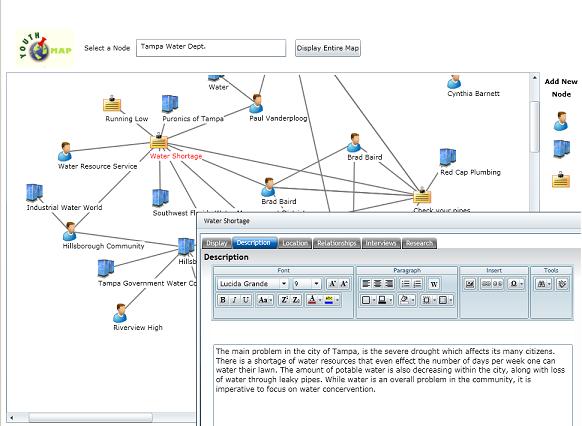
  • We have begun to create computer-based games in which classes of high school or middle school students quickly generate network maps of local issues, organizations, and people. The following is part of a real map concerned with water issues in the Tampa, Florida area. It was quickly created by a class of 9th graders, who pooled their knowledge to produce a sophisticated understanding. (One node is open to reveal notes the student has typed.)

  • We are also in the midst of creating an open network for the Boston metro area in which nodes will be organizations or issues, and anyone will be able to add to the map, use it to recruit volunteers, and navigate it to explore the structure of this region’s civil society. It’s not ready for a public launch, but one can explore the map here.

These are just preliminary experiments. They do not yet harness the full potential of network analysis and visualization, nor the power of computers to harvest network data automatically from websites. My basic recommendation is that governments and foundations should invest in providing transparent relational data along with the other information that is already online.