That is the title of today’s blog post. The text is not here but on the Huffington Post. I co-wrote it with Scott Warren and Alison Cohen of Generation Citizen, and it’s about the civic achievement gap in high schools.
book talks on civic engagement
This fall, please join these four authors for discussions of their new books.

Sept 9, Noon-2 pm, Rabb Room, Lincoln Filene Hall
Henry Milner
The Internet Generation: Engaged Citizens or Political Dropouts
Tufts University Press, 2010
Henry Milner is a political scientist at the University of Montreal in Canada and Umeå University in Sweden, and co-editor of Inroads, a Canadian journal of policy and opinion

Oct. 13, 4:30-6:00 pm, Rabb Room, Lincoln Filene Hall
Shirley Sagawa
The American Way to Change: How National Service and Volunteers Are Transforming America
Jossey Bass, 2010
As special assistant to President Clinton for domestic policy, Sagawa drafted the legislation that created AmeriCorps and the Corporation for National and Community Service. After Senate confirmation as the Corporation’s first managing director, she helped lead the development of the new agency and its programs. She is co-founder of the sagawa/jospin consulting firm and Visiting Fellow at the Center for American Progress.

Oct. 15, Noon-2 pm, Crane Room, Paige Hall
Mark R. Warren
Fire in the Heart: How White Activists Embrace Racial Justice
Oxford University Press, 2010
Mark Warren is Associate Professor of Education at Harvard University. A sociologist, he is concerned with the revitalization of American democratic and community life. He is the author of several previous books, including Dry Bones Rattling: Community Building to Revitalize American Democracy.
Co-Sponsored by the Social Justice Initiative

Dec. 10, Noon-2 pm, Crane Room, Paige Hall
Richard Wolin
The Wind from the East: French Intellectuals, the Cultural Revolution, and the Legacy of the 1960s
Princeton, 2010
Richard Wolin is Distinguished Professor of History, Comparative Literature, and Political Science at the City University of New York Graduate Center. His previous books include Heidegger’s Children and The Seduction of Unreason and he writes regularly in Dissent, the Nation, and The New Republic.
Co-sponsored by the Department of Romance Languages and the Center for the Humanities at Tufts (CHaT)
the heart, the head, and who you vote for
Nansook Park and Christopher Peterson ask people to rank themselves on a battery of strengths that are “intellectual and self-oriented” (such as curiosity, judgment, and appreciation of beauty) and a set of “strengths that are emotional and interpersonal” (such as love, prudence, bravery, and hope). They find substantial differences in the average scores on these scales among U.S. cities. They also find that city-level differences matter for several important outcomes.
An example is the 2008 presidential election. Cities that ranked themselves high on “strengths of the head” chose Barack Obama. Cities that prided themselves on “strengths of the heart” preferred John McCain. I illustrate that pattern with two examples, San Francisco and Arlington, TX. I give San Francisco a score of 50 for strengths of the head because it was top ranked in that category among the nation’s 50 largest cities. I give it a 3 for strengths of the heart because, in that category, it surpassed only Seattle and our own warm and friendly city of Boston. Arlington was virtually the mirror image. (Vote counts from here.)
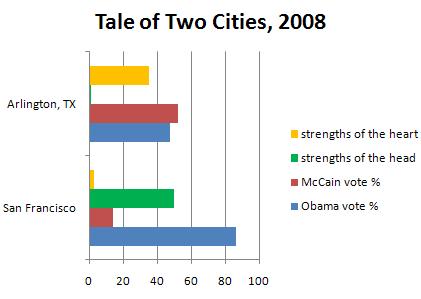
Some caveats would be appropriate. These are self-reported scores, so they may measure the perceived value of the various strengths, rather than their real prevalence in each city. The sample is not random, although the authors argue that it is representative. The relationship between the two virtues and voting outcomes might not be causal; it could be explained by some third factor. (It is not, however, the case that a particular virtue–such as faith–is mainly responsible for the results; the authors check for that.)
Caveats aside, these results seem plausible. America has hard-driving, competitive, creative, and cerebral cities that like Democrats, and warm, friendly, emotional, and devout cities that prefer Republicans. People move to San Francisco, Seattle, and Boston if they think they can succeed in research, consulting, or the arts, and they surround themselves with neighbors who would gag before voting Republican. People move to El Paso, Mesa, and Fresno because they want friendly neighbors and church picnics. They don’t necessarily vote Republican (cities in general tilt leftward), but they are far more conservative than their peers in the cerebral cities.
The Republican Party is supposed to be committed to competition and individualism; the Democrats, to solidarity and care. Yet the very cities that are most competitive and individualistic are most enthusiastic about Democrats. Maybe a caring government seems more valuable in San Francisco and Boston than in Arlington, TX.
reflections after a videoconference
I just finished three consecutive meetings that addressed versions of the same questions: How can universities prepare young people for active democratic citizenship? And how can such efforts be measured and assessed? The first meeting involved Tufts faculty from various departments. I either knew the participants before the discussion began or had network ties with them. We are part of the same organization, with a common work culture. We met in a room where I have spent hundreds of hours. I know exactly where this thoroughly familiar place fits in the broader physical space of Tufts, Medford, Massachusetts, America. We shook hands, helped one another to coffee, and watched each other’s faces as we spoke.
Then two young leaders (from the Sustained Dialogue Campus Network) met with me and a colleague in my own office. Now the space was quite small, piled with my own stuff, and extremely familiar to me–although not to my visitors. I understood their backgrounds and the broad outlines of their work lives, but I cannot picture their offices or exactly how they spend their days. The flow of conversation was fluid among the four participants. We talked about potential projects and next steps. We were getting to know one another, which is an important precondition of collaboration.
And then I went to a basement space with a video link, to participate in a virtual conference with colleagues from Tecnológico de Monterrey, a major Mexican university. Now I was in a strange underground room somewhere beneath a physical space that I know well. I was interacting with a face projected on a large, high-quality video screen. I do not know where he sat on the surface of the globe, let alone what he would see if he walked off camera to his right or left. Behind him was a glossy world map, coincidentally showing my real location immediately over his right shoulder, although Mexico itself was obscured. My face appeared in a fuzzy frame below his right hand. He and the several other participants spoke mostly in Spanish, a language which I unfortunately have never studied; but I was able to keep up (to a degree) by pasting their PowerPoint slides into Google Translate on a laptop.
Google’s translation revealed remarkably similar themes to the morning’s discussion at Tufts. It felt like one conversation, as if you could walk through the screen and find yourself sipping coffee with colleagues in Mexico who would know your friends from Tufts. The video monitor created the illusion of an open portal. Yet thousands of miles, an armed political border, and a language gap separated us. I felt stiffer, more formal, less humorous, and less responsive in the last situation than the first two. It’s one world now, but propinquity still matters.
making our own mosque
With all the controversy about building a mosque in Lower Manhattan (not to mention various bills and laws against erecting minarets in Europe), I thought this might be a good time to recycle a photo of the little “mosque” that my daughter and I built when she was seven.
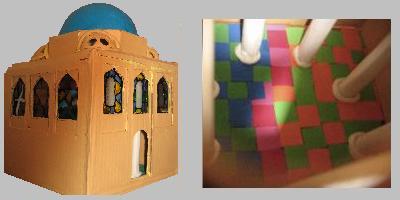
Height: 14 inches. Construction materials: cardboard, plastic freezer baggies, papier-mâché over a popped plastic balloon. Current location: our attic. It is not really a mosque because it lacks a mihrab (to orient people for prayer) or a minbar (the Islamic equivalent of a pulpit). Our motivations in making it were not doctrinal, nor ecumenical, nor political. Rather, this is our amateur homage to one of the world’s finest architectural traditions, the heritage of Islamic religious architecture.