against a cerebral view of citizenship

For a faculty seminar tomorrow, a group of us are reading Aristotle’s Politics, Book III, which is a classic and very enlightening discussion of citizenship. Aristotle holds that the city is composed of citizens: they are it. Citizenship is not defined as residence in a place, nor does it mean the same thing in all political systems. Rather, it is an office, a set of rights and responsibilities. Who has what kind of citizenship defines the constitution of the city.

According to Aristotle, the core office or function of a citizen is “deliberating and rendering decisions, whether on all matters or a few.”* In a tyranny, the tyrant is the only one who judges. In such cases, the definition of a good man equals that of a good citizen, because the tyrant’s citizenship consists of his ruling, and his ruling is good if he is good. Practical wisdom is the virtue we need in him, and it is the same kind of virtue that we need in dominant leaders of other entities, such as choruses and cavalry units. Aristotle seems unsure whether a good tyrant must first learn to be ruled, just as a competent cavalry officer first serves under another officer, or whether one can be born a leader.

In democracies, a large number of people deliberate and judge, but they do so periodically. Because they both rule and obey the rules, they must know how to do both. Rich men can make good citizens, because in regular life (outside of politics) they both rule and obey rules. But rich men do not need to know how to do servile or mechanical labor. They must know how to order other people to do those tasks. Workers who perform manual labor do not learn to rule, they do not have opportunities to develop practical wisdom, but they instead become servile as a result of their work. Thus, says Aristotle, the best form of city does not allow its mechanics to be citizens.

Note the philosopher’s strongly cognitive or cerebral definition: citizenship is about deliberating and judging. Citizenship is not about implementing or doing, although free citizens both deliberate and implement decisions.

But what if we started a different way, and said that “the city” (which is now likely a nation-state) is actually composed of its people as workers? It is what they do, make, and exchange. In creating and exchanging things, they make myriad decisions, both individually and collectively. Some have more scope for choice than others, but average workers make consequential decisions frequently.

If the city is a composite of people as workers, then everyone is a citizen, except perhaps those who are idle. It does not follow logically that all citizens must be able to deliberate and vote on governmental policies. Aristotle had defined citizens as legal decision-makers (jurors and legislators); I am resisting that assumption. Nevertheless, being a worker now seems to be an asset for citizens, not a liability. Only the idle do not learn both to rule and to be ruled.

Aristotle’s definition of citizenship has been enormously influential, but it has often been criticized: by egalitarians who resist his exclusion of manual workers and slaves; by Marxists and others who argue that workers create wealth and should control it; and by opponents of his cerebral bias, like John Dewey. The critique that interests me most is the one that begins by noting the rich, creative, intellectually demanding aspects of work. That implies that working, rather than talking and thinking, may be the essence of citizenship. I draw on Simone Weil, Harry Boyte, and others for that view.

*Politics 1375b16, my translation.
youth voter turnout 20%: what does that mean?

(This is piece originally ran today on the Huffington Post.)

About one in five young citizens (20% of those between the ages of 18 and 29) voted in this year’s election. About nine million young citizens voted. Their turnout rate and sheer number of youth votes is down somewhat from 2006–a statistically significant decline but not one of tremendous magnitude.

If you care about youth voting–as a manifestation of democracy and a bellwether of future participation–you should take some comfort in the fact that young adults voted at roughly the same rate as usual in a midterm election. You should reject exaggerations about the size of the decline, especially after four consecutive federal elections in which youth turnout rose.

On the other hand, youth turnout is low compared to what we should want in a great democracy. At best, about one in three young adults vote even in the most engaging midterms, and they skew toward the most privileged youth. Arguably, we need a game-changing event or movement to increase turnout to a whole different level. If you were hoping that 2008 was such an event, yesterday’s results may be discouraging. It is time to ask whether the millions of young people who were deeply engaged in the 2008 campaign could have been invited to engage more in governance once the election was over. I offered some suggestions about how to do that in a January Huffington Post piece.

If you are excited about the Millennial Generation (those born after 1984), you should stay excited. They are an appealing group, with high levels of volunteering and a record of strong turnout in 2004 and 2008. They are already producing creative and skillful leaders. They are the most diverse generation in American history and they have other important assets, such as skills with media and technology. They certainly care about issues and the future of their country. Significant numbers of them specifically care about political participation and worked round the clock to mobilize their peers.

On the other hand, yesterday’s election (with its 20 percent turnout rate) reminds us that generational change cannot explain everything. Participation rises and falls from one election to the next. Members of the same generation vote very differently depending on their state, their race, class, and gender, and their politics. As a whole group, today’s young people are not sharply different from their predecessors. The arrival of the Millennials will not restore American democracy, although it provides opportunities.

If you are a Democrat, you should not blame young people. They did turn out at fairly typical rates and they supported Democratic candidates, on the whole. Nationwide, in House races, 56% of young people voted for Democratic candidates and 40% voted for Republican candidates. Republicans did somewhat better than in 2008 but much worse than in 1994, 1998, 2000, and 2002, when they ran neck-and-neck with Democrats for the youth vote. Earlier today, Bill Wimsatt wrote on the Huff Post, “for four national elections in a row, young voters continue to be the most progressive segment of the population — and the most progressive generation on record since exit polling began in 1972.”

In virtually every state, young adults were the most Democratic age group. For example, Senator Harry Reid (D-NV) won 58% of the under-30 vote but only 44% of seniors. Ron Paul (R) won the Kentucky Senate race easily, but he lost the under-30s by three points. Indiana and Louisiana are exceptions: the Republican Senatorial candidates in those states won the youth vote and performed better with young adults than they did with Gen-Xers (ages 30-44).

If you are a Republican, you are entitled to celebrate the election as a whole, but you should give some thought to youth. They represent the future and they did not vote Republican except in the reddest of red states. Even though some young people lean libertarian, the Kentucky results suggest that libertarian Republican candidates have gained little traction so far with the younger generation. The Tea Party is probably a turnoff for young people–if not because they disagree with its policy positions, then because it doesn’t reflect a diverse and future-oriented image of America.

If you are any kind of political leader, you should think hard about the way the last election was played: with a barrage of expensive, negative advertising targeted to specific demographic groups, especially the elderly, and encouraging fear. That style can sometimes win elections but it is no way to engage young Americans.

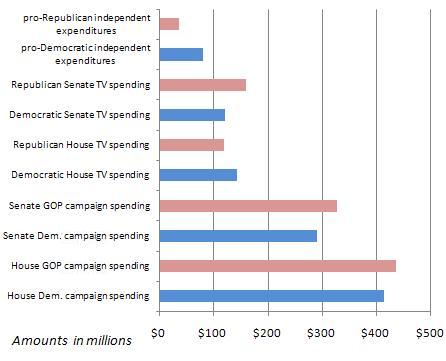
campaign spending summary 2010

Here are some preliminary figures on campaign spending for 2010: numbers will rise with the next round of disclosures.

Independent expenditures are those disclosed to the FEC through Oct. 31 and compiled by the Washington Post. TV spending is based on actual purchases of advertising time, as measured by Kantar Media (inc.) and reported in The New York Times. The bars for campaign spending refer to disbursements reported to the FEC as shown on the FEC’s website today. These categories are not mutually exclusive: TV spending is a subset of campaign spending.

Note that both the Democrats and the Republicans are spending right about 37% of their campaign money on television. It’s interesting to compare that strategic choice to the pre-Internet era. According to the Congressional Research Service (PDF), “major-party Senate candidates in 1992 spent 42% of their funds on electronic media advertising. … Major party House candidates that year spent 27% of their resources on electronic media. These percentage levels were similar in both 1990 and 1994.” These estimates from the 1990s include TV and radio air time, plus production costs and media consultants, whereas I show only TV time above. Thus it appears that candidates are now spending a higher proportion of their money on TV than they used to, but not a much higher proportion. That may surprise people who believe that TV has decreasing importance–or perhaps campaigns are misspending their money.

It may also surprise many Democrats that their side is ahead in independent expenditures and not far behind in total campaign expenditures (i.e., Senate and House campaigns combined). Putting those two categories together, Democrats and pro-Democratic groups are $36 million behind the Republicans, which is equivalent to about five percent of their total resources.

has the administration let down young voters?

In today’s New York Times, Damien Cave quotes me:

    “[Young voters] were emotionally invested,” said Peter Levine, director of the Center for Information and Research on Civic Learning and Engagement at Tufts University. “Somehow that should have been turned into, for Democrats, a revival of progressive policy, and in a neutral way, a revival of democracy starting with young people.”

    “So far, it hasn’t happened,” he added.

I agree with my own quote, but I’d broaden the picture with some additional points:

  • The youth turnout rate (which CIRCLE will calculate by 10 am on November 3) will not prove that there was anything wrong with the administration’s policies and strategies. We don’t know if it will be higher or lower than the average for midterm elections, but it will probably be in the usual range. If it happens to be down from 2006, that can be explained in many ways, including economic factors.
  • Some young people are engaged, perhaps more than usual for a midterm election (although that remains to be seen). And there is a robust and skillful movement of nonprofits, mostly non-partisan and mostly led by young adults, that has been working like mad to energize young people and that uses smart, tested strategies. So nobody should be saying that there is anything wrong with young people today or with youth voting organizations.
  • But the US has the worst turnout of any major democracy, and the Americans who vote (regardless of age) are unrepresentative of the population. That is a serious problem that demands the attention of major institutions, which should employ creative, innovative solutions. Roughly $4 billion will be spent on this election, and very few of the people and companies behind that spending are trying to engage young people.
  • The Obama Administration, to its great credit, expanded AmeriCorps and kept it strictly and truly nonpartisan. That’s great, but it doesn’t increase political participation. The administration has also done things for young people, like allow them to stay on their parents’ health insurance. And the president has tried to talk to young people, on the Daily Show and elsewhere.
  • But the Obama Administration has not tried to govern with young people, even though the Obama campaign won an election with young people. The lack of creativity, innovation, and investment seems disappointing.

Cave astutely notes, “Indeed, a look back at e-mails from Organizing for America as health care legislation developed does show a general approach that did little to focus on young people. E-mails dealt with telling supporters what to say, rather than asking for input — and as a result, many young people said, they stopped reading them.” (That was also true of some of us not-so-young people.)

Young activists would have been, in general, considerably to the left of the president on health care, climate change, and Afghanistan. That means that empowering them politically would have posed a risk for the White House. If they had been asked for input, they would have said, “Single Payer!” and that wasn’t going to pass.

On the other hand, there is a political risk to not getting pressure from your left flank if you’re a Democrat. FDR said that leadership is deciding which pressure to cave to, and the lack of pressure from the left has hurt this president’s ability to lead. Besides, I think the administration could have risked a dialogue with activists. Young people are fully capable of listening.

My final point: It’s not over yet. Young people can vote on Tuesday—they have that power and that right, regardless of what polls may predict. And after the election, they can still play a powerful role in governance.

Jürgen Habermas approves this message

I expected my morning newspaper to bring stories about angry American voters and American politicians behaving ridiculously: data about the state of our democracy. I did not expect to see a wide-ranging essay on German democracy by one of the world’s greatest living political thinkers, Jürgen Habermas. Having him pop up in the Times a few days before the election was like suddenly receiving a briefing from Isaiah Berlin or Reinhold Niebuhr.

Habermas describes three phenomena as broadly linked. The first is rising xenophobia, defined nowadays by religion instead of race or language. “With an arrogant appropriation of Judaism—and an incredible disregard for the fate the Jews suffered in Germany—the apologists of the leitkultur [national culture] now appeal to the ‘Judeo-Christian tradition,’ which distinguishes ‘us’ from the foreigners.” In contrast, Habermas’ own position is radically cosmopolitan and liberal: “the state should demand [no] more of its immigrants than learning the language of the country and accepting the principles of the Constitution.” Even in our pluralist democracy of immigrants, that is not a settled position; many people, including some on the left, believe that the community has a right to teach some elements of a national culture. In fact, I would count myself in that camp.

The second phenomenon is “the rejection of political parties and party politics,” in favor of “charismatic figures who stand above the political infighting.” Habermas finds that trend disturbing in the light of German history, but it is certainly evident here as well.

And the third phenomenon is a wave of mass protests against government decisions, especially public protests against a huge public building project in Stuttgart. Habermas blames the government: “the authorities did not, in fact, provide sufficient information … , and thus citizens did not have an opportunity to develop an informed opinion on which they could have based their votes. To insist that they should have no further say in the development is to rely on a formalistic understanding of democracy.” They are taking to the streets because the government ignored the principles of deliberative democracy.

Habermas traces all three trends to a “helpless political system.” National governments are weakening, and “politics submits to what appear to be inevitable economic imperatives.” As a result, people naturally lose faith in representative/deliberative institutions. He doesn’t mention European integration, but that is surely one reason that the state is weakening. (European integration is a direct reason for the Stuttgart train station project, which has E.U. funding.)

Somewhat surprisingly,* Habermas ends with a favorable comparison to our side of the Atlantic. “The United States has a president with a clear-headed political vision, even if he is embattled and now meets with mixed feelings. What is needed in Europe is a revitalized political class that overcomes its own defeatism with a bit more perspective, resoluteness and cooperative spirit. Democracy depends on the belief of the people that there is some scope left for collectively shaping a challenging future.”

*I am not surprised that Habermas holds positive views of the United States; that has been true all along. I am surprised to see anyone favorably evaluate our politics at this precise moment.