what the markets think about the election

I was in a foundation board meeting today, in DC. We heard the usual presentation from investment advisers about the state of the endowment and the future of the markets. Their boilerplate document treats as a positive factor the coalition governments in Britain and Australia and the likely divided government in the US starting in January. Apparently, there will be more checks and balances now, hence more stability and predictability. I presume such thinking helps explain, or justify, why many large investors are backing Republicans.

The coalition government in Britain has actually launched a radical experiment in austerity during a recession that, at best, makes the future there quite unpredictable. Meanwhile, in the US, I fear we will see gridlock that preserves the status quo, which means a long, slow, painful climb out of the hole we’re in.

One interpretation: the finance guys are right. Divided government means stability, and that’s good for “the economy.”

A second interpretation: Republican and Tory victories are good for financial markets but not for most people. Investment advisers know that but don’t say it, even to their own clients, for fear of alienating people who might have different values.

A third interpretation: Investment advisers believe exactly what they write, although they are too optimistic about the public benefits of conservative policy. Their sincere but wrong beliefs tell us something about the micro-structure of ideology.

I don’t know which is correct, but I do know these folks are advising their clients to invest in “emerging markets.” In other words, welcome tax cuts here but outsource your capital to countries with actual growth.?

trying to look at the Empire State Building

(Washington, DC) Over the weekend, I finished Mark Kingwell’s excellent book Nearest Thing to Heaven: The Empire State Building and American Dreams. By coincidence, I spent today in an office three blocks south of the actual Empire State Building. I saw it first from an airport taxi, got a good direct look at it from the window on 31st Street, walked by its front door, and then watched it vanish over Queens on my way to La Guardia.

Seeing it, however, is problematic–that is one of Kingwell’s themes. First of all, it is actually very big. If you are far enough away to see the whole thing, it becomes misleadingly small, unremarkable, dwarfed by routine buildings closer by, sometimes just an extra piece of equipment in the backdrop of a New Jersey auto dealership or a Brooklyn lot. If you come close enough to sense its scale, it veers away so sharply that you can’t really see anything. What you do glimpse is just the skin. It’s a three-dimensional structure; to experience it fully (if such a thing were possible) would require going inside: time and motion would be needed as well as vision.

The Empire State Building is also hard to “see” because you have seen it so many times before, in real life, in postcards and movies, inside snow globes, on tee-shirts, carved as chocolates or soaps. As a result of all that mechanical reproduction, you carry the wrong shape in your mind. In my memory, it had more stone and less steel, more shoulder and less head, than in my experience today.

And it’s a hard object to see because savvy New Yorkers don’t stare up at it, whether they’re walking down the street or in meetings on 31st Street. They are too busy, too blasé. Tourists were standing around the entrance on Fifth Avenue, and since I was also a tourist but didn’t want to seem one, I hurried past.

From the taxi, though, it was OK to stare. The building looked a little solitary, standing down there in the thirties. I recalled Kingwell’s idea that the Chrysler Building is its uptown girlfriend; they seemed a little distant. At first sight, on a grey day, the Empire State Building looked pixilated, like a stack of tiny cubes with angular edges all the way to the Deco dirigible dock at the top. A surprising dark stripe crossed its belly.

I wrote the above on the plane from New York to DC, without really reaching a conclusion before we had to put computers away for landing. We came in low over the Potomac, Georgetown lamps shimmering on the river, the Lincoln Memorial’s skylights glowing upward, and the obelisk standing in the middle of it all. It may have been a trick of the perspective–or something to do with my twenty years of past wrapped up in Washington–but it looked grander than the city we had left.

a map of the civic renewal field

If there is not yet a civic renewal movement, there are certainly many organizations and individuals devoted to fair, deliberative, transparent, participatory democracy. If we hope to build a movement, it is important to understand these groups, how they fit together, and what types of organizations and coalitions may still be missing.

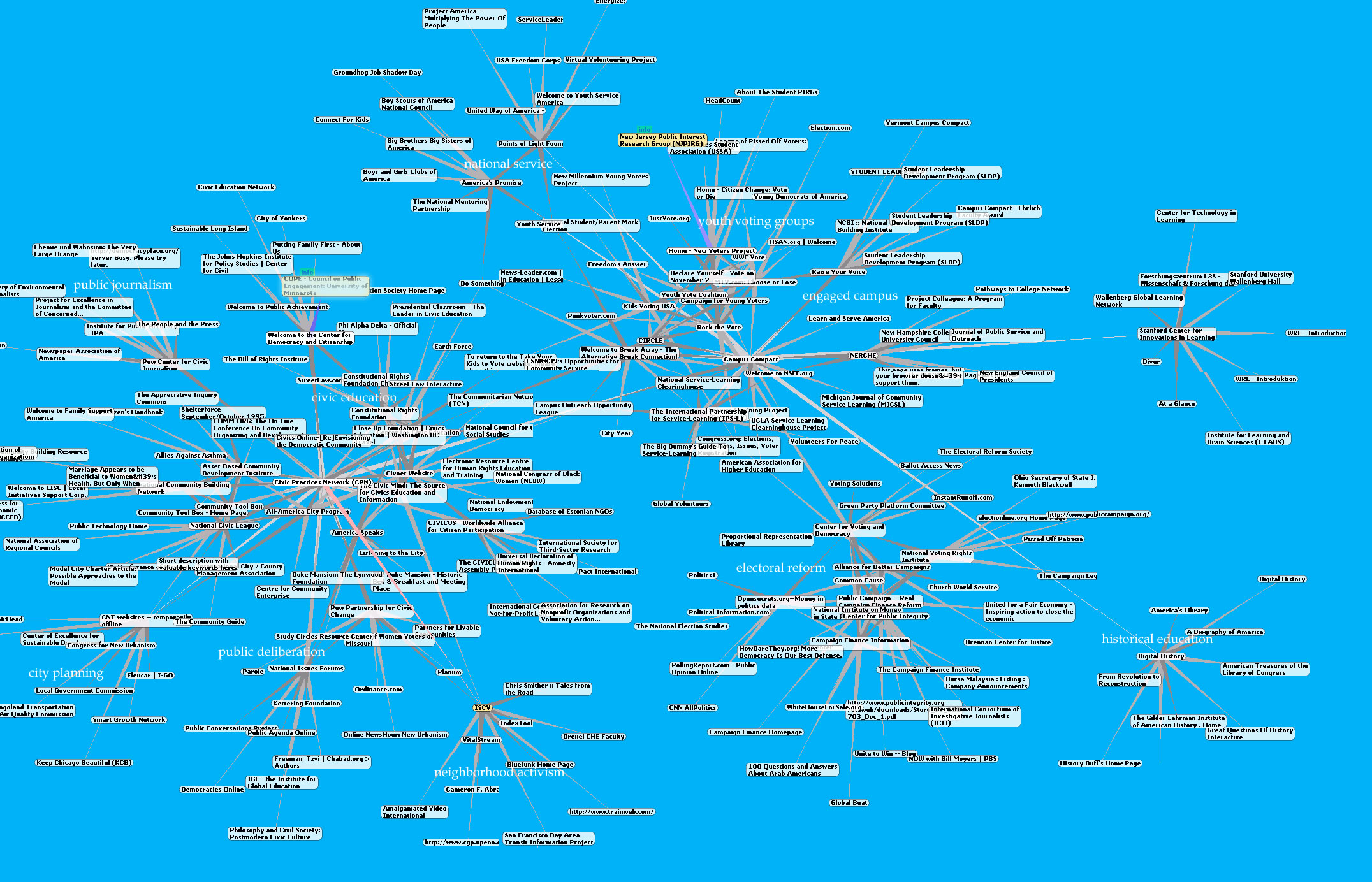
In 2005, I created two maps (one and two) using the links among civic organizations’ websites to create a list of groups and then organize them as a network. That method is dependent on how webmasters handle links–always a bit arbitrary, and increasingly so as groups make heavier use of Facebook and Twitter.

So I have made a new map in a more-labor intensive way. I hand-entered information about all the member organizations of the following networks, which I would argue are important to the field:

  • Strengthening Our Nation’s Democracy II (a coalition of political reform, community organizing, and deliberative democracy organizations)
  • Campaign for the Civic Mission of Schools (a coalition in support of civic education, which was not heavily represented at SOND II)
  • Deliberative Democracy Consortium (a coalition that did participate in SOND II, but some of whose members did not)
  • PACE–Philanthropy for Active Civic Engagement (ditto, but consisting only of foundations)
  • The Democracy Imperative (ditto, but emphasizing higher education)
  • The Voices for National Service Steering Committee (one of several networks in the “service” field).

I could have included other coalitions, such as the National Coalition for Dialogue and Deliberation, Service Nation, or the America’s Promise Alliance, but each of these has such long lists of members that the total number of groups would have become enormous and, I think, less meaningful. By the way, I excluded individuals, government agencies, and whole universities, although I included specialized centers within higher education.

The result was a list of 117 organizations. I can think of missing groups, but the point is not to identify the organizations that I happen to know and admire, but rather to generate a network from a set of initial nodes that I don’t control.

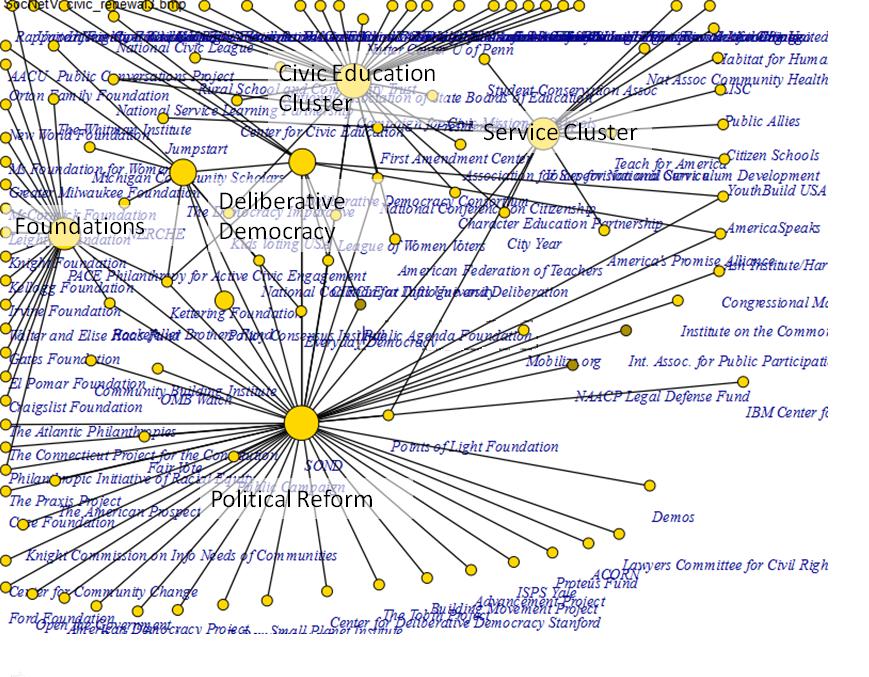
The resulting network has many links–for instance, my own center has close working ties with at least a dozen others–but to detect all the actual connections would be a major project. Instead, I simply entered memberships in the six coalitions listed above. That yielded 270 links. Click on the thumbnail to see the resulting network displayed as a set of rough clusters:

(The method I used here was to display all the nodes randomly on a blank plane within the free software package called SocNetV, and then apply an algorithm that treats each node as an electron that repels the others, and each link as a tie that pulls its two nodes together. That tends to sort the field into clusters.)

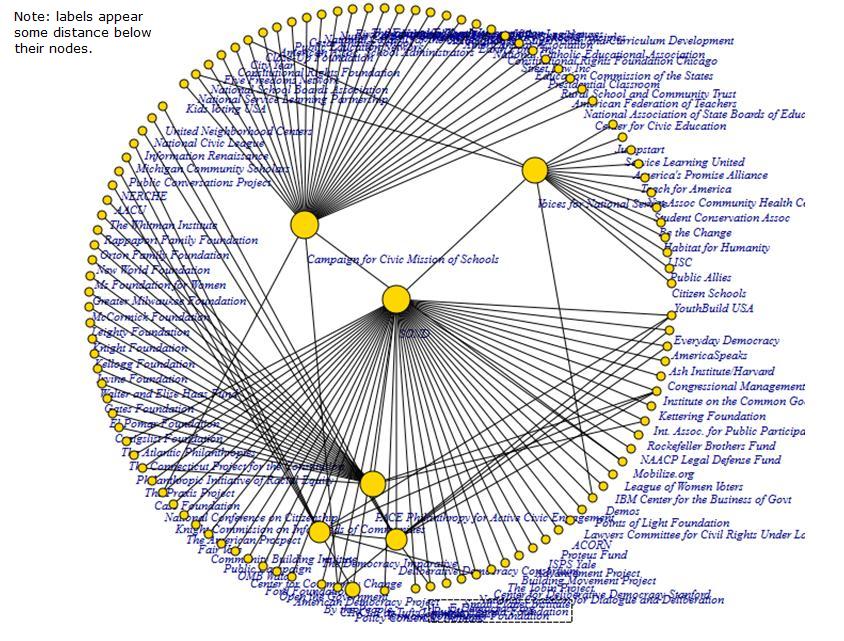
Here is another way to look at the map. Now the network hubs are placed close to the center in proportion to how many nodes they have. This is useful for showing which nodes are most important for keeping large sets of organizations connected. (The size of the node shows the number of members it has.)

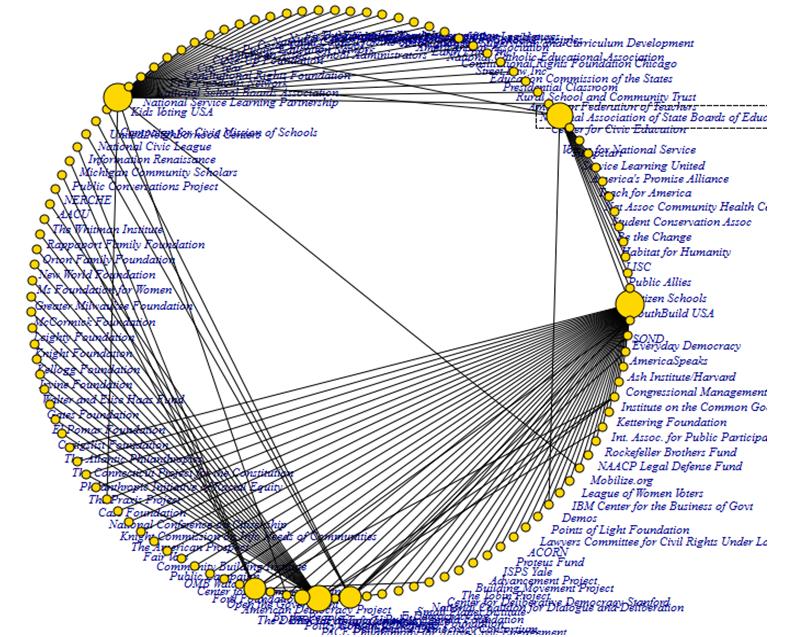
And here is a third way. Now all the nodes are displayed around one circle. If every one were directly connected to every other, the picture would like like a tight ball of yarn. The white space in the middle indicates that the network is not very dense.

Maps are only one way to investigate this set of 117 organizations. One could also count what they do, how they are organized, and who runs them. I have not yet done that rigorously, but eyeballing the list reveals some clear patterns. Overall, I would make these observations:

    1. We badly need an active and robust organization that fits in the spot occupied by SOND. If you deleted SOND from the network, its density would drop by 34%. The network is reasonably coherent if groups can communicate through SOND and be coordinated or convened by SOND. But SOND has no staff or budget. Thus the network is less robust than it looks, although the very existence of SOND lets us see the potential value of an organization in its spot.

    2. We need more organizations with grassroots constituencies. The map includes some. For example, the American Federation of Teachers (AFT) is included because of its membership in the Campaign for the Civic Mission of Schools. But I would say there is a rough inverse proportion between centrality in this network and size of grassroots base. With a few exceptions, such as the League of Women Voters, the organizations that have the most citizen members are peripheral to civic renewal, and the pure civic renewal groups are grant-supported professional organizations or foundations.

    3. We need more diverse leadership. I would roughly estimate that at least 90% of the top leaders of these 117 organizations are white and have college degrees.

    4. Certain organizations play significant bridging roles, not as coalitions but as active members of multiple coalitions. The Kettering Foundation has four memberships within this network; Everyday Democracy and CIRCLE have three. Several organizations belong to two coalitions.

    5. There is a reasonably broad ideological mix in the network as a whole. A simple left-right spectrum seems crude for understanding how these groups differ, but it is interesting that the network includes both ACORN and Teach for America (for example). Without taking a position on the issues that divide these two organizations, I would classify both as having a strategy for “civic renewal”–but each has a very different strategy.

economic stimulus, compared

A New York Times news article asserts that Keynsianism is being ignored in Europe. Instead of stimulating their economies by borrowing and spending or cutting taxes, European governments are tightening their belts. Writing specifically about the looming cuts in Britain, Paul Krugman sees disaster ahead.

On the other hand, European countries have institutionalized Keynsianism (to a degree) by creating social welfare entitlements. When people are entitled to extensive unemployment benefits, as unemployment rises, state spending can soar. In Germany, for example, people who are laid off get between 60 percent and 67 percent of their former income as government benefits, plus health care. Thus I thought that perhaps the current round of budget cutting in Europe was only a course correction after a lot of automatic Keynsian stimulus.

You can measure spending lots of ways, and I ran the numbers for gross government expenditures in nominal dollars and as a percent of GDP. But I decided that the clearest story about governments’ decision-making was the trend in their annual expenditures compared to their own pre-recession baselines. Here is that comparison, based originally on IMF data:

It’s interesting that the US has had the largest stimulus, despite our relatively weak policies for automatically raising entitlement spending in recessions, and despite our alleged resistance to government. The stimulus began under Bush and actually leveled off under Obama. Likewise, Britain has more modest social welfare policies than those in Germany and France, yet British spending has increased more than theirs. As we look forward, the spending line is likely to flatten out in the US but decline in Britain.

the proper role of experimentation in social reform

    The country needs and, unless I mistake its temper, the country demands bold, persistent experimentation. It is common sense to take a method and try it: If it fails, admit it frankly and try another. But above all, try something. The millions who are in want will not stand by silently forever while the things to satisfy their needs are within easy reach. We need enthusiasm, imagination and the ability to face facts, even unpleasant ones, bravely. We need to correct, by drastic means if necessary, the faults in our economic system from which we now suffer. We need the courage of the young. Yours is not the task of making your way in the world, but the task of remaking the world which you will find before you. May every one of us be granted the courage, the faith and the vision to give the best that is in us to that remaking!

    Franklin D. Roosevelt, Oglethorpe University Commencement Address (22 May 1932)

I think FDR’s words apply today–to the letter–because our problems are as serious, and our understanding of what will fix them is as tentative and preliminary, as it was in 1932. Once again, we especially need a new generation to be social innovators. But I would distinguish between two forms of “experimentation.”

1. Looking for “cures,” replicable programs and strategies that are proven to work. This is a very popular goal today (consider the Department of Education’s What Works database). The major analogy is to bench science, and the hope is to find treatments for social ills that work as reliably as chemicals that kill harmful microbes on contact. A social entrepreneur is someone who invents a new solution, proves that it works, and helps it spread through society, rather like Jonas Salk with the polio vaccine.

2. Tinkering: setting up programs that embody one’s profound ethical commitments and theories of society and then experimenting in order to improve their impact or–if they consistently fail, scrapping them and moving on. (As FDR advised, sometimes you have to “admit [failure] frankly and try another” approach.)

One of the flash-points today is the proper role of randomized experiments with control groups. (See, for example, this New York Daily News story headlined, “200 families on brink of homelessness being treated like ‘rats in lab experiment'”.) Randomized experiments do raise ethical questions about the treatment of the people in the studies. But they can be handled ethically, and they are powerful tools for determining what works. I think they have special promise as part of a “tinkering” strategy.

Experiments are actually rather simple and accessible tools for practitioners to use in program-improvement. Imagine, for example, that you are running a program that depends on regular meetings, and you need good turnout. Who shows up seems to depend on when you schedule the meeting, but you aren’t sure whether recent changes in the meeting time have helped because there are many other factors in play (the weather, the subject of the meetings, and so on). You can answer the question with a simple experiment. Randomly divide the next ten meetings into two groups: say, evenings and Saturdays. Count the total number of people who attend the two categories. If one is much better than the other, go for that. No fancy math, survey design, or other research skills are required.

If many organizations routinely applied experimental designs, they could become more effective, and that would help society. Randomization is merely a tool; they would also need a general ethic of experimentation and rigorous self-review.

But often randomized experimentation is motivated by a faith in a shorter path. The hope is to identify big cures that can be quickly “taken to scale” after experiments prove they work. This hope is likely illusory.

A randomized experiment can prove that a social intervention works; its success was not caused by other factors, such as the participants’ enthusiasm. But an experiment cannot prove that the same intervention would work in different contexts. To find real “cures,” one would have to replicate success in many contexts. But experimental results rarely replicate when human beings and communities are involved.

One reason is that the roots of problems lie in human motivations and choices. Often, the chief culprits are not the people directly in view as one experiments, such as the delinquent adolescents who are enrolled in a program. The real fault may lie with policymakers, business leaders, and other people out of view. But in any case, human intelligence and will are involved. So when one intervenes, all the affected parties adjust and seek their own goals, often frustrating the intervention. Microbes don’t respond that way. It is true that bugs can evolve to develop resistance, but human change is deliberate and immediate, not evolutionary.

Besides, many of the most important factors that determine human well-being are not programs or interventions that we can possibly offer to people or assign them to. An example of a program would be a community-service opportunity that students can be required to take or else rewarded for choosing. That is worth assessing with a randomized experiment. But consider a community service activity that kids develop completely on their own. That might be more important and valuable than a program, yet there is no point in assigning individuals to such an experience; it is essential that they created it. Or consider a community, like the city of Somerville, MA, where I am writing this paragraph. There are good things and bad things about Somerville as a context for human development, and we should understand its pros and cons and tinker with its elements as citizens. But Somerville wasn’t designed by anyone, nor can people be assigned to live there (without changing it dramatically). Somerville emerged from three centuries of choices and work by countless powerful and relatively powerless people. If you try to replicate its positive aspects elsewhere, you will be creating something entirely different.

In short, I believe in “bold, persistent experimentation.” I take “experimentation” literally and believe that techniques developed for scientific experiments, such as randomized control groups, have value. But we shouldn’t fool ourselves into thinking that there are cures waiting to be discovered. Persistent experimentation is the key: constantly refining our programs and projects in the light of the best available evidence.