Wilentz v. Ganz on the Obama social movement

During the 2008 presidential primary campaign, the Princeton historian Sean Wilentz was a strong backer of Hillary Clinton and critic of Barack Obama. He launched many debating points. For example, the Obama Campaign allegedly showed “indifference–and at times, even pride” about the fact that white working class voters were opposing Obama in the primary. Wilentz predicted “a Democratic disaster among working-class white voters in November should Obama be the nominee.” Obama was supposedly the anti-political candidate, the heir of goo-goo reformers like Adlai Stevenson and Jimmy Carter, whereas Hilary Clinton, like Franklin Roosevelt, relished partisan combat and understood how to pass legislation. When she insisted on the importance of elected national leaders in the civil rights struggle, she was correct about history, and her critics were just playing the race card by claiming that the movement had achieved its victories at the grassroots.

And now Wilentz gets his chance to say, “I told you so.” His recent New Republic piece is headlined, “Live By the Movement, Die By the Movement: Obama’s doomed theory of politics.” “Clearly,” he writes, “the hopes and dreams that propelled Obama to the White House are in disarray. The social movement politics that some of his most fervent followers ascribed to him–the idea of electing a ‘post-partisan’ president as the leader not of a nation or even of a political party but of a personalized social movement–has failed.” Wilentz names Marshall Ganz as the source of this failed idea.

Of course, Ganz’ diagnosis is the precise opposite. A moral social movement, rooted in Democratic Party cadres and angry about conservative abuses, swept Obama into office over the technocratic Hillary Clinton and the fake populists McCain and Palin. But after Inauguration Day, Obama “chose to demobilize the movement that elected him president. By shifting focus from a public ready to drive change–as in ‘yes we can’–he shifted the focus to himself and attempted to negotiate change from the inside, as in ‘yes I can.'” In other words, there was no progressive social movement when it really counted, and that is why the president couldn’t make more headway on policy. President Obama actually governed the way Wilentz had hoped President Hillary Clinton would govern.

Wilentz writes:

    Fundamental to the social movement model is a conception of American political history in which movements, and not presidents, are the true instigators for change. Presidents are merely reactive. They are not the main protagonists. Obama himself endorsed this conception constantly on the campaign trail, and has repeated it often as president, proclaiming that ‘real change comes from the bottom up.’

But this theory was only one theme during the campaign, and a deeply submerged theme in the administration so far. Much more prominent is the idea that Wilentz seems to endorse: Democratic presidents solve our problems by negotiating and implementing smart policies. As I observed months ago, the President’s rhetoric has been subtly shifting from civic empowerment to a focus on his own personal leadership–from “we” to “I.” Seeking the nomination in Iowa, Barack Obama said, “I hold no illusions that one man or woman can do this alone.” More than two years later, responding to the Massachusetts Senate election, he said:

    So long as I have some breath in me, so long as I have the privilege of serving as your President, I will not stop fighting for you. I will take my lumps, but I won’t stop fighting to bring back jobs here. (Applause.) I won’t stop fighting for an economy where hard work is rewarded. I won’t stop fighting to make sure there’s accountability in our financial system. (Applause.) I’m not going to stop fighting until we have jobs for everybody.

Whether change comes from the grassroots up or from national leaders down is a worthy topic of debate. How the president should govern is certainly a worthy and difficult topic. But it’s important to get clear on the factual basis of the debate. First, the “post-partisan” and “anti-political” themes, if they were present at all in the campaign, have nothing to do with the embrace of a social movement and bottom-up change. The social movement that elected Barack Obama was partisan, political, and ideological. Second, the campaign and the administration never embraced Marshall Ganz’ strategies, except at the margins. Thus the Obama Administration’s first two years are no test of Ganz’ theory, which remains basically untried.

(I’ve never read Sean Wilentz’ historical writings and would surely learn from them. But I’ve been watching his public interventions for a long time and marking them as an example of a certain kind of elitist liberalism that contributes, in my view, to the weakness of the left. During the impeachment hearings of Bill Clinton, he lectured House Republicans, predicting that “history will track you down and condemn you for your cravenness.” I was certainly against the impeachment, but I don’t think that professional historical expertise was particularly relevant to the decision, nor that Professor Wilentz could see into the future. To me his testimony rang of Ivy League disdain, an effort to make a particular moral worldview look like the only intelligent position. Ganz is certainly a moralist as well, but he respects and engages with the core moral commitments of other Americans.)
how more young African American voters could have been engaged

According to new research released today by CIRCLE and the Generational Alliance, younger African Americans (ages 18-29) represented 14% of all younger voters, just about the same as their proportion of the whole young-adult population (14.4%). That means that young African Americans voted on par with other young adults, not a bad comparative showing when you consider that they face the challenges of lower average educational attainment and higher rates of disenfranchisement. On the other hand, keeping pace with other young Americans was not such a great result when the turnout of all 18-29s was only 21%. And younger African Americans lost a lead that they had previously held: they had the highest turnout rate among young people in 2008. If Black youth turnout had been higher in 2010, it would have been good news for Democrats (86% of young adult African Americans voted Democratic) and a source of political strength in the African American community.

Could anything have been done to raise the turnout rate? To start, politicians should not have taken it for granted. Biko Baker, one of the best young organizers in America and a member of CIRCLE’s advisory board, offered to take a leave of absence from his nonpartisan work to help organize for the Democrats in urban Wisconsin. The party told him it wasn’t necessary: “we truly think that people will be inspired to help the President during these next couple of weeks.” But our own focus groups in Baltimore in 2008, plus the observations of real experts like Cathy Cohen (director of the Black Youth Project) found that young African Americans were never in love with Barack Obama. Even in 2008, they felt hope mixed with a great degree of skepticism. It was an open question whether they would be “inspired to help the President,” and much would depend on what he did for them. In the end, turnout was low–not compared to other young people, but compared to what the Democrats needed to win.

To engage young African Americans, the administration could have explicitly addressed racial injustice and issues perceived as racially salient, such as sentencing disparities. Instead, as Cohen writes, a decision was made to “run away from race, and only respond to the issue of race when it was in crisis mode …, leaving young people feeling alienated by the rhetoric and discourse around race in this country.” I agree that the administration has been muted on racial issues–probably more so than other Democratic administrations would be–out of fear of reinforcing animus against the Black president. But I also think that the politics were tough. Explicit discussions of race would have alienated some white voters, and it would have been hard for the president to deliver more than rhetoric on issues like sentencing disparities.

A second strategy would have been to address the critical issues facing young African Americans. The September unemployment rate for African Americans between the ages of 16 and 24 was 32 percent (edging down to 29.7 percent in October). That is catastrophic. But I fear that our political system and climate gave the administration inadequate tools to respond.

The third strategy would have been to give young African Americans a voice and work to do on behalf of the causes that they care about. Many thousands were mobilized as active supporters of Barack Obama in 2008. When the election was over, they should have been maintained as part of an interracial social movement. It would have been illegal as well as unethical to use public funds or the White House to support that movement, but the millions of Obama donors could have been persuaded to fund grassroots work privately.

That would have meant hiring people like Biko Baker and giving him real authority. In turn, he advises integrating media and creative work into a youth movement. He cites as an example the Black Youth Project’s “Democracy Remixed” Video Contest. Thus I’ll end with my favorite video from that contest, by Chris Webb. I don’t necessarily agree with Webb’s whole message, which focuses relentlessly on culture change within the Black community. But I post his work because it exemplifies the excellence of young people’s political voice.

Millennials and News Summit

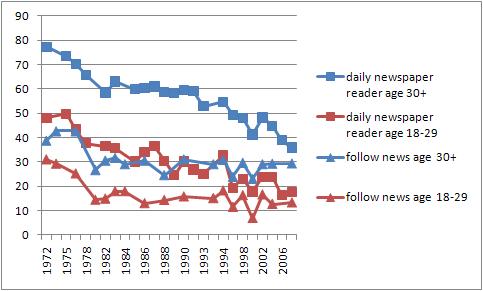
I will be going to Austin, TX later this week for a “Millennials and News” summit at University of Texas. I just made the following graph to orient my own thoughts:

It shows a severe decline in newspaper readership since the early 1970s. The decline is much less pronounced for young adults (ages 18-29): they started out lower but their elders have fallen to meet them. This trend is ground for concern because traditional newspaper readers had many civic virtues, being much more likely to engage in community affairs. I believe the reason for the decline is not a disappearance of civic virtue, but rapid changes in the news business.

The graph also shows a decline in following the news and public affairs “most of the time.” As newspaper readership plummeted in the 2000s, following the news did not fall in tandem–because people were switching to new sources of news. But those new sources didn’t solve our problem, because attention to the news remains lower than it was in the 1970s and 1980s. For youth, the “attention” rate has been pretty constant, despite rapid changes in the news environment, since 1980. It is also very low by any reasonable standard, with less than 15% regularly following the news.

Tony Judt’s Postwar

I just want to put in a plug for Tony Judt’s book Postwar: A History of Europe Since 1945, which I finished a few weeks ago. It’s a sweeping, comprehensive essay about politics, economics, popular culture, high culture, diplomacy, and society in Europe from Ireland to Belarus, from 1945 to 2005. Judt provides no references and quotes relatively sparely, so the narration is uncluttered and un-academic; it moves along at an exhilarating pace. Judt long ago abandoned the grand theoretical frameworks of Marxism and Zionism that he held in his youth, and Postwar is a model of history as a set of concrete, particularistic, contingent episodes (one damn thing after another). Many of the trends in modern European history emrge as fairly accidental–political integration is the best example.

Judt is certainly not value-neutral; in fact, he is a firm moralist with humane and classically liberal judgments–and no tolerance for the deeply intolerant.

A few large conclusions surprised me. Mikhail Gorbachev emerges as a pivotal figure, whose discretionary choices as General Secretary sent Europe on one course when it could have gone in quite different directions. I don’t think Judt subscribes to a Great Man Theory of History–no other individual in the book plays a similar role. But Judt does deny that the peaceful collapse of communism was inevitable, or that it was brought down by US policy or anti-Communist dissidents. He thinks Gorbachev took it down, which would make the former Soviet leader one of the great figures of all time.

The differences among European social welfare states emerged as more important than I had realized. The French nationalized major industries to control employment and wages (and then privatized once they had an officially Socialist government). The Scandinavians, on the other hand, never nationalized but taxed income and spent liberally on individual entitlements. The British government directly provided health care when the Germans and most other continentals relied on private delivery.

On the other hand, certain similarities between communist states and western democracies struck me. Judt is unsparing in his criticism of the purges, the environmental devastation, the human waste, and the general tyranny of communism. But the Warsaw Pact states operated in the same financial and commodities markets as the West and experienced some of the same ups and downs. They also experienced similar generational changes. They were governed until the sixties by old men who had been formed before World War One, and then changed when a new cohort of people took over whose formative experiences had been in the fifties.

Judt’s wide scope takes in parts of Europe often ignored (by people like me), such as the southern Balkans, the eastern Slavic lands, Portugal, and southern Italy. Postwar is partly the story of amazingly rapid modernization, spreading from northwest Europe outward. A comparison to contemporary China seems appropriate.

Postwar ends with a thoughtful essay about what Europe is like today and where it seems to be headed. Judt is aware of the frailties of the European Union and the challenges of the present, including how to deal humanely and justly with immigration and how to serve the young appropriately when populations are predominantly old. Yet he sees tremendous potential in this huge zone of economically integrated democratic states. For all the talk of China (or India) as the great power of the next century, I would not be surprised if Old Europe actually dominates.

against a cerebral view of citizenship

For a faculty seminar tomorrow, a group of us are reading Aristotle’s Politics, Book III, which is a classic and very enlightening discussion of citizenship. Aristotle holds that the city is composed of citizens: they are it. Citizenship is not defined as residence in a place, nor does it mean the same thing in all political systems. Rather, it is an office, a set of rights and responsibilities. Who has what kind of citizenship defines the constitution of the city.

According to Aristotle, the core office or function of a citizen is “deliberating and rendering decisions, whether on all matters or a few.”* In a tyranny, the tyrant is the only one who judges. In such cases, the definition of a good man equals that of a good citizen, because the tyrant’s citizenship consists of his ruling, and his ruling is good if he is good. Practical wisdom is the virtue we need in him, and it is the same kind of virtue that we need in dominant leaders of other entities, such as choruses and cavalry units. Aristotle seems unsure whether a good tyrant must first learn to be ruled, just as a competent cavalry officer first serves under another officer, or whether one can be born a leader.

In democracies, a large number of people deliberate and judge, but they do so periodically. Because they both rule and obey the rules, they must know how to do both. Rich men can make good citizens, because in regular life (outside of politics) they both rule and obey rules. But rich men do not need to know how to do servile or mechanical labor. They must know how to order other people to do those tasks. Workers who perform manual labor do not learn to rule, they do not have opportunities to develop practical wisdom, but they instead become servile as a result of their work. Thus, says Aristotle, the best form of city does not allow its mechanics to be citizens.

Note the philosopher’s strongly cognitive or cerebral definition: citizenship is about deliberating and judging. Citizenship is not about implementing or doing, although free citizens both deliberate and implement decisions.

But what if we started a different way, and said that “the city” (which is now likely a nation-state) is actually composed of its people as workers? It is what they do, make, and exchange. In creating and exchanging things, they make myriad decisions, both individually and collectively. Some have more scope for choice than others, but average workers make consequential decisions frequently.

If the city is a composite of people as workers, then everyone is a citizen, except perhaps those who are idle. It does not follow logically that all citizens must be able to deliberate and vote on governmental policies. Aristotle had defined citizens as legal decision-makers (jurors and legislators); I am resisting that assumption. Nevertheless, being a worker now seems to be an asset for citizens, not a liability. Only the idle do not learn both to rule and to be ruled.

Aristotle’s definition of citizenship has been enormously influential, but it has often been criticized: by egalitarians who resist his exclusion of manual workers and slaves; by Marxists and others who argue that workers create wealth and should control it; and by opponents of his cerebral bias, like John Dewey. The critique that interests me most is the one that begins by noting the rich, creative, intellectually demanding aspects of work. That implies that working, rather than talking and thinking, may be the essence of citizenship. I draw on Simone Weil, Harry Boyte, and others for that view.

*Politics 1375b16, my translation.