Not Quite Adults

Richard Settersten and Barbara E. Ray have published Not Quite Adults: Why 20-Somethings Are Choosing a Slower Path to Adulthood and Why It’s Good for Everyone (Bantam 2010). Their book is a product of the MacArthur Research Network on Transitions to Adulthood and Public Policy, an ambitious collaborative project that also yielded, among many other works, an article by Constance Flanagan and me on “Civic Engagement and the Transition to Adulthood.”

Not Quite Adults is admirably broad, accessible, and well-written, enriched by the stories and voices of real people. (The Network conducted 500 interviews). It begins with a vignette of a typical young person of 30 or 50 years ago, who left home and started life immediately after high school graduation. Today, in contrast, half of 18-24-year-olds still live in the bedrooms where they were children. The ages at which people become financially independent, move out of their parents’ homes, marry, vote, and finish their final degree have all risen rapidly.

One response is to view all these young people as slackers or immature. But that overlooks the profound difficulties young Americans face today in becoming independent. It also overlooks the many ways in which the third decade of life can be a valuable time for learning, developing skills and networks, and contributing to society. Finally, it overlooks serious gaps in the experience of different groups of young people. Some–Settersten and Ray call them “swimmers”–are using their young adult years to strengthen their positions, racking up advanced degrees and social networks before they settle into careers and families. This is all to the good (as long as their expectations of success aren’t excessive, leading to disappointment). Others–whom the authors call “treaders”–struggle to move through the cross-currents of economic insecurity. For them, the third decade of life is increasingly difficult, and they need social investment. Settersten and Ray point to Youth Build, Youth Corps, and Civic Justice Corps as examples of programs that need more support.

The book has its own interactive website, including a blog on which Rick Settersten asks most recently, “Why do so many Americans have it out for young people?” At a time when many of the basic indicators of young people’s well-being (crime, violence, teen pregnancy, and drug use) have been improving, older Americans seem convinced that the new generation is a threat. Asked to discuss “youth,” working class Americans immediately identify behavioral problems–violence, crime, lack of respect for adults and for themselves–while elites are just as concerned about low test scores and dropout rates. Meanwhile, the data on young people suggest substantial improvement.

college students expect service, study abroad, and extracurricular clubs but report stress and low emotional health

Trends in Expectations for College (CIRP Freshman Survey)

Using data from the College Freshman Survey of the Higher Education Research Institute (HERI), John H. Pryor reports that incoming college freshmen are increasingly likely to expect that they will participate directly in extracurricular activities, community service, and foreign study–all experiences that have civic purposes and benefits.

But the same study also shows that incoming college students report increased levels of stress and historically low levels of emotional health. A record-high proportion of incoming freshmen (73%) say that the “chief benefit of a college education is that it increases earning power.”

For institutions of higher education, these trends raise several questions: Are we meeting the expectations of our incoming students? Can meaningful service activities be antidotes to stress and poor psychosocial well-being? Can they enhance students’ economic opportunities? Or do some students report being “overwhelmed” because they are pursuing civic experiences as well as academic work and jobs?

(Cross-posted from the CIRCLE homepage.)

the Campaign for Stronger Democracy

The Campaign for Stronger Democracy pulls together activists for campaign and election reform, deliberative democracy, transparency, collaborative governance, civic education, national and community service, and community organizing. It is an unprecedented coalition, the need for which I tried to demonstrate rigorously through an exercise in network mapping. The Campaign’s monthly newsletter is turning into my favorite compendium of relevant articles. You can register for the free newsletter here.

the Eight Americas

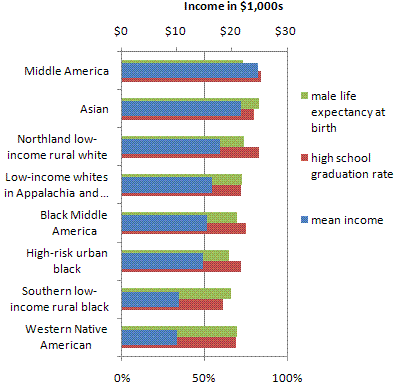
Christopher Murray and six colleagues have published an article entitled “Eight Americas: Investigating Mortality Disparities across Races, Counties, and Race-Counties in the United States.” They divide the entire US population into the following categories:

    1. Asian: Asians living in counties where Pacific Islanders make up less than 40% of total Asian population

    2. Northland low-income rural white: Whites in northern plains and Dakotas with 1990 county-level per capita income below $11,775 and population density less than 100 persons/km2

    3. Middle America: All other whites not included in Americas 2 and 4, Asians not

    in America 1, and Native Americans not in America 5

    4. Low-income whites in Appalachia and the Mississippi Valley (with 1990 county-level per capita income below $11,775)

    5. Western Native American: Native American populations in the mountain and plains areas,

    predominantly on reservations

    6. Black Middle America: All other black populations living in countries not included in

    Americas 7 and 8

    7. Southern low-income rural black: Blacks living in counties in the Mississippi Valley and the Deep South with population density below 100 persons/km2, 1990 county-level per capita income below $7,500, and total population size above 1,000 persons (to avoid small numbers)

    8 High-risk urban black: Urban populations of more than 150,000 blacks living in counties with cumulative probability of homicide death between 15 and 74 [years] greater than 1.0%

Disparities in life expectancy are enormous–for example, women in America 1 outlive men in America 8 by 20 years. It is illuminating to view these empirically-derived categories instead of the usual baskets (such as White versus African American). Below is my chart of selected disparities from the article:

what would Jane Addams say?

This is the tiny rocking chair in which Jane Addams learned to read as a little girl, encouraged by her father, John (“double-D”) Addams, who served in the Illinois State Legislature with Abraham Lincoln.

Zoom out to Jane Addams’ bedroom, decorated with a painted portrait of Tolstoy and wallpaper in the William Morris style. That room is at the head of the stairs in the gracious Italianate Victorian building known as Hull-House where Addams lived for many years.

Zoom further out to the neighborhood where once the Hull-House Settlement, a whole complex of public buildings around green courtyards, once served its neighborhood of tenement houses, factories, and outdoor food markets. “Served” is not really the right word, because the neighbors co-created Hull-House and all of its programs with Addams. Their neighborhood was flattened–quite literally–in the 1960s to make room for the spare modernist blocks of the University of Illonois at Chicago.

Addams always kept her distance from universities. It is an irony that UIC was built on the bulldozed buildings of Hull-House, after the latter had taken its unseccessful fight to survive all the way to the US Supreme Court. But today UIC is a diverse, engaged, urban research university–not much like the University of Chicago from which Addams kept a critical distance. So perhaps the irony is not so painful.

Zoom further out to follow my taxi en route from Addams’ house to Midway Airport. Soon we pass the Cook County Juvenile Detention Center, built with beds for 500 although it often houses 800 young people amid rampant vermin and loose ceiling tiles that can be used as missiles.

We cross a vibrant Mexican-American shopping street, each storefront brightly decorated, and then return to quiet working-class districts of brick homes. Next comes the Cook County Jail, set on 96 acres of city land, housing 9,800 inmates and employing more than 10,000 people, ringed by double coils of concertina wire. Family members wait in line by the maximum security wing.

And then vast industrial lots near the railway yards–historic sources of Chicago’s wealth and its solid jobs. The lots are still huge and busy, but now machines handle the containers and move the heaps of gravel. Hardly a human being is visible for blocks at a time, although I spot a fat black cat hunting in the tall weeds.