Category Archives: philosophy

aesthetics and history

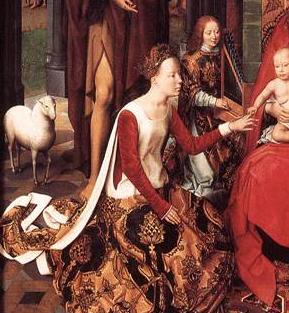
Last week in Bruges, Belgium, at the medieval Hospital of St. John, we saw an altarpiece by Hans Memling that’s sometimes entitled the “Mystic Marriage of St. Catharine.” (The picture to the right is just a detail; click here for a photo of the whole original painting.)

Even if you knew nothing about this work, you might like it–not necessarily in a digital photograph, but in its original 31 square feet of paint. The figures are extraordinarily realistic. The cloth is rich; the colors are luminous and balanced. The woman wears an expression of repose and kindness. Her pale white skin, the ruddier skin of the man behind her, and the wool of the lamb create interesting tactile contrasts. However, if you somehow thought this were a modern illustration, you might not give it a great deal of thought. You would have to acknowledge the artist’s technique, since practically no one can paint light, texture, and skin so naturalistically today. But then again, naturalistic oil painting isn’t very useful now that we have color photographs. And if the image turned out to be a photo of models in medieval clothing, it would be downright strange.

Actually, the altarpiece was painted from 1474-79. That fact makes it much more beautiful than it would otherwise be, I believe. But how can an external fact increase the beauty of an image? The colors would be as rich and harmonious if they had been painted yesterday.

I think that the date and provenance of a work are relevant to its aesthetic value–for two reasons. First, a painting can evoke a whole lost culture. Flanders in the 15th century was cruel, superstitious, oppressive, dirty, and sometimes vulgar. (There is even some vulgarity in the right wing of the “Mystic Marriage of St. Catharine.”) The same civilization was also dynamic, prosperous, and vigorous–the world’s leader in international commerce–yet capable of spiritual purity and calm. An image like Memling’s altarpiece reflects the best of its entire cultural milieu, which greatly increases its beauty.
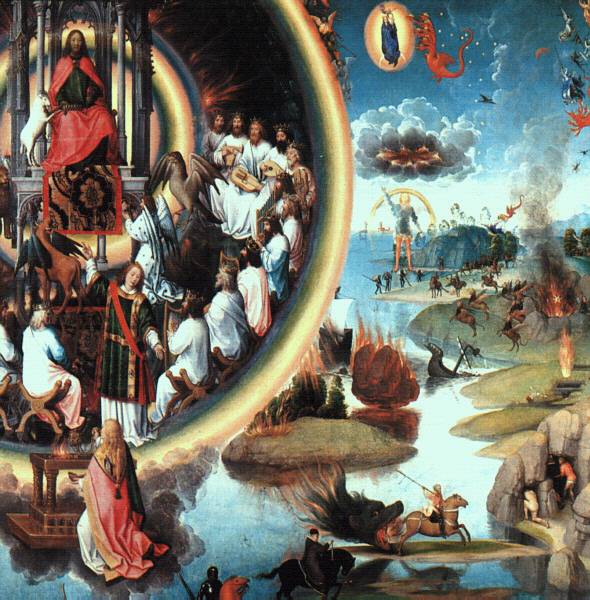
Second, a great work from the past belongs to the “history of art.” We tell this story as a series of discoveries and revolutions (borrowing ideas from other fields of history). It is a heroic tale, beginning with the Archaic Greeks and ending with Picasso and Matisse, if not with post-modernism. Each era or movement is described as solving problems or overcoming prejudices inherited from the past. Once the great artists of a particular moment have solved their problems, we no longer admire repetitions of their success. Thus Memling is impressive because he can imply complex interactions among multiple figures much better than his teachers, Van Eyck and Van der Weyden, could. But any journeyman artist of the 17th century could place eight people in an organized open space and show how each related to the others. So what is original in Memling is commonplace two centuries later. And what is original is also beautiful, because we view the whole history of (Western) art as a moving narrative.

Our emphasis on the historical development of art is itself a feature of our own civilization, not something universal. The first people to tell heroic stories about the development of art were Pliny and Vasari, each coming after a great era of creativity. Their way of appreciating painting and sculpture works perfectly in a secular museum, less well in a temple or a church, which has a different purpose. Memling himself would have had a very limited understanding of the history of art, as shown by the fact that he placed biblical figures in late-Gothic, Flemish settings. Yet our historical sense is what makes us find Memling so beautiful.

against “cultural preservationism”

Near the end (p. 227) of Anne Fadiman?s The Spirit Catches You and You Fall Down (which I discussed on Monday), there?s a dialogue between a doctor and psychotherapist. They have been talking about Lia Lee, the Hmong girl whose treatment for epilepsy violated several basic Hmong beliefs. I?ve reformatted Fadiman?s paragraphs into a mini-dialogue:

Physician: You have to act on behalf of the most vulnerable person in the situation, and that?s the child. The child?s welfare is more important than the parents? beliefs. You have to do what?s best for the child, even if the parents oppose it, because if the child dies, she won?t get the chance to decide twenty years down the road if she wants to accept her parents? beliefs or if she wants to reject them. She?s going to be dead.

Psychotherapist (tartly): Well, that?s the job you have taken on in your profession.

Physician: I?d feel the same way if I weren?t a doctor. I would feel I am my brother?s keeper.

Psychotherapist: That?s tyranny. What if you have a family who rejects surgery because they believe an illness has a spiritual cause? What if they see a definite possibility of eternal damnation for their child if she dies from the surgery? Next to that, death might not seem so important. What?s more important, the life or the soul?

Physician: I make no apology. The life comes first.

Psychotherapist: The soul.

The psychotherapist mentions beliefs about the after-life, which are especially thorny because no one can know what happens after death?there is no empirical evidence. If a treatment saves lives but causes damnation, then one should certainly forgo the treatment. However, just because parents believe that a treatment will put their child?s soul in peril of eternal torture, that doesn?t make them right. Parents do not own their children. As I argued earlier in discussing the Amish, there is a profound conflict between children?s freedom and parental freedom. I believe that a liberal state should protect children against their parents, although it is harrowing to read about California?s unjust and harmful decision to take custody of Lia Lee.

In any case, the Hmong don?t believe in eternal damnation. Although Lia?s parents were concerned about what would happen to her reincarnated soul if her blood were drawn (violating a taboo), that was not the main problem. The main problem was their belief in the efficacy of traditional Hmong healing and their skepticism about the effects of Western medicine. In short, they thought that a Hmong shaman could cure their daughter, while American doctors were making her worse. Fadiman argues that there was some limited truth to this; the physicians made serious errors, whereas Hmong shamans are non-invasive healers who work only on the spiritual level and often get good psychological results. They would have done Lia no harm and might at least have helped her parents.

But ultimately, Western medicine is going to work better than Hmong shamanism for a lot of diseases. Hmong people are learning this; some are even becoming doctors. Thus their traditional culture is bound to change. Even if they preserve shamanistic medicine, it will have a new meaning for them. They will either use it to fill gaps left by Western medicine (especially psychiatry), or they will choose to preserve it because of its cultural significance. But a ritual performed because it is traditional is fundamentally different from a ritual performed because it cures a disease.

Cultural institutions address problems and must change when they are no longer effective. Sometimes there is a lag, because people understandably cling to what they know; but there is no way to stop history. Contrary to the racist articles that described Hmong immigrants as moving out of the ?Stone Age? when they reached America, they had been part of history all along. In fact, they had participated in high-tech battles and suffered a holocaust during the Vietnam War. Some had learned to fly fighter jets. And this was by no means the first time that they had adjusted to a changing world.

The argument against preservationism also applies to cases in the West. For example, some people want to preserve jobs for Yorkshire coal-miners and the Chesapeake Watermen. But their ways of life no longer make sense. Coal is expensive and bad for the atmosphere; crab-trapping doesn’t pay. Preserving these traditional jobs and cultures would require state subsidies or new ?business models? based on tourism instead of commodity sales. A tough, blue-collar culture must change fundamentally if its function changes. It cannot be ?preserved,? because its traditional values included efficiency and self-sufficiency, and those are gone. The only way is forward.

humanistic versus technical philosophy

My two good friends from as early as kindergarten, the brothers Marcus and Jason Stanley, are guest-blogging with Brian Leiter. Lately, they have considered the very question that I have been writing about lately as I try to finish my current book-in-progress: the distinction (if there is one) between humanistic and technical philosopy.

My expertise, to the extent that I have any, is strictly limited to moral and political questions. In those fields of philosophy, there are not two distinct camps, the humanists versus the technical analysts. But there are two poles in a continuum. The same continuum defined moral philosophy in the Renaissance, when humanists (writers and teachers who practiced the studia humanitatis) challenged the highly technical Scholastics, who saw philosophy as a science. I believe that we should move closer to the humanistic pole today, reviving certain aspects of Renaissance humanism. [Warning: The rest of this post is long, because I’ve pasted a section from my book into it.]

Continue reading

how deep is cultural diversity?

“Historicism” is the view that our values are phenomena of our cultural backgrounds and contexts; and contexts differ from time to time and place to place. Although even the ancient Greeks recognized some degree of moral diversity, true historicism was a discovery of the nineteenth century.

However, modern natural and social science have suggested that some important aspects of psychology are common to all members of homo sapiens, the results of our evolved physical natures. For example, it appears that all people place a higher value on a certain gain than on a probable gain of much greater worth; but they have the opposite view of losses. For related reasons, people will go to great lengths to save $5 on a $10 purchase (?fifty percent off!?), but will not inconvenience themselves to save exactly the same $5 on a $125 purchase. A loss of money reduces happiness more than an equivalent gain increases it.

I mention these findings because we are told that they emerge consistently in studies from around the world; they may reflect mental heuristics that evolved when people were hunter-gatherers. Robert Wright tells us that ?people?s minds were designed to maximize fitness in the world in which those minds evolved,? our ancestral state, which apparently resembles modern life among the !Kung San people of the Kalahari Desert or the Inuit of the Arctic.

However, even if such claims are true, they do not negate the existence of deep diversity in other aspects of psychology and moral judgment. If our physical natures directly determined our answers to all moral questions, then we would not debate ethics or literally wage wars over differences of principle. Besides, many of the features of human psychology that are universal are not moral. Perhaps we evolved to be aggressive toward competitors and altruistic toward relatives. Yet we also have the capacity to limit our aggression and to generalize our altruism beyond family and tribe. People disagree about when aggression is appropriate and in what circumstances one must be altruistic. These differences are especially evident when one compares individuals from long ago or far away. Thus the natural basis of aggression and altruism does not in any way reduce the importance of moral diversity and disagreement.

Finally, the very science that generates findings about human nature is embedded in a particular time and society. This does not mean that truth is inaccessible to science or that its findings are arbitrary. It does mean that we should ask whether the questions and methods of recent science are at least somewhat limited by our local interests and capacities. In sum, Isaiah Berlin was right: ?human beings differ, their values differ, their understanding of the world differs; and some kind of historical or anthropological explanation of why such differences arise is possible, though that explanation may itself to some degree reflect the particular concepts and categories of the particular culture to which these students of this subject belong.?

Derrida (the death of the author)

Jacques Derrida died on Friday. All the obituaries I have seen have fundamentally mischaracterized his thought and the movement he inspired, ?deconstruction.? (The Times gets the biographical facts right but avoids defining deconstruction by stressing its obscurity.) I found Derrida annoying when, as an undergraduate, I watched him sign students? t-shirts and then cross out his name to put it ?under erasure.? I criticized him in my Nietzsche and the Modern Crisis of the Humanities (pp. 175-181). After I finished that book in 1992, I ignored him. So did many others, for he became increasingly irrelevant?a fate that may have bothered him much more than angry criticism. So I don?t think much of Derrida; but we ought to associate his name with views that he actually held, not with the vaguely Marxist (materialist and historicist) opinions that are often pinned on him.

Derrida claimed that certain prejudices, which he called ?logocentric,? are to be found in ?all the Western methods of analysis, explication, reading or interpretation? [Of Grammatology, translated by Gayatri Chakravorty Spivak (Baltimore, 1974), p. 46.] These prejudices include a preference for the world over language, for reality over fiction, for sounds over letters, for the signified over the signifier, and for masculinity over femininity. A classic deconstructionist reading of a text involves (a) demonstrating that the text presumes these dichotomies and (b) calling the distinctions and value-judgments into question. For instance, one might very plausibly argue that Dante combines irrationality, verbosity, femininity, and falsehood in the figure of Francesca da Rimini, whereas God is male, rational, silent, and true. Drawing attention to this dichotomy would be deconstructionist criticism.

Derrida went beyond standard deconstruction, however?starting at the latest with Glas (1974). He knew that any argument against logocentrism would itself be logocentric, just because it would be an argument. He wanted to get outside a form of thinking that was, according to him, universal. To achieve ?exorbitant? effects (ones that went outside the normal orbit), he played with styles of writing. For example, Glas consists of two parallel columns, one inspired by Hegel and the other by Genet. Hegel was a great systematic thinker who could incorporate all alternative views within his comprehensive system. Criticizing Hegel would be playing the philosopher?s own game. So Derrida analyzed a completely different author in the same book, discussed disgusting bodily functions, stretched puns beyond any reasonable limit, and said, in effect, ?Philosophize this.?

Everything depends upon the universality of the ?logocentric? prejudices that Derrida identified. If they are omnipresent and important, then Derrida was engaged in a radical project of some interest (but of doubtful value). I think, however, that calling the West ?logocentric? was a massive oversimplification. There are binary oppositions in our thinking, but also trinities and unities. Some of us believe that written text is merely a representation of sounds, which are ?primary?; but others disagree. If the thinking of the West is deeply diverse, then there is no way out of its ?orbit.? In that case, Derrida invented a rather easy game for himself: escaping prejudices that plenty of people had always disagreed with. Some deconstructionist readings are trenchant and plausible, but Derrida?s own works mainly look ridiculous.

Jack Balkin has a nicer take, as does Michael B?rub?.