Category Archives: revitalizing the left

federalism, for liberals

There are good tactical reasons for the American left to embrace federalism, just as Republicans in the era of George W. Bush have favored the national government at the expense of the states (witness No Child Left Behind and the Patriot Act). In the nation as a whole, there is a slim majority that’s culturally conservative, yet many large states are culturally liberal. Therefore, if states make their own policies, many Americans will live in jurisdictions that provide access to abortion, stem-cell research, education that mentions Darwin, and gun control. But if the federal government dominates, all these policies will be threatened–everywhere.

Meanwhile, states are in a position to address social problems if they can innovate freely. For instance, it should be possible to cut the cost of health care almost in half while improving outcomes. After all, our government spends as much per capita on health care as European states do, and then American citizens spend thousands of dollars more on private insurance, deductibles, and fees–all the while leaving 40 million people without preventative care. A state could solve this problem, but only if it could withdraw from Medicare and Medicaid and spend the same amount of money on a single-payer system. Likewise, we spend billions on farm subsidies that drive up consumer prices, harm nature, and reduce incomes in the developing world. Many a “blue” state (predominantly urban and suburban) could opt out of the subsidy system, save money, and improve agriculture. States could also experiment with legalizing marijuana or reforming criminal sentences.

Continue reading

youth protest and media bias

Yesterday, I heard Sarah A. Soule, an Arizona sociologist, present a paper on “Student Protest and Youth Collective Action in the United States, 1960-1990.” She and her colleagues have coded thousands of stories from The New York Times that mention a wide range of collective political actions, from riots and “melees” to lawsuits and petitions. Their huge dataset allows them to observe the frequency of youth protests over time, the rate of collective action on any particular topic (e.g., civil rights), the percentage of protests that involve violence, and many other matters. I won’t “scoop” Soule by describing her results in any detail, but they are deeply interesting. One unsurprising result is a substantial decline in student protest between 1970 and 1990, partly offset by a rise in campus events that favored White supremacy during the 1980s.

Reliance on The New York Times raises methodological issues. It’s certainly possible that The Times has a consistent bias–or worse, has changed its bias over time, thus giving an inaccurate impression of trends in actual political behavior. Soule is something of an expert on media bias, so she is well equipped to handle the methodological problems. Nevertheless, most of the questions from the floor yesterday pressed her hard on the potential for bias. I may be reading too much into these questions, but I thought I detected the following implicit idea: The Times (a representative of what one person called the “corporate media”) avoids reporting on leftist protests, especially those led by students and youth. In reality, youth opinion is further to the left than we think, but the press overlooks the evidence, thereby making elites feel that they can move to the right.

All I can say is, I wish it were so. If anything, I suspect that The Times is biased in favor of reporting certain types of liberal student protest. For example, it gave very intensive coverage to the anti-Apartheid student movement that developed at Yale while I was an undergrad there. (After all, there’s a Times stringer on campus.) It gives hardly any attention to campuses of comparable size and location whose students are more likely to be mainstream conservatives. Quinnipiac University, Albertus Magnus College, and Southern Connecticut State are all very near Yale but never make The Times. Meanwhile, The Times has mentioned the Campus Crusade for Christ just 76 times in the last 33 years, according to Nexis; and most of those mentions were incidental. Campus Crusade for Christ claims 110,000 staff and trained volunteers.

I mention these factoids not because I am conservative or angry at the “liberal media,” but only because I believe good strategy begins by facing reality. Soule’s data, major opinion surveys, and personal observations all tell us that committed young leftists are relatively rare today, and there is a groundswell of genuine grassroots support for conservative causes. That should be the beginning of the conversation.

the left and liberty

Bill Galston has an important article in the Washington Monthly entitled, “Taking Liberty: Liberals ignore and conservatives misunderstand America’s guiding value: freedom.” Although Bill is my boss and friend, we have never discussed this essay or its arguments. I basically endorse it, but I would put the matter in a slightly different way.

The deepest political change in North America, Europe, and East Asia since World War II has been a great increase in the importance and value of individual choice. We can observe this change in family structures and courtship practices, labor markets and educational institutions, media offerings and cultural identities, and religious denominations and political parties across the industrialized world. It is bad news for traditionalists, communitarians, trade-unionists, and democratic socialists, but good news for libertarians of all stripes.

Indeed, three major libertarian groups are influential today:

1. Right-libertarians argue that unregulated markets are the linchpin of all freedom. To be sure, markets require certain virtues that do not arise naturally or automatically. However, right-libertarians are confident that voluntary associations can promote these virtues better than states. Governments are prone to use their financial and police power to restrict choice in insidious ways.

2. Liberal libertarians argue that people are freer when they receive government financial support; but state funds should come without strings attached. For instance, schools, welfare systems, and arts programs should provide students, poor individuals, and artists (respectively) with economic resources, but should not intervene further in their individual decisions. I think that liberal libertarianism has been the dominant ideology of the national Democratic Party since the 1970s.

3. Radical libertarians and anarchists criticize both states and markets for restricting liberty. In contrast to liberal libertarians, they are deeply suspicious of governments, so instead of decrying cuts to welfare and education, they try to build private non-market alternatives.

I am somewhat libertarian myself, but I worry that choice isn’t all that it’s cracked up to be. Choice trades off against solidarity, equity, and security. It can even be a kind of trap, when we make decisions based on our own past experiences and preferences and are never forced to expand our horizons. It seems to me unfair to give young people lots of choices and then expect them to bear the consequences of their mistakes. As for poor people–I’m not sure that they can gain substantial political power without belonging to disciplined organizations (like unions) that restrict their choices. Finally, there is something to be said for what Benjamin Constant called the “liberty of the ancients”, that is, the ability to participate in weighty group decisions. To the extent that individuals make all the important choices for themselves (the “liberty of the moderns”), collective decision-making becomes inconsequential, and then we lose a kind of liberty.

Notwithstanding all these worries, I agree with my boss Bill that the tide is running with individual freedom. To criticize choice in favor of equity or solidarity is a losing strategy. Galston recommends: (1) emphasizing that classic liberal programs, such as Social Security, actually benefit individual freedom; and (2) revising some progressive programs so that they promote equity in maximally libertarian ways (for instance, via vouchers). I’m afraid that this strategy will never allow us to address some of the real disadvantages of choice. In fact, to paraphase Churchill, I suspect it’s the worst strategy–except for all the others that we’ve tried already.
Democrats on government waste

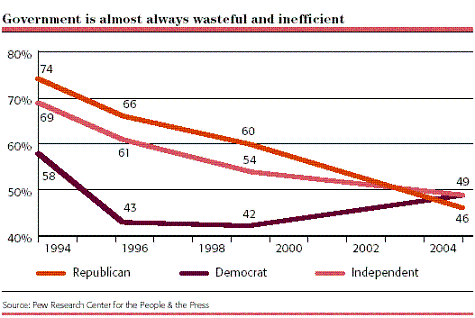
This is a fascinating chart from the Pew Research Center’s “Trends” report.

Once upon a time, a Democrat was someone who believed that most existing government programs were worthwhile. A Republican was someone who thought that most government programs were a waste of money. There is now no difference between the parties on this question, although Democrats are slightly more likely to view federal programs as wasteful.

I suspect that Republican voters became more positive about government after the Clinton-era welfare reform, which ended the traditional federal subsidy to poor women with children. Perhaps they became even more positive once their party ran the government, and the most conspicuous federal programs became the “war on terror” and the invasion of Iraq (plus Social Security and Medicare)–all of which they support.

Conversely, Democratic voters don’t like the administration’s foreign policy adventures or the people in charge of them, and that may be part of the reason that they see government as wasteful. But here’s an additional hypothesis that would help explain the current weakness of the left. Many Democrats have come to see existing government programs–including welfare, education, health, and housing initiatives–as wasteful. This suspicion has a profound effect on politics; it means that a Democratic candidate cannot whole-heartedly or passionately advocate a different position from the Republicans’. Even his or her core constituency doesn’t believe that government programs really get good results. The best that Democrats can do is what Kerry did in ’04: talk vaguely about the need for health care reform, knowing pretty well than any particular legislation is dead on arrival. All that’s left is the ethical commitment to universal health insurance without any confidence that it can be achieved.

I see two main responses: (1) Democrats and liberals are simply demoralized, led into pessimism and cyncism by years of anti-state propaganda. They need to snap out of it–not just the leadership, but also the voters. Or (2) existing federal programs have a record of wastefulness and damage that has become too hard to ignore. We just can’t overlook farm subisidies, huge prisons, urban neighborhoods bulldozed by HUD, and even large school systems like the one my kid is in, with high per-pupil spending but insufficient money trickling down to classrooms. Furthermore, no one has shown us how federal money might solve problems like rust-belt unemployment, high crime and incarceration, or global poverty.

If (2) is true, the Democrats aren’t going anywhere until they develop bold and persuasive plans for reforming government.

the impact of religion on the 2004 election

On p. 29 of Trends 2005, a report from the Pew Research Center for the People and the Press, there is a fascinating chart. (Go directly to the pdf.) Luis Lugo and his colleagues have estimated the importance of various demographic factors in predicting whether an individual voted Democratic or Republican in 2004. They found that church attendance was as important as race; almost twice as important as living in a union household; 2.5 times more important than the urban/rural split; between three and four times more important than income, age, gender, or region (North vs. South); and 5.6 times more important than education. The impact of race was “almost entirely a function” of the Democratic leanings of African American voters; but “the relationship between church attendance and vote choice is seen across the full range of the population.” The impact of church attendance was about one fifth greater in 2004 than in 2000. Gender became less important.

Continue reading