Category Archives: revitalizing the left

the world of DailyKos

In the New York Review of Books, Bill McKibben reviews a new book by the bloggers Jerome Armstrong and Markos Moulitsas Z?niga, Crashing the Gate: Netroots, Grassroots, and the Rise of People-Powered Politics. He uses the opportunity to describe the network of Z?niga’s DailyKos, Talking Points Memo, Atrios, and related blogs as “the most ambitious, interesting, and hopeful venture in progressive politics in decades.” I found the review a perceptive description of this network (which draws at least half a million people a day); but I have mixed feelings about its impact and potential.

Armstrong and Z?niga describe Howard Dean’s appeal in ’04 as “ideologically agnostic, purely partisan.” That’s also a reasonable summary of their style of web-based politics. [See an explicit statement here.] They want to see Democrats play hard. They admire politicians, like Gov. Dean, who attack the Republicans; and they despise Democrats, like Senator Lieberman, who cloud the issue by praising Republicans. Their fury at Lieberman is not ideological, for they will support Democrats who defend the Iraq war–it’s rather the anger of a sports fan who thinks that an athlete is not playing to win.

To give Z?niga and his allies their due: They have pioneered techniques that allow many thousands of people to participate in Party politics. People without much money can make small financial contributions that are aggregated strategically on the Web. Participants can also volunteer time and contribute ideas. Devoted fans of the Democrats are becoming players.

Another benefit of this new style of politics is to increase participation and competition in every community, even the “reddest,” most gerrymandered of GOP congressional districts. Unlike the official parties (which save their ammunition for “swing” seats), Kos and his allies believe that every election should be contested. That is good because it gives more people opportunities to participate.

I should also note that 2006 is the perfect year for the Kos approach. The main issue really will be incompetence and corruption in one-party Washington, and people (some people) really will vote Democratic simply in order to check and oversee the Republicans. This is one year when it may work simply to attack the incumbent party and promote an alternative set of players.

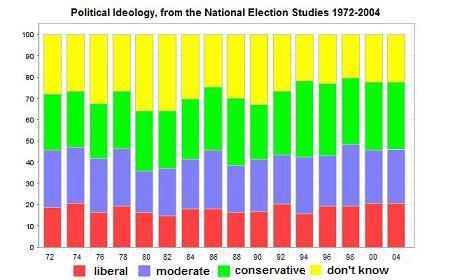
But that approach didn’t succeed in ’04, and it won’t work in ’08. The reason, in my opinion, is a basic imbalance between liberals and conservatives. For a long time, there have been more of the latter than the former.

Continue reading

Fukuyama and BHL on intellectuals

Thanks to reader Joe Sinatra, here’s an interesting dialogue between Francis Fukuyama and Bernard-Henri L?vy (two political theorists who write best-sellers). It ends with an exchange about the role of intellectuals. BHL criticizes neoconservatives–who supported the Iraq intervention for reasons of principle–for lining up with Bush on all other issues (e.g., the death penalty, gay marriage, stem-cell research). Since they are educated and worldly people, surely they can’t be against gay rights. BHL suspects they have compromised their principles to gain access to power.

Fukuyama suggests that neoconservatives sincerely agree with Bush on these questions of social policy, much as this might shock a European. And then he makes a more general comment about intellectuals who work in institutions:

The idea that an intellectual must always speak truth to power and never compromise means for ends seems to me a rather naive view of how intellectuals actually behave, and reflects in many ways the powerlessness of European intellectuals and their distance from the real world of policy and politics. Of course, the academy must try to remain an institutional bastion of intellectual freedom that is not subject to vagaries of political opinion. But in the United States, to a much greater degree than in Europe, scholars, academics and intellectuals have moved much more easily between government and private life than in Europe, and are much more involved in formulating, promoting and implementing policies than their European counterparts. This necessarily limits certain kinds of intellectual freedom, but I’m not sure that, in the end, this is such a bad thing.

Fukuyama describes his own time at RAND, where there was no intellectual freedom but many opportunities to influence policy and learn. To which BHL replies:

That’s it. I think we have come to heart of what divides us. … The problem lies with the definition of what you and I call an intellectual, and beyond its definition, its function. Unlike you, I don’t think an intellectual’s purpose is to run the RAND Corporation or any institution like it. Not because I despise RAND, or because I believe in Kubrick’s burlesque portrayal of it. No, I just think that while some people are running RAND, others no more or no less worthy or deserving should be dealing with, shall we say, the unfiltered truth. … America needs intellectuals with a selfless concern for sense, complexity and truth.

Four observations:

1. One does not have to choose between working in powerful institutions or being fully independent and providing the “unfiltered truth.” One can also work within organizations that represent ordinary people or marginalized groups or that grow at the grassroots level. Dewey spent a lot of time in schools and settlement houses. Jane Addams’ thought was grounded in even deeper experience. Or consider Dorothy Day or various Marxist intellectuals who have worked inside independent socialist and labor organizations.

2. The independence that BHL prizes is quite hard to find. If you teach in a university, then you work for a powerful institution whose social function is subject to criticism. If you write a best-seller, then you are paid by a big media corporation. Working at RAND is not necessarily more problematic.

3. I believe in truth, but it requires method. Truth doesn’t just pop into one’s mind, even if one has graduated from the Ecole Normale Sup?rieure. Many methodologies are helpful–among them, what Fukuyama calls the “discipline” of operating in “the real world of power and politics.” I haven’t read BHL’s new book, American Vertigo, but presumably his method there is to travel and observe for short periods. I find that method quite problematic. (See Marc Cooper’s first-person description of BHL in the field.) If BHL developed a complex and novel social theory or collected data (qualitative or quantitative), I would be more impressed by his claim to “truth.”

4. Tony Judt is very insightful about “the demise of the continental [European] intellectual.* On May 31, 2003, Jacques Derrida and J?rgen Habermas (together), Umberto Eco, Richard Rorty, and several other leading intellectuals published coordinated essays about Iraq in distinguished European newspapers. The result “passed virtually unnoticed. It was not reported as news, nor was it quoted by sympathizers. No-one implored the authors to take up their pens and lead the way forward. … The whole project sputtered out. One hundred years after the Dreyfus Affair, fifty years after the apotheosis of Jean-Paul Sartre, Europe’s leading intellectuals had thrown a petition–and no one came.”

Judt suggests several explanations. Intellectuals can no longer get fired up about social-liberal causes, because their position prevails across Europe. Capitalism remains a target of criticism, but no one knows what to do about it. I would add that most European intellectuals lack the discipline of working inside institutions. Such work would give them more access to truth as well as more credibility.

*Judt, Postwar: A History of Europe Since 1945 (New York, 2005), pp. 785-7
a postscript to yesterday

In the schematic that I presented yesterday, one axis was defined by attitudes toward “the state.” That’s actually too simple. The state can be unitary, hierarchical, and centralized; or it can be decentralized and participatory. Attitudes toward each kind of state can vary from favorable to hostile. Unfortunately, I can’t draw a four-dimensional box, but it would be better to show a range of attitudes toward a range of types of government.

My own sympathies lie with governmental bodies–neighborhood commissions, public corporations, advisory boards, public/private ventures, police beat councils, charter schools, problem solving courts, and the like–that address local realities and that allow volunteers to participate. These bodies are better suited to influence culture, which was yesterday’s topic. On the other hand, they may also reinforce harmful cultural norms. Federal mandates certainly helped to make local schools and town governments less racist.

I’m just making things as complicated as possible here ….

on culture and poverty

“The central conservative truth,” Senator Moynihan famously wrote, “is that it is culture, not politics, that determines the success of a society. The central liberal truth is that politics can change a culture and save it from itself.”

This is the great issue of the present, or so it seems to me. But there are more positions than Mohnihan?s liberalism and conservatism. In fact, we can classify responses along three axes. First, materialists believe that to succeed and to be happy, you need money–or things that money can buy. Their opponents are cultural determinists who believe that what matters is the “fit” between a person’s norms, habits, and beliefs (on one hand) and the dominant culture of modern capitalism (on the other). A second axis runs from love for this dominant corporate culture to hatred of it. The third axis runs from those who think that government is helpful to those who consider it incompetent or corrupt.

When there are three axes, there are eight pure positions available, along with various moderate views. I think the following combinations are particularly serious and influential today:

Materialist left-liberalism: This is the view that poor people mainly need money (or its equivalent) to get ahead. They should get financial help from the state. However, no one should try to manipulate their values or beliefs.

Materialist libertarianism:: Everyone would prosper (to the maximum extent possible) if it weren?t for state institutions and regulations that distort choices, block exchanges, and forcibly educate people in bad habits and beliefs.

Left cultural criticism: What determines success is the fit between a person?s culture and the dominant, white collar, market system, with its demands for discipline and rationality. However, that system is wickedly imperialistic and dehumanizing. Capitalism, not working class and traditional cultures, must be changed.

Moynihan-style neoliberalism: What keeps some poor people poor is a set of habits and values that don’t prepare them well for a competitive market economy. However, the state can and should make them more competitive. For instance, if some parents don’t read to their preschoolers, then four year-olds should be in Head Start. If some households and neighborhoods impart anti-intellectual lessons, then we should lengthen the school day and year and toughen academic curricula.

Cultural conservatism: What keeps some people poor are their habits and values, but the state is bad at changing cultures. In fact, it tends to reinforce the worst cultural traits among the poor. It would be better to reduce state influence on values. For example, more students should attend religious schools.

I have no answers, but I suspect that: (1) Some degree of materialism is still important. For instance, people would be better off if they had affordable or free health insurance. (2) Nevertheless, there is a conflict between many subcultures and the dominant, corporate-capitalist world. That conflict means that no amount of redistribution will end poverty. While the redistributive programs of the twentieth century (Social Security, Medicare, Medicaid) are valuable, they leave cultural problems unresolved. (3) The record of the state in changing values and habits is neither excellent nor awful, but mixed. There have been successful initiatives, e.g., Quontum Opportunities Program, which cut dropout rates in half. There have also been numerous failures.

could manufacturing back the Democrats?

It is a truth universally acknowledged that a party without possession of Congress or the White House must be in need of some rich donors. I wish this weren’t true; for two years, I worked for Common Cause, advocating campaign finance reform. But private money still runs campaigns, and so the question is, on whom will the Democrats depend for funding in 2008?

Continue reading