Category Archives: Internet and public issues

a caution about the “commons”

“Commons” are various types of resources that are either owned by no one (e.g., the oceans and the Internet), or owned jointly by some community. There are many advantages to commons. They can be free, diverse, communitarian, egalitarian, creative, and democratic. We can cite examples of commons that meet each of these criteria. But chances are, the various goods that we expect from commons will conflict in actual cases. For example, there are highly communitarian commons in which everyone knows everyone else; strong social pressures ensure that all contribute genuine goods to the common pool. These commons are communitarian, but not free or diverse. Then there are extremely libertarian commons, like the Internet, in which diversity, creativity, and freedom are rife, but many people free-ride or pollute the common pool with spam and viruses; and trust is low. There are commons that are democratic in the sense that everyone has an equal vote on policies the affect the whole, but if such votes are binding, then there may not be much individual liberty. I am not convinced that there are commons that meet all the desirable criteria at once.

These are familiar tensions that we see in the design of all institutions. I believe it is important to acknowledge them when we champion the commons, or else it will look like a panacea when it is not.
the commons and youth development

I’m writing a paper (for a conference organized by Lin Ostrom) that connects my two main preoccupations: the Internet as a commons, and youth civic development. Actually, I believe this link is very important. A “commons” is a public asset. It requires voluntary contributions, and it can be ruined by pollution or exploitation. Therefore, it depends on people who display trust, reciprocity, long time-horizons, optimism about the possibilities of voluntary collective action, and personal commitment. People have to be raised this way; they aren’t born “civic” (i.e., with a deep feeling of belonging and responsibility for some common good).

Lots of evidence shows that people develop durable attitudes toward the public sphere during adolescence. They either come to see themselves as efficacious, obligated, critical members of a community, or they do not. Their identity, once formed in adolescence, is hard to shake. This theory derives from Karl Mannheim, but it has considerable recent empirical support. In the 1920s, Mannheim argued that we are forced to develop a stance toward the public world of news, issues, and governments when we first encounter these things, usually in our teens. Our stance can be one of contempt or neglect, or it can be some kind of engagement, whether critical or conservative. Most of us never have a compelling reason to reassess this stance, so it remains in place throughout adulthood. That is why generations have enduring political and social characters, formed in their early years.

Unfortunately, there is reason to suspect that young Americans are less likely to develop civic identities and values today than in the past. For instance, most of the decline in social trust since 1970 is a result of young Americans becoming highly distrustful of fellow citizens. This is bad news for any effort to develop a commons–whether a small-scale resource like a community garden or a vast social form like the Internet. There are (of course) some young people with habits and norms that are friendly to the commons, but not nearly enough.

On the bright side, we know how to develop civic identities. Adolescents need to feel that they are assets, rather than potential problems; that they matter to a group. It also helps to have direct experience with civic or public work. This is the impetus behind much service-learning. It is also what we are trying to accomplish at Maryland by helping young people to create free public goods for display on a community website.

cyberbalkanization

There’s a lively discussion of “cyberbalkanization” on the Deliberative Democracy Consortium’s blog. The discussion was prompted by a New York Times article last Sunday that claimed that people use the Internet to sort themselves into small, homogeneous groups and to filter out views that don’t interest or please them. I’ve pasted my comment below, but I recommend the full discussion:

For my money, the best theoretical account of cyberbalkanization is still a 1996 paper by Marshall van Alstyne and Erik Brynjolfsson. They predict that the Internet will help people who are so inclined to increase the range and diversity of their information and contacts. They also predict that the Internet will allow people to “filter” out unwelcome ideas or contacts and to form narrow, exclusive groups. So the technology will not determine the outcome; people’s motives will. And clearly, people have various motives. Some prefer diverse ideas and serendipitous encounters; others want to shun people who are different and simply confirm their own prejudices.

I am fairly pessimistic about the cyberbalkanization problem, not because of the technology, but because of cultural trends in the US. Niche marketing has become highly sophisticated and has divided us into small groups. There’s more money to be made through niche programs than by creating diverse forums for discussion. Meanwhile, people have developed consumerist attitudes towards news, looking for “news products” that are tailored to their private needs. And broad-based organizations have mostly shrunk since the 1950s. In this context, the Internet looks like a means to more balkanization. In a different context, such as contemporary Saudi Arabia, it may have a much more positive impact.

online organizations

I’ve been asked to write an article on how young political activists use the Internet. After an introduction about the political potential of the “commons,” I turn to various types of online youth activity. One short section concerns online political organizations. Comments would be welcome. I’m planning to say:

Political, ideological, and civic organizations have formed largely or entirely online, representing virtually all ideologies, identities, and agendas. Their organizational structures also vary greatly, but compared to offline groups, they are more likely to have anonymous or pseudonymous members. Anonymity has the advantage of allowing candor, which is especially beneficial for members of stigmatized groups (such as the only gay adolescent in a small community). It also allows people to experiment with novel identities. However, anonymity may have the disadvantage of making relationships relatively superficial and may permit behavior that is disruptive to the group itself. If members can adopt fictitious identities, then they can change their identities as soon as anyone threatens to expel or socially ostracize them.

Compared to offline groups, online ones tend to be easier to “exit” but harder to change by exercising “voice” (Hirschman), because there is no method of democratic decision-making that one can influence. Because exit is easy, groups tend not to discipline their own members by demanding contributions or particular forms of behavior in return for membership. Again compared to offline groups, online ones tend to be “thin” rather than “thick” (Bimber, p. 148). In a classic “thick” group, such as a family and ethnic group, members are committed to the survival and flourishing of the collectivity; but its purposes are changeable and subject to debate. In a “thin” group, members enter having some purpose, and view membership as instrumental to that goal. Although many online groups are “thin,” unstructured, and easy to exit, this is not true of massive, multiplayer games, whose participants invest considerable time in developing fictional characters. Often, they become highly committed to the flourishing of the game community as an end in itself.

However, most games are not political. Political or civic groups more typically allow members to visit a website, contribute money, and/or elect to receive email messages. A prominent example is MoveOn.org, a liberal organization in the United States that claims 2.3 million members as of January 2004. MoveOn was formed to oppose the impeachment of President Clinton, but now tackles issues that its members choose by voting. It has raised and spent millions of dollars to influence US policy. No information is available about the median age of MoveOn members or staff, but it has been described as an “an inter-generational grouping heavily peopled by young voters, something that most political constituencies lack” (Schechter, 2004).

young people and Internet campaigns

We released a survey today that contains a lot of data about young people–their

civic and political behavior and attitudes, and specifically their reaction to

the ways political campaigns are using the Internet.

Campaigns are effectively using the Internet to reach young people, and will

continue to do so.

But is this because young people are computer-savvy and demand Internet based

campaigns? Or is it because campaigns see advantages to a cheap medium that

can reach and expand their base (more cost-effectively than broadcasts and

mass mailings)? Overall, our data show that young people are not particularly

favorable toward new, online campaigns techniques. They favor some approaches

but oppose others.

Despite a general lack of enthusiasm for many online campaign techniques,

however, there are some pools of young voters who do like the new technologies.

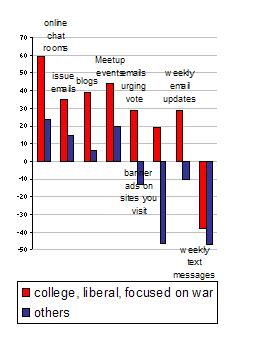
For example, those college students and college graduates who are liberal

and concerned about the War in Iraq are overwhelmingly aware of blogs and

favor their use in campaigns by 68%-32%. This group also likes “banner ads”and

weekly email updates, which are unpopular among youth in general.

The graph shows the percentage who like each campaign technique, minus those who don’t like it or call it a “turn-off.” We distinguish liberal college students who are concerned about the war (red bars) from other youth (blue).

These findings put the Dean phenomenon in context. The demographic group

that most likes his campaign themes is also most favorable toward electronic campaigning.

It is not at all clear that blogs and Meetup events would work nearly as well

for other candidates. Given that strong partisans and well-educated youth are most enthusiastic about the new technologies in politics, the Internet looks like a means to organize core voters, not a way to expand the franchise