Category Archives: Internet and public issues

Wikipedia entries as class assignments

Jon Beasley-Murray, a Canadian professor of Spanish literature, assigned to his students the task of writing Wikipedia entries on various important Spanish-language novels. Each student would receive an A if his or her work achieved “GA [good article] status,” and an A+ if the work was named a Featured Article (of which there are about 2000 in English). Indeed, his student’s page on El Señor Presidente by Miguel Ángel Asturias became a Featured Article.

There is an insightful interview with Beasley-Murray on Wikipedia Signpost. He tells interesting stories about challenges and strategies for overcoming them. He also makes the general point that “educational technology” tends to ghettoize students’ work on private, amateurish sites. He prefers to involve his classes in producing real social media. His students’ best articles are being viewed about 600,000 times a year.

I like the idea of asking students to contribute to Wikipedia. Apparently, quite a few other professors and some secondary-school teachers have done so. In a similar vein, I asked my students this fall to publish their weekly writing assignments on a blog. We all agreed that it would not get much traffic, and it will probably be temporary, because the class is helping to build a much more sophisticated social networking website that will make the blog obsolete. Still, the act of “publishing” their work–making it accessible to search engines–has ethical and motivational significance. It means that they must consider what a community member would feel who came across their work. They are in the public sphere, which is where real citizenship takes place.
the new media literacies

The old “media literacy” meant being able to understand a news broadcast or a commercial; having some idea how it was constructed and how it might manipulate you; being able to choose reliable and relevant broadcasts and avoid junk. Those are still good skills to have. But the new “media literacies” include things like “digital storytelling”–being able to tell a story using words, images, and sound on a website–designing a digital game, or writing a text document online with lots of collaborators.

These are active skills, befitting a more active media environment. They are also highly challenging, and it is definitely not true that “young people today” know how to use them effectively. Quite the contrary–teenagers are less likely than some older groups to spend time doing these things, and I have often found them intimidated by the combination of tech skills and civic/political skills that you need to be effective.

But here are two amazing toolkits people of all ages can use to learn the new media literacies.

1. Puget Sound Off, a great social network for youth in the Seattle area, now has a set of “interactive videos to help you master blogging, digital storytelling, and other multimedia skills.”

2. The New Media Literacies Project at MIT has a large library of training videos and games that are designed to be combined, augmented, and amended by a community of users.

I think this field is in its infancy and we are just learning what skills are important and how to teach them. The best learning is experiential, and I’ve gained a lot from interactions with both of the projects listed above.

open source politics

(heading back to Boston from the Midwest) I’ve been thinking about when it’s a good idea to develop knowledge in an open way–by inviting anyone to contribute to a common pool. Wikipedia is a remarkable resource that has been built by volunteers who not only write, but also edit others’ work. Google often leads you quickly to the best information, even though nobody sits at Google’s HQ writing websites or picking the best ones. Google’s search results are driven by choices that millions of other people have made.

Yet the White House’s recent open discussion of “transparency” was quickly dominated by people who wanted Barack Obama’s “real” birth certificate to be released. Their comments couldn’t be deleted as irrelevant, because they did have a concern about transparency. I think their concern was simply embarrassing (to them), but I don’t get to decide what’s valuable or ridiculous in an open forum. The whole discussion was mostly unhelpful, in my opinion, because they dominated.

I recently visited Project Vote Smart, which employs hundreds of college students every year to collect and code candidates’ position papers, speeches, and votes. This is a labor-intensive model that is threatened by automated systems that promise equally good results without human labor. Yet I suspect that the careful work of Project Vote Smart is indispensable. I doubt that we can rely on a wiki or a search engine to provide reliable information about local candidates.

Reflecting on these examples, I would propose three general principles for deciding when to use an open process:

1. It works best when value-conflicts are minor or absent and information is the main issue. That means that an open process works better in science and technology than in politics or religion.

2. It works best when millions of people participate, because they can swamp small groups of cranks. But in American politics, below the presidential level, millions of people do not participate actively. An open forum about a candidate for state legislature, for instance, is likely to draw just a handful of actual contributors.

3. It works best when stakes are relatively low. If I organized a public discussion of transparency on this website, there would be few participants, but their comments would probably be well-intentioned and thoughtful. There would be no motivation to disrupt a discussion on my personal website, because my site has little or no political importance. But if the White House organizes a discussion, all of its political opponents have motives to disrupt it. The White House is powerful, and it has enemies. When power and conflict are involved, many of the old rules of politics reassert themselves–even online.

what the Dickens?

“I don’t care whether I am a Minx or a Sphinx”

— Charles Dickens, Our Mutual Friend

Tired of those ugly and complicated web page addresses? This site will convert any URL into a random quotation from the works of Charles Dickens. For example, instead of using the awkward address of my blog, you can enter http://dickensurl.com/7e94/I_dont_care_whether_I_am_a_Minx_or_a_Sphinx and find yourself right back here. Bookmark it!

This is a silly example, but there are significant issues regarding domain names. When I first became interested in technology policy around 2000, I thought that simple, memorable names were going to be scarce resources that the rich and powerful would monopolize. I still think it is valuable to own, say, Boston.com (even though the current owner is the poor beleaguered Boston Globe). But it turns out that there are so many billions of web pages–often automatically generated from databases–that people can’t remember URLs or tell them to each other. Instead, we rely on tools to find sites, and the most influential tools are search engines. A high Google-ranking is more valuable than a catchy domain name. That means that the policies and algorithms used by the major search engines deserve constant scrutiny.

mapping Boston’s civil society

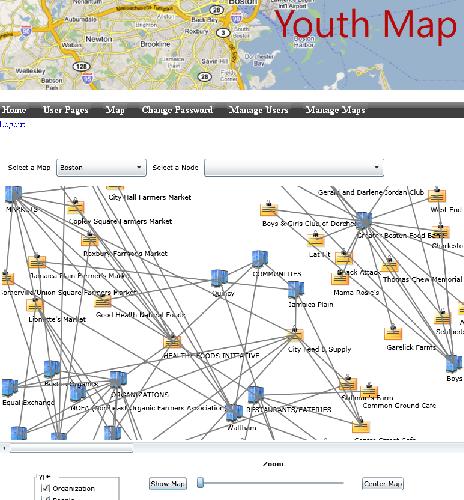
We’re busy mapping Boston. Students place nodes that represent people, ideas, or organizations on a blank plane. Each node stores data, such as contact information, goals, activities, and geographical locations. Connections among nodes represent real collaborations. The data can be shown in lots of ways–on a geospatial map, as a network diagram with various center-points, as a list of search results. Ultimately, this software will be an application for Facebook and MySpace, making it easy for people to add or use data . For now, we have a standalone website.

Here’s a screenshot from today. This represents the work of just a few Tufts undergrads over a couple of weeks. We’re already working with students at UMass Boston and will be expanding beyond those campuses in the spring. The software is also capable of automatically harvesting organizations and links from the Web and pasting them here to be analyzed by human beings.

Purposes:

  • Recruiting people and organizations. One can search for individuals who are connected, even indirectly, to a given issue and then ask them to participate in events or projects.
  • Finding opportunities. One can search for places to volunteer, give money, or organize politically. The search can be by key-word. More interesting is to search for organizations that are linked to other organizations.
  • Analysis and deliberation. One can link two issues together, or link an issue to an organization, and then debate the connection. Is homelessness worsened by zoning? That hypothetical connection can be discussed on the map itself.
  • Broadening sources. Journalists, government agencies, foundations, and researchers tend to ask the same people for information and opinions. They often rely on formal credentials as evidence of knowledge. The network map can lead them to overlooked citizens who are useful sources because of the social roles they play.
  • Investigations. One can look for inappropriate or problematic connections, or lack of connections.

Issues that students have brought up so far:

  • Privacy: Whose information should go on the map, and who decides that?
  • Chilling effects: Would people be discouraged from linking to controversial organizations and causes if their links could be mapped?
  • Spam and other bad stuff: Inappropriate content can be added to the map
  • Marketing: Instead of recruiting volunteers or activists for a social cause, a company could use the map to find influential customers.
  • Sustainability: It’s fun for me and my colleagues to build the map. But other people who contribute need to know that it will still be there (and kept current) in five years.
  • Limits: This is a Boston area map. That geographical definition gives it useful density. But Darfur could belong on the map, since Boston-area students work on Darfur. Former Bostonians could place themselves on the map. Is there any point to a geographical limit?