Category Archives: education policy

strategic and open-ended politics

The Washington, DC public school where my daughter used to study and my wife used to teach is a little chaotic, inefficient, and inequitable, but it is also very diverse, participatory, and tolerant. It has its successes: academic, ethical, and cultural. In other words, it is a public institution (and a community) that can easily flourish or fail–or do a bit of both at the same time. Many adults devote attention and passion to trying to make it flourish, rarely in unison but with overlapping values and goals.

One of the most obvious problems that this particular school faces is the system’s bureaucracy, which is often arbitrary and wasteful. Charter schools are permitted to operate independently of “downtown.” They have grown to such an extent that more than half of Washington’s public school population now attends charters. So whether to turn our old school into a charter is an obvious issue for discussion. As a matter of fact, I didn’t notice much talk about charters–partly because many people were ideologically opposed to them, and partly because a group of parents had actually left the school to launch a charter. But it’s easy to imagine a conversation beginning.

With that background, consider two ways that a charter debate might unfold within a school like ours:

1. Strategic politics: Advocates favor charters (in general) for several quite different reasons. Some see them as means to introduce competition into education. Others see them as opportunities for teachers to obtain professional autonomy and dignity. For either group, an individual charter school is an experiment designed to test a general principle. That principle can generalize, not only beyond the individual school, but beyond education altogether. For instance, libertarians have seen charters as a way to demonstrate that competition can improve outcomes even for one of the most traditional and accepted functions of government–the school. If charters work, libertarians feel they gain an argument in favor of a different kind of society, which is also why some of their opponents try to block charters. Again, libertarians provide only one example; there are also leftist charter-advocates who want to test principles of localism and teacher-control.

Unless you are an unethical ideologue, you must care about local issues, such as the impact of any policy on individual kids and the proper timing, risk, cost, and inconvenience of a particular change. You should also be open to the possibility that your experiment will fail. Yet if you are strategic, you believe that society as a whole would be better off if your theory were applied more generally, and you are right to look for opportunities to test it responsibly. From that perspective, a school is a chance to try the theory.

2. Open-ended politics: Members of our old school community might not be interested in charters, pro or con. They might care instead about what’s good and bad in their own school and how to improve it. In other words, their unit of analysis might be the building and the people in it, not something as general as charters, let alone competition or professionalism. Each participant in such a debate would have slightly different objectives and different beliefs about what works. But they would share a primary concern for the particular institution.

Most people will bring into such particularistic discussions some prior opinions about general concepts, such as bureaucracies, charters, teachers, competition, liberalism, etc. But if their focus is on the school itself, such concepts will arise as just one type of consideration among others. Instead of debating whether charters advance a general cause, they may be concerned about the school principal (who happens to be good at her job), and ask how she would fare if the school became a charter. Or they might worry about the effects of any controversial change on the cohesion of their community. For them, turning into a charter competes for attention and credibility against modest, everyday changes, such as beefing up the fifth-grade curriculum or raising more money at the annual auction. They look inside the “black box” of the school and are concerned about each teacher, curriculum, test, and rule.

I am not against strategic politics. I have my own general beliefs and I think they matter. But I think that open-ended politics is:

  • Under-studied, notwithstanding some great work by the likes of Harry Boyte, Lewis Friedland, Archon Fung, Jenny Mansbridge, Carmen Sirianni, and Mark E. Warren. There is incalculably more research about interest groups and ideologies than particularistic, open-ended public work.
  • Under-resourced, because vast quantities of money and skill are devoted to various kinds of strategic politics, but hardly anyone subsidizes or rewards open-ended politics.
  • Rather counter-cultural, because a group of Americans who assemble today to discuss an issue are quick to seize on a general cause and look for “messages” and strategies to persuade others.
  • Disfavored by modern policies, which often implement very general theories. (An interesting exception, however, may be the charter school movement itself, if you think that a charter creates an opportunity for open-ended politics.)
making tests

I’m at the Educational Testing Service in Princeton, NJ, helping them to cook up a test. There are many cooks at work on this particular broth. In fact, what strikes me most about the process of designing a national student assessment is the enormous complexity of the process. There are laws, policies, rules, budgets, curricular standards and objectives, “items” (i.e., questions of various types), answer keys, trainings and guides for scorers, data from preliminary laboratory tests of items, pilot tests of whole exams, statistical results from the pilot tests, revised items and instruments, final results, statistical scales, summary measures, and reports. There are content experts, item-writers, statisticians, psychometricians, scorers, trainers, trainers-of-trainers, and various layers of contractors and government agencies and reviews.

If you are prone to distrust or dislike pencil-and-paper exams (and I understand and respect those arguments), all this apparatus may seem like a bureaucratic and technocratic nightmare. Indeed, any test involves countless value-judgments, guesses, and compromises, often buried in technical or administrative jargon. There is something extremely “Weberian” about a government-sponsored exam or assessment. It is a classic example of the effort to standardize and measure in order to control and improve.

On the other hand, if you are not directly acquainted with the process of test-design at the federal level, you might not realize how many different people struggle to develop and implement tests that reflect ethical principles of fairness, reliability, relevance, and social significance. The result is, if nothing else, the product of a lot of hard work.

coming of age in a winner-take-all society

These are some winning words from the National Spelling Bee, by year:

1932: knack

1940: therapy

1973: vouchsafe

1975: incisor

2001: succedaneum

2004: autochthonous

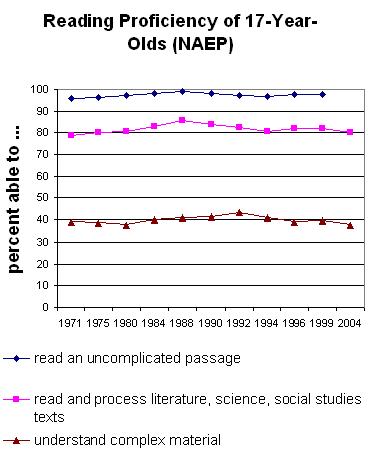
The tremendous increase in difficulty is sometimes taken as evidence of rising achievement (e.g., in Strauss and Howe’s book, Millennials Rising.) But compare the national achievement rates in reading, as measured by the Federal Government’s National Assessment of Education Progress:

High school reading scores are totally flat, and far from adequate in a competitive, 21st-century economy. (And these results reflect only youth who are still enrolled at age 17; one third drop out before graduating.)

This pattern seems to be a perfect example of what Robert H. Frank calls the “winner-takes-all” society. It only takes a few superb contestants to make an entertaining national Spelling Bee competition that’s fit for TV. Given the rewards of winning, hundreds of thousands of American kids will enter, and the very best will rise to the top. The Spelling Bee process doesn’t have any relevance to, or direct effect on, the remaining 99.999% of kids.

By itself, that’s not a problem–in my opinion, awesome spelling achievement is a parlor trick that any computer can perform to perfection. But the same logic applies to more important competitions as well: admission to an engineering school, becoming a partner in a law firm, being drafted to the NBA, getting a seat in an orchestra, or making tenure at a good university. The few who make it to the top win bigger rewards than ever before, because the process of selection is increasingly efficient and the base of contestants is larger. The excellence of the winners is impressive. But the effects on the rest of the population are problematic, at best.

measuring what matters

(Washington, DC) I am here for a meeting of a federal committee–one of dozens–that helps to decide which statistics to gather from public school students. We are especially focused on socio-economic “background variables” that may influence kids’ success in schools. What to measure often boils down to what correlates empirically with test scores or graduation rates. For instance, a combination of parents’ income, education, and occupation can explain about 15%-20% of the variance in test scores. And so we measure these variables.

But the mere fact of a correlation between A and B doesn’t mean we should measure both. We could look for correlations between the length of students’ noses and the weight of their earlobes. Instead, we look for covariance between parental income and the total number of questions a kid can answer correctly on a test that we write and make him take. Why? Because of moral commitments: beliefs about what inputs, outputs, and causal relationships matter ethically in education.

So it’s worth getting back to fundamental principles. These would be mine:

Continue reading

unequal starts

Last week, we joined about 250 other parents in the bleachers of the Belmont (MA) High School gym. Spread across the floor were musical bands ranging from elementary school beginners to the high school’s wind ensemble. The bands took turns playing for more than two hours. While they waited, the 5th- and 6th-grade musicians near me were all reading books–flopping around in their chairs but quiet and intent on their fiction. A little further away, the 7th- and 8th-graders mostly had big textbooks out and were doing homework. Even though there were about 500 people in the room, the only significant background noise was an occasional infant’s cry.

These hundreds of children and parents were all focused all evening on the reading and performance of music and other texts. The whole event was intentionally “developmental”–the 9-year-olds could hear the expertise and success of the high school seniors, who were asked to help the younger kids with their instruments and stands. It was a community-wide function, combining kids from three levels of public school and a significant local nonprofit organization. We were witnessing only about one third of the whole enterprise, because there are equally large events for string ensembles and choruses, not to mention a parent/teacher band.

I suppose one could criticize the program. It takes a lot of parents’ time. Scheduling lessons can produce family stress. These kids are not learning how to organize their own activities because so much of what they do is organized for them. (I write this not at all as a personal complaint but because of the work of the sociologist Annette Lareau.) One could also criticize the music, most of which is written by very minor band composers.

But overall, surely, Belmont Bandarama Night is a model of success and achievement. Kids are receiving massive investments–not only from their well-funded schools, but also from their own parents and other volunteer adults. The investments take the form of time, attention, skill, and awareness of prevailing status markers–each as important as cash. The kids respond with intellectual discipline. Even the teenagers are willing to act publicly in ways that please adults. For instance, the high school chorus recently dressed in medieval costumes to sing downtown. In some communities I can think of, you’d be beaten up for wearing doublet and hose and singing “Greensleeves.” These youth will win prizes, pass tests, attend colleges, and enter the middle class, replicating their parents’ social position. Cultural capital will appreciate and be inherited.

Continue reading