Category Archives: education policy

the meaning of Michelle Rhee’s defeat

Last week, Democratic primary voters dismissed the incumbent mayor of Washington, DC, Adrian Fenty. It looks virtually certain that DC Schools Chancellor Michelle Rhee will also be on her way out. She was the most prominent school district leader in the US, featured on the cover of TIME magazine with a broom as the symbol of her housecleaning efforts.

I have a somewhat unusual take on what happened. Most opinion seems to be divided among these reactions:

1. Rhee was a great reformer. She took over a school system that spends nearly $13,000 per student but only $5,355 on teachers, classroom equipment, and other forms of “instruction.” She raised test scores, narrowed achievement gaps, and stopped the flow of students to charter schools, but was defeated by special interests–notably the teachers’ union that spent $1 million on the election. The problem, in a sense, was “civic engagement”–the active engagement of people whose interests were threatened by her reforms. No wonder Rhee said (well before the election), “collaboration is overrated.”

2. Rhee was misguided or actively malevolent, and DC voters exercised their democratic responsibilities when they stopped her. One commenter on Sam Chaltain’s blog decries “her arbitrary mass firings of hundreds of D.C. teachers, including some of their finest, without any reliance on data or due process. … This isn’t simply the case of another of those misguided, slightly inept reformers who needs another 4 years to carry out her unfinished business before taking a cushy job with the foundations. Rather, Michelle Rhee is a dishonest, megalomaniacal teacher basher–possibly the worst in the country, being egged on by her patrons who see her as the spearhead in their struggle against teacher unions.”

3. Rhee and Fenty had basically the right policies, but their job was to persuade DC voters to support them, and they failed to do so. That is Rhee’s own reaction. According to Education Week, “The chancellor said one of her mistakes early on was in how she communicated with the public. ‘I sort of thought, “Well, OK, if we put our heads down and do the work, after two years we’ll have great results, and everybody would be happy.” That was very naive of me,’ Ms. Rhee said. ‘We weren’t proactive and strategic enough about communication and thinking about how do we get out there and talk about the great things that are happening.’” According to this view, civic engagement is neither good nor bad; it is just a fact of life, and skillful leaders deal with it by effectively communicating.

4. The election had little to do with Michelle Rhee or the schools. It was between Adrian Fenty and Councilman Vincent Gray. Voters did not deliver a verdict on Rhee.

In my view, there was a need for housecleaning in the DC school system. News reports have revealed startling examples of bureaucratic failure: warehouses full of new textbooks that are never distributed to students, payroll systems that cannot keep track of employees.

Rhee presumed that the teacher matters most to a student’s success. Every classroom should be led by a competent and motivated teacher who is supported by efficient systems for distributing textbooks, cutting paychecks, and so on. The most skillful teachers should be deployed in schools where they are needed most, those where test scores are lowest. DC employs excellent teachers–far more skillful and dedicated than I would be–but also many poor ones. Consequently, the Chancellor’s priorities were to remove poor teachers, assign strong ones to troubled schools, and reduce bureaucratic waste.

Research lends her strategy some support: William Sanders and June Rivers deeply influenced national education policy by showing that more effective teachers could move student 50 percentile points higher on standardized tests.

And yet it is far from clear that one can cause better teachers to appear in the classrooms where they are needed most–and persuade them to remain there, year after year–simply through better management. Urban teaching will remain a frustrating job if the social context is difficult (for instance, the crime rate for adolescents in DC is three times the national average), the motivations and expectations of students and parents are misaligned with the goals of the schools, and even high school graduates face poor job prospects. Students will not comply with demanding curricula if they doubt there is a route from the schools to satisfactory employment. Teachers will burn out if the schools prove unable to remedy deep social problems. I have personally known teachers who were reassigned to more difficult DC schools and who immediately left for the suburbs instead.

In any case, imagine that the Chancellor’s strategy worked, and she improved the impact of her teachers on students’ test scores and graduation rates. If the teachers’ impact is limited to the classroom and the school day, it cannot be profound enough to overcome crises in the broader society, from obesity and violence to a lack of jobs. Even if the teachers are able to change parenting styles and other aspects of their students’ home environments, we should ask whether this change is desirable. Who are they to change a working-class culture to match the norms and expectations of Georgetown and Cleveland Park? As always, our social problems are entangled with culture and connected to our deep moral commitments, about which we have no consensus.

So I think the people of the District must be civically engaged to make their schools better in ways that they can endorse. More democracy is the cure, and collaboration is essential, not “overrated.” But the form that civic engagement takes is crucial. Low-turnout primary elections are poor tools for the people of a large city to shape policy. Teachers unions have a right to participate, but political influence should not be a function of money, and no interest group should have predominant power.

Former Mayor Anthony Williams, with whom I have the honor to serve on the AmericaSpeaks board, introduced innovative ways for citizens of the District to discuss and shape policy. In particular, his Citizens Summits (large, representative, deliberative meetings) generated strategies to “support [the] growth and development of all youth.” Summits and other manifestations of deliberative democracy are valuable but not sufficient; there must be daily opportunities for citizens, civic groups, churches, businesses, youth, and others to collaborate with schools on the actual work of education. That is truly an alternative to the strategy pursued by Adrian Fenty and Michelle Rhee, and we need to try it next.
the value-added debate in education policy

The debate about assessing teachers’ impact has reached full volume. The Los Angeles Times recently released a public database that rates teachers’ “value added,” the New York Times has a new front page article about that kind of method, the Economic Policy Institute has published an important paper by 10 famous authors against it (pdf), and various prominent bloggers have weighed in.

We must assess the performance of public employees whom we pay for important public tasks–teachers included. Everyone who has ever been inside a school knows that teachers differ in their skills, relevant knowledge, and motivation. Once upon a time, we trusted educators–teachers, administrators, and unions–to assess themselves, but there is pretty broad dissatisfaction with that approach today.

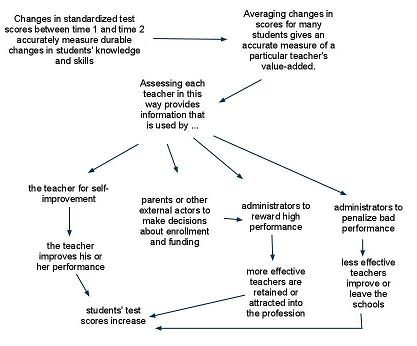
The leading solution–enshrined in federal and state law–is to use standardized test scores to assess teachers. But now we’re supposed to use them in a sophisticated way, not just looking at the average score for each class (which is evidently affected by many factors other than the teacher). The leading sophisticated approach is to assess average changes in a teacher’s students over time. In essence, that method controls for students’ starting position and relies on the Law of Large Numbers to even out random or external factors that might affect any given kid.

It’s not a crazy theory–it has some research support, especially from the groundbreaking work of William Sanders–but notice how many premises and causal relationships the full strategy assumes:

This can go wrong in so many ways. Tests can be poor measures of students’ competence: they are never perfect measures. The Law of Large Numbers does not apply in this case, because each teacher can have a significant impact on only a modest number of kids. Hence there are large random fluctuations in value-added scores.

I have never seen evidence that parents try to place their kids in schools with the highest “value-added” teaching staffs. It would be odd if they did, because a student benefits more from a privileged peer group or a good school climate for learning than from teachers who add the most to standardized tests. (Larger increases can be achieved in low-income schools that don’t face “ceiling effects,” but you don’t see affluent parents enrolling their kids in those schools to reward the teachers.)

When teachers use standardized test scores to modify their own performance, they often “teach to the test” and narrow the curriculum. When administrators use such data, they do not consistently enhance the strength of their teaching staffs; they certainly don’t make the workplace more desirable for talented teachers. Even if a school’s faculty does add more average value to test scores, that doesn’t mean that graduates will become better citizens–or even that students will stay in school.

Kevin Drum thinks we face a Hobson’s Choice: no tests and no accountability, or poor accountability through testing. “The criticisms of value-added seem compelling. At the same time, if a teacher scores poorly (or well) year after year, surely that tells us something? At some point, we either have to use this data or else give up on standardized testing completely.”

I’m not saying that the answer is easy, but there are alternatives to this dilemma. We could reorganize schools so that teachers were able to hold one another more accountable: what I have called “internal accountability.” (Evidence from other fields shows that when internal accountability system are replaced with external measures, people become less motivated to do good work.) We could also bring parents into schools as partners, not just consumers, and boost what I have called “relational accountability.”

Either way, we would shift the metaphor. Teachers wouldn’t be service-providers whose service must be measured in a standardized way. They would be members of a community (also comprised of families), who hold one another accountable for contributions to a common task.

These ideas may sound idealistic, but they actually make fewer assumptions and leaps of faith than the supposedly hard-nosed strategy shown in the diagram above–which is embodied in current law.

what parents (and other adults) want from schools

These are some interesting tidbits from a recent (June 2010) Public Agenda survey of 1,400 Americans, including 646 parents of kids currently enrolled in k-12 schools.

First, people are more concerned about behavioral issues than about academic “performance,” as that is typically measured:

The most pressing problem in your local schools: parents all respondents
social problems and kids who misbehave 63% 56%
low academic standards & outdated curricula 27% 31%

Second, although people value basic writing and math skills, teamwork ranks higher on their list of priorities than scientific skills and principles.

Which of these are absolutely essential to learn in schools?: parents all respondents
basic scientific ideas and principles 60% 56%
being able to work in a team 80% 74%

Third, when asked what should be taught more or less in their own kids’ schools, elementary school parents seem basically satisfied, but the most common request for more time is for computer and technology skills. I wish parents wanted more social studies, but that’s second-to-bottom on their priority list, right above art. Middle- and high-school parents rank it a bit higher, above advanced science, advanced math, fine arts, and sports/gym.

Hirsh on how to save the schools

E.D. Hirsh’s review of Diane Ravitch’s The Death and Life of the Great American School System: How Testing and Choice Are Undermining Education is not very good–as a review. Ravitch’s book is important, and Hirsch doesn’t really analyze it. Instead, he uses the opportunity to argue for his own view. But his position is worth considering: it is orthogonal to the main debates in education.

The main debates concern incentives or pedagogy. That is, the two main strategies for improving schools are to change the rewards and punishments, or else to convince/educate teachers to act differently.

Strategies that involve incentives appeal to several types of reformers. Some want to test students and allocate resources according to the test scores (the NCLB approach). Some want parents to be able to choose schools for their own children and let the public money follow the kids. Some want to raise teachers’ pay in order to motivate qualified people to enter and remain in the profession. All share the assumption that the government can’t or shouldn’t improve our 120,000 public schools by directly influencing the content of education in each one. We improve other sectors by shaping external incentives for innovation and impact, and the idea is to do the same with schools.

Strategies that involve pedagogy are equally controversial. The two main poles of this controversy are Deweyan progressivism versus traditionalism. Progressives are “child-centered” or “constructivist” (see my summary here). They want kids to shape their own learning according to their diverse interests and motivations–to be active participants in interpreting and creating knowledge and culture. Traditionalists worry that leaving children to make such decisions short-changes them. They think that students benefit from being told and explained things. Both sides want to influence our 120,000 schools by training or persuading our 3.5 million teachers.

Hirsch is a traditionalist on the question of pedagogy, but he has an alternative strategy for reforming schools. He focuses on the curriculum. This is his lever of change. For him, the curriculum is a set of things students should know: facts, concepts, names, dates, and places on the world map. Put another way, it is a set of texts that students should read and understand (texts that competently present the things that students should know). The curriculum as a whole should be:

  • Transparent, a literal list, so that students from marginalized and disadvantaged backgrounds and the teachers who serve them can know what the kids need to learn.
  • Uniform, because Hirsch argues that success in life requires knowing what everyone else is also expected to know. If that varies, mastery is impossible.
  • Finite, because students can only absorb so much material, and they ought to have time left in the day for other activities.

Unlike proponents of vouchers and charters, Hirsch is perfectly willing to say that all schools should change the content of the education they provide. Unlike the proponents of various pedagogies, he doesn’t trust in a strategy of changing what teachers do. He wants to redefine what they teach.

I have not made a study of the independent research on Hirsch’s approach. In theory, it could work. The question seems strictly empirical to me. As an advocate for civic or democratic education, I care most about civic outcomes. I want to see students prepared to play active and effective roles in our public life. I do not take it for granted that the path to that outcome must itself be democratic or participatory. Maybe all kids should read The Federalist Papers and Letter from Birmingham Jail (and other texts), and that is all they need. I sort of doubt it, but I respect Hirsh for putting an alternative on the table.

classroom practice from an ethical perspective

(Madison, WI) I am here for one of a series of meetings organized by University of Wisconsin Professor Diana Hess and funded by the Spencer Foundation. Diana and her colleagues have assembled remarkable empirical data about high school students and their social studies classes. From their longitudinal surveys–which follow the students into their twenties–they can draw inferences about the effects of various school experiences. Their elaborate interviews of students and teachers and their classroom observation notes help to explain the quantitative data and also provide numerous interesting anecdotes. The interviews, in particular, draw attention to dilemmas. Should you deliberate issues in a classroom that may be offensive to some students? Should you allow students to deliberate issues that should be settled? Should a teacher disclose his or her personal views?

The empirical data are relevant to these questions. For instance, it might turn out that teachers’ disclosing their opinions affects students’ opinions. But the data cannot settle these questions, which also involve value judgments about both means and ends. The appropriate ends, in particular, are by no means clear.

Therefore, Diana and her colleagues have assembled professional philosophers to discuss the empirical data with the researchers. There are actually three kinds of background in the room. Almost all the participants have personal experience as teachers. The quantitative data is more general and systematic but less rich than personal experience. And everyone has some level of philosophical training or interest. This seems to me a model for how to think about thorny issues.