I am proud to announce the debut of the Journal of Public Deliberation, a peer-reviewed, free, online, “open access” publication that will include scholarly articles and essays aimed at practitioners. I serve on the editorial board and have spent considerable time over the last six months reviewing articles and discussing matters of editorial policy. The first issue contains five articles:
Category Archives: deliberation
an experience of globalization
Today, a group of teachers from Azerbaijan visited my office. With help from Streetlaw (on whose board I serve), they are teaching their students to deliberate about current issues, as a form of civic education. Since I have long worked on deliberation and civic education, both separately and in combination, I was interested to hear their experiences. Meanwhile, Professor Gabriel Murillo from Colombia, a leading proponent of public deliberation, happened to be visiting. I know Prof. Murillo from past work with the Kettering Foundation, so I accompanied the Azeris to his talk. He lectured in English on the role of deliberative democracy in development. An Azeri interpreter provided simultaneous translation into Russian, since not all of the delegation from Azerbaijan speaks Azeri. Dr. Murillo said at one point that he thinks in Spanish; I sensed that he was translating words like “consentimiento” into English as he spoke. The Azeri translator presumably had to think in his own (Turkic) language as he generated Russian words from Dr. Murillo’s English. And some of his colleagues who know Azeri better than Russian may have had to translate into their native language to understand what he was saying. At one point, an Azeri of Russian ethnicity stood and bravely asked Dr. Murillo a question in Russian, which several people helped to translate into English so that Dr. Murillo could reply. The whole point of his speech was the need for communication in a pluralistic society, and that’s exactly what we experienced–albeit through the medium of English.
handbook of public deliberation
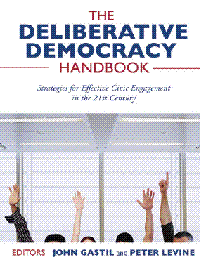 John Gastil and I are busy organizing the production of our co-edited volume, The Handbook of Public Deliberation: Strategies for Effective Civic Engagement in the 21st Century. Jossey Bass will publish it this summer. Of the 19 chapters, 16 describe very concrete and practical approaches to public deliberation; thus the book will offer a diverse menu of choices for civic groups, governments, school systems, and others to use. (The three remaining chapters are overviews of the field.) Since almost all chapters have been written by teams, usually comprised of both scholars and practitioners, there are 44 authors in all. Coordinating everyone’s participation has been quite a job for John and me. However, we’ll reach a milestone tomorrow when we submit a fully edited and complete manuscript.
The cover design to the right is preliminary. We’ve asked for more people, more evident diversity, and less office ceiling. (Apparently, that’s the publisher’s office, and one arm belongs to our editor.) Still, I like the informality and zest of the basic design.
deliberation blogs
I don’t like to resort to listing blogs, but a lot of my readers are seriously interested in public deliberation, and they may want to consult other blogs specifically on that subject. I recommend:
deliberative democracy and tolerance
Last Friday, I heard a colleague present a good paper on tolerance and deliberation. I don’t want to summarize his position here, but I think that mine would be different. I see a tension between public deliberation and tolerance. In a true “deliberative democracy” (which, in practice, we can only approximate), everyone who is potentially affected by an issue discusses it together, without limitations as to topic or outcome, giving reasons and considering underlying values and principles. Deliberation can increase tolerance as people come to understand one another’s perspectives; but that’s hardly guaranteed. Such conversations often reveal profound differences of principle, which are closely connected to identity. Karl Mannheim argued that “political discussion” characteristically turns into a fundamental attack “on the whole life-situation of the opponent.” He exaggerated, but he had a point.
If you want people to get along, to “live and let live,” then you may want to take certain issues off the table. For example, the Constitution bans state-sposored religion. This narrows the range of serious discussion but probably increases tolerance. You may also want to create mechanisms for reaching decisions without direct interaction among people who disagree. Elections and markets provide such impersonal interactions.
Many proponents of deliberative democracy are upset by the profound gap in values between, for example, Greenwich Village and rural Mississippi. They’d like these two “communities” to sit down together and come to understand each other’s values. I also favor diverse and inclusive conversations, but not because I expect them to increase tolerance. I think the best way to help Greenwich Village and rural Mississippi to coexist peacefully is to keep them separate and allow their elected representatives to logroll and compromise their way to a deal. Some federal money can go to arts subsidies, some can go to farm supports, and both sides can purchase goods on the same market. If they don’t deliberate, neither group has to think too hard about the other.
By bringing disagreements to the surface, deliberative democracy threatens tolerance, but it also depends on it. Without a basic willingness to put up with people who disagree, conversations will go badly. Thus, if we are committed to public deliberation (perhaps because we believe it will create better policies and help people to develop and refine their own opinions), then we’re going to have to work hard to keep the peace.