Category Archives: deliberation

the EPA and public involvement

On several occasions, the US Environmental Protection Agency has managed to involve a wide variety of citizens in addressing local problems. This approach was already evident in 1983, when EPA Administrator William Rickelshaus created a deliberative forum that allowed the citizens of Takoma, WA to make their own collective decision about whether to close a dangerous copper smelter at the cost of local jobs. Recently, EPA launched a Public Involvement website that summarizes the Agency’s experience and provides questionnaires and other tools for practical use.

Perhaps the most interesting feature for a non-specialist is the list of case-studies, and particularly the cases of “community-based environmental protection.” When environmental problems broaden beyond “point-sources” (such as factories and large sewage pipes) and include homes and small businesses, it is necessary to get whole communities involved in environmental protection. Participation must be voluntary or it will never work. Fortunately, it is sometimes possible to find common ground among people with different interests and cultures–for example, environmentalists and ranchers in the West. The by-product of such successful deliberations and collaborations can be stronger communities. The EPA’s database is full of good examples.
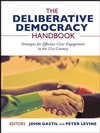
The Deliberative Democracy Handbook

It’s out! I have my copy of the Deliberative Democracy Handbook, co-edited by John Gastil and myself. There are 19 chapters (mostly co-written, so there are about 30 authors in all). For the most part, each chapter is devoted to a different, practical process for engaging the public in deliberations and influencing policy. The processes come from all over the world. The book has its own website with more information.

a totally new fundraising strategy for civic engagement

Deliberative Polling is an important innovation in “civic engagement.” Citizens are randomly selected to meet as a kind of large jury for several days. They hear testimony from experts, deliberate at length, and finally vote their opinion on a contentious issue. Deliberative Polling has been used by television broadcasters in the US, Britain, and Australia. The participants deliberate, interview national political candidates, and report their results on TV. Deliberative Polling has also been used as part of the formal process for regulating public utilities in Texas, among other cases.

Deliberative Polling is relatively expensive, and everyone in the civic renewal field constantly struggles with money issues. But get this–the Texas prosecutor who is investigating Rep. Tom DeLay, Ronnie Earle, has forced Sears, Cracker Barrel, Questerra, and Diversified Collections Systems to contribute large amounts of cash to the Center for Deliberative Polling at UT-Austin. These companies were accused of making illegal contributions in connection to the DeLay case, as part of what Earle called “an effort to … control representative democracy in Texas.” But they settled out of court by agreeing to support deliberative democracy in the state.

a researcher-practitioner meeting

Yesterday, I spent an interesting day talking to some people who work in the world of public broadcasting about a project to produce high-quality news shows for use in high schools. A lot of the discussion was about how young people might contribute to the shows as well as use them.

Today is the second annual Researcher & Practitioner Conference of the Deliberative Democracy Consortium. That’s a mouthful. It’s also an interesting and unusual project. Last year, we convened a bunch of people who organize citizens’ deliberations at a human scale–in towns and cities. We also invited some scholars who study the process of deliberation. The whole group spent two days developing a shared research agenda and planning some valuable research projects that could be conducted by teams of scholars and practitioners. Thanks to the Hewlett Foundation, we had more than $100,000 to allocate (through a competitive process) to teams that formed at the conference.

This is the second year, so we will be hearing reports from the teams that received funding. We will also revise our research agenda and allocate another batch of funds from Hewlett. As a by-product of these conferences, I believe we are strengthening a network that consists of academics and practical folks–something that’s not nearly as common as it should be.

Archon Fung: “Deliberation Before the Revolution”

My friend and colleague Archon Fung has published an article entitled ?Deliberation Before the Revolution: Toward an Ethics of Deliberative Democracy in an Unjust World? (Political Theory, Vol. 33, No. 3, Spring 2005: pdf).

“Deliberative democracy” is an ideal: people are supposed to exchange ideas, values, and arguments freely, in a variety of formats and genres; and their discourse (alone) is supposed to determine the outcome. In real life, social inequality, bureaucracy, secrecy, force and threats of force, bargaining, prejudice, and many other non-deliberative factors influence outcomes. How should someone who is committed to the ideal of deliberative democracy behave in an imperfect world?

Fung rejects two options. The first is to act in a purely deliberative way despite injustice. He thinks it is naive to commit oneself to give reasons and arguments (and nothing but reasons and arguments) even when powerful people refuse to listen. Strikes, boycotts, lawsuits, voter-mobilization campaigns, nonviolent protests, and even occasionally violent uprisings may be necessary. At the same time, Fung believes it is a mistake to abandon deliberation altogether until the “revolution” comes–in other words, until there is enough political equality and until institutions are well enough designed that deliberation can prevail. If one waits for the “revolution” before becoming a deliberative democrat, then the imperfections of our current order can justify abandoning all pretense of deliberation and simply trying to amass power. That is a path to cynicism and corruption.

Fung favors a middle course. The realistic (yet idealistic) deliberative democrat should try to make the world more deliberative through effective political activism, but he or she should be ethically constrained by certain deliberative norms. Specifically, the activist should keep in mind the goal of making institutions more fair and more influenced by reasons. He or she should assume that others will deliberate in good faith until they show by their behavior that they will not. The activist should exhaust deliberative forms of politics (e.g., giving arguments, organizing open meetings) before resorting to non-deliberative tactics. And any non-deliberative responses should be strictly proportional to the situation. Just because my opponent has been somewhat deaf to my arguments or somewhat secretive and authoritarian, it doesn’t follow that I may abandon deliberative norms altogether and simply use force.

Continue reading