Category Archives: deliberation

America’s civic core

Today, the National Conference on Citizenship released its annual Civic Index report, which we worked on heavily. The most innovative aspect of the report was a decision to focus on a new set of civic activities–not ones that we should hope everyone would undertake (such as voting and volunteering), but relatively demanding forms of engagement. We defined a group that does “citizen-centered work” (using the terminology of Cindy Gibson’s white paper for the Case Foundation). This means a combination of talking about issues and working directly to address problems. Look at how heavily engaged this group of millions is:
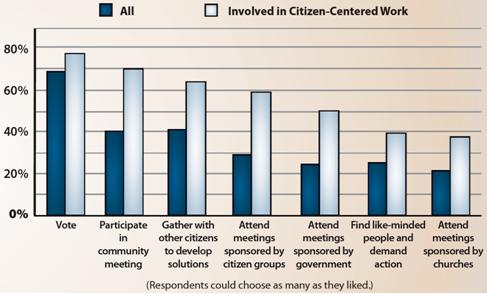
We also defined groups of “deliberators” (who participate in diverse discussions of issues) and “netizens” (who participate heavily online). They too are heavily engaged and well-informed.

I can describe how I got to this approach by way of an imaginary dialog:

Realist: Americans are resistant to conflict and controversy. They opt for consumerism and limit their political conversations to people just like themselves in order to avoid the tensions that arise when serious issues are on the table and participants have diverse values. (“Realist” may have been reading books that present impressive and depressing empirical evidence, written by Diana Mutz, Nina Eliasoph, and John Hibbing and Elizabeth Theiss-Morse).

Idealist: We know how to recruit diverse people for deliberative forums, train them to hold respectful, productive discussions, moderate these discussions, reach constructive conclusions, act voluntarily, and bring their experience back into discussions. (“Idealist” may have been reading the Deliberative Democracy Handbook, edited by John Gastil and me.)

Realist: What powerful, large, well-funded institutions have incentives to organize these forums? Not political professionals, corporations, parties, or the mass media. Deliberations will always be small-scale experiments, organized by boutique programs, and limited to highly civic communities.

I’ve struggled with Realist’s rejoinder for a while, and this is what I’m now prone to say:

Peter (the chastened idealist): Everyone has the right and the intrinsic ability to participate, but we’ll never have the resources or incentives to achieve a truly deliberative democracy on a mass scale. Yet our new survey shows that a significant minority of Americans actually do deliberate with other people and use the results to guide their civic behavior, such as their volunteering. Our strategy should not be to raise that proportion to 50% or 100%–although 25% might be achievable. Instead, we should strive to make the civic minority in America fairly representative of our nation’s diversity. We should give those people the tools, institutions, and resources they need. We should increase their political clout. We should build networks to connect them with one another. And we should make sure that all Americans have a shot at entering this civic minority even if they come from very disadvantaged backgrounds.

mark your calendars

At CIRCLE, we’re working on two reports whose contents are embargoed, but both contain a lot of interesting new findings about Americans’ demand for civic participation and their engagement in relatively impressive forms of civic work:

On October 4th in Washington, the National Conference on Citizenship will release a major national poll. It helps to reveal how many and which Americans are currently involved in deliberation and public work.

On November 7th in Washington, CIRCLE will release the results of a major national study based on our interviews with 386 college students on 12 four-year colleges and universities. Like the NCoC study, but in different ways, it probes deliberation and attitudes toward politics and civil society.

polarization in American communities

At yesterday’s conference, someone in the audience raised a question: Why are public discussions so polarized and dominated by hot-button issues? The questioner came from Kansas, and she specifically mentioned local discussions of education. Thus I suspect she was thinking about the well-publicized evolution/creationism debates in her home state. Abortion would be another example of a “hot,” divisive issue.

Her question wasn’t directed at me, but this would be my tentative answer. First of all, we have actual disagreements that split us into groups, and we sometimes have to deal with these issues. But they seem over-represented in our public life.

This is partly because most of us lack practical experience in mobilizing people except when issues are polarized. From countless news stories and movies, we know the “script” for angry, adversarial politics. We know how to organize our allies when we are angry at another group: we can call for a march or a rally, put up flyers, alert the media. There are also techniques for organizing people around less contentious issues–ways literally to get citizens out to meetings and then to achieve social change without relying on polarization. These techniques include the “one-on-one” interviews popular in community organizing; Study Circles and other deliberative forums; and volunteering opportunities that are connected to discussion and reflection. But such techniques are not widely reported or described in fiction; even less are they taught in schools.

Another reason for polarization is the narrowness of the topics about which we invite public discussion. I believe that citizens have deep and diverse moral concerns about schools: how students treat teachers, how boys relate to girls, what topics are presented as especially important, and how competitive our schools’ teams are. We do not agree about these issues, but we aren’t necessarily polarized about them, either. For example, most of us want more orderly schools, although we may disagree about the means.

These issues are considered the province of professional educators–teachers, administrators, school psychologists, test-writers, and others. Communities aren’t invited to discuss them, let alone act on their discussions. But no one can stop activists from suing or organizing a political slate on a hot-button issue, such as prayer in school or evolution. These issues pay off for political partisans and organized ideological interests. Consequently, some citizens channel their political energies into fundamentally unproductive topics that serve as proxies for deeper discontents. (For instance, I’ll bet that most proponents of prayer in school would trade that objective for schools that were more orderly and less sexualized.) Most other citizens simply stand on the sidelines, unwilling to clash on the hot-button issues but not sure how else to engage.

an appetite for deliberation?

Several recent studies have argued that Americans are resistant to controversy. Therefore, we tend to avoid voluntary opportunities to exchange ideas with people who are different from ourselves. [See three Cambridge University Press books: Nina Eliasoph, Avoiding Politics: How Americans Produce Apathy in Everyday Life (1998); John R. Hibbing and Elizabeth Theiss-Morse, Stealth Democracy: Americans’ Beliefs About How Government Should Work (2002); and Diana C., Mutz, Hearing the Other Side: Deliberative Versus Participatory Democracy (2006).]

Based on some quite ambitious current empirical work, I’d propose a different hypothesis. College students (at least) are hungry for a particular kind of conversation that is serious and authentic, involves diverse views, but is free of manipulation and “spin.” They want discussions that are open-ended in the sense that everyone is truly trying to decide what should be done.

Today’s young people are barraged with messages that have been designed to persuade them to do things that someone else wants. They experience an unprecedented amount of commercial advertising: companies spent $17 billion to advertise to children in 1992 (when our college student sample was entering grade school)–up from $100 million in 1983. Commercial advertisers use increasingly sophisticated techniques of persuasion, based on detailed public opinion research. The government, political candidates, parties, interest groups, and reporters and pundits also use such techniques. For example, political messages are now pre-tested in randomized experiments to measure their impact on specific demographic groups.

I believe that college students are aware that they are targets of manipulation; they resent it; and this is one reason that they are reluctant to engage in politics. They see such manipulation at work in several domains–the news media, political advertising, and their fellow students who are activists for social causes. However, a considerably proportion of college students can recall particular conversations that they’ve had that seemed open-ended. They seem grateful for those discussions, which took them out of what they call their “bubble.”

new article on activists’ views of deliberation

Rose Marie Nierras and I have just published “Activists’ Views of Deliberation“, Journal of Public Deliberation (vol. 3, no. 1, article 4). We interviewed more than 60 practitioners from more than 20 countries to explore the tension between activism and deliberation and to propose some compromises.

We define an “activist” as someone who tries to advance a substantive political or social goal or outcome. A clear case would be someone who seeks government money for a new health clinic. Activism is always an attempt to exercise power, yet some activists’ motivations are highly altruistic. They try to develop and employ power for ethical ends. To complicate the definition, we note that many activists feel constrained by democratic procedures or principles. For example, they may drop their demands when they see that they have been outvoted or have lost a public argument. They may be sincerely interested in learning from rival perspectives; and they may try to help other people to become independent political agents with goals and interests of their own. In all these respects, activists can be democratic, not merely strategic.

Meanwhile, an organizer of a public deliberation is someone who helps people to decide on their collective goals and outcomes. A clear case would be someone who organizes a forum to discuss how much money the government should raise in taxes and how the funds should be spent. To organize such a deliberation means suppressing or deferring one’s own views about state spending in the interests of promoting an open-ended conversation.

Nevertheless, organizing a deliberation is also an exercise in power. It requires making substantive decisions that can be controversial. Even to invite people to a deliberative session, one must give oneself the right to define the scale and scope of the community, to identify certain issues as important, and to select a method or format for discussion. Even if the process is very open-ended, organizers may rationally predict that a particular outcome will emerge. In such cases, they may use deliberation as a tool to obtain support for the outcome they want.

In short, activists and organizers of deliberations are not sharply distinguishable. It is not only activists who have agendas, desired outcomes, and some degree of power. However, the two groups cluster at opposite ends of a spectrum. At one end, politics is strategic and oriented toward policy goals (albeit constrained by procedures or ethical principles). The main evidence of success is achieving the desired outcome. At the other end of the spectrum, politics is open-ended; the main evidence of success is a broad, fair discussion leading to a set of goals that may be unanticipated at the outset.

If one stipulates that an activist has the right agenda and fully appropriate plans, then it may seem unfair to saddle him or her with the norms of deliberation, which require listening to other people, providing neutral background materials, sharing control of the process, etc. But it is generally unwise to assume that one’s own agenda is right. The value of deliberation lies as much in the listening as in the speaking; as much in the opportunity to learn as the chance to persuade. Learned Hand said, “The spirit of liberty is the spirit which is not too sure that it is right; the spirit of liberty is the spirit which seeks to understand the minds of other men and women; the spirit of liberty is the spirit which weighs their interests alongside its own without bias.” That is the best argument for deliberation, although there is certainly also a case to be made for forceful political action.