Category Archives: philosophy

ethics from nature (on Philip Selznick)

(en route to the Midwest for a service-learning meeting.) Here is a fairly comprehensive ethical position. It is my summary of Philip Selznick’s The Moral Commonwealth, chapter 1, which is presented as an interpretation of Dewey’s naturalistic ethics. I have not investigated whether Selznick gets Dewey right–that doesn’t matter much, because Selznick is a major thinker himself. His position has just a few key ingredients:

1. “The first principle of a naturalist ethic is that genuine values emerge from experience; they are discovered, not imposed” (Selznick, p. 19). So we shouldn’t expect to ground ethics in a truth that is outside of experience, as Kant advised.

2. Experience is the understanding of nature, broadly defined. Such experience has moral implications. There is “support in nature for secure and fruitful guides to moral reflection and prescription” (p. 27). Yet “humanity is in the business of amending nature, not following it blindly” (p. 18).

3. The study of nature that we need for ethics is more like “natural history” than “theoretical science.” In other words, it looks for generalities and patterns, but it doesn’t assume that true knowledge is highly abstract and universal. “For modern theoretical scientists, nature is not known directly and concretely but indirectly and selectively. Ideally embodied in mathematical propositions, nature becomes rarified and remote. In contrast, students of natural history–naturalists–are interested in the situated wholeness of objects and organisms. They perceive a world of glaciered canyons, burnt prairies, migrating geese.” They exhibit “love for the world” (p. 26).

4. Certain facts about human beings (not to be sharply separated from other natural species) emerge from such empirical observation and are ethically important. For instance, human beings have a potential for growth or development in interaction with community, and such growth gives us well-being. “When interaction is free and undistorted–when it stimulates reflection and experiment–powers are enhanced, horizons expanded, connections deepened, meanings enriched. Growth depends on shared experience, which in turn requires genuine, open communication” (pp. 27-8).

Dewey/Selznick begin with observable facts about us as a natural species, identify growth as a “normative idea” (p. 28), and are soon on their way to strong ethical conclusions. For instance, Dewey claimed that democracy is the best system of government because it permits free collective learning; but a democracy is desirable to the extent that discussion and experimentation prevail (rather than the mere tabulation of votes).

This approach suggests that it’s better to “benchmark” than to set ideals. That is, it’s better to assess where we are as a species, or as a community, or as an individual, and then try to enhance the aspects that seem best, rather than decide what a good society or a good character should be like in principle. Dorf and Sabel have tried to work out a whole political theory based on this distinction. (Link opens a Word doc.)

I find Selznick’s view attractive, but I have two major methodological concerns. First, I’m not sure that the selection of natural features is as straightforward as Selznick and Dewey presume. We are naturally capable of learning together in cooperative groups, thereby developing our own competence and enriching our experience. We are also capable of exploitation, cruelty, faction, brutality, and waste. These all seem equally “natural.” I suspect the pragmatist’s preference for “growth” is closer to a classical philosophical premise than a naturalist observation. In fact, it sounds a lot like Kant’s requirement that we develop ourselves and others.

We could read Dewey’s conclusions as simply a contribution to public debate. He likes “growth”; others can discuss his preference. If we reach consensus within our community, we have all the ethical certainty we need. If we disagree, our task is to discuss.

That’s all very well as long as we recognize that consensus is highly unlikely. (This is my second objection.) Imagine Dewey in a debate with an Iranian Ayatollah. The latter would reject Dewey’s method, since revelation should trump experience; Dewey’s understanding of natural history, since the world began with creation and will end apocalyptically; and Dewey’s goals, since salvation after death is much more valuable than growth here on earth. No experience can directly settle this debate, because we only find out what happens after death after we die. And until the Mahdi actually returns, it’s possible that he is waiting.

But here’s an argument in favor of Dewey’s method. The debate is not just about abstract principles and unfalsifiable predictions. It’s also about how principles play out in real, evolving institutions. So we should compare not just the metaphysics of a Shiite Ayatollah and an American pragmatist, but also the institutions that each one endorses: contemporary Iran versus a Deweyan model, such as a laboratory school or a settlement house. It seems to me that contemporary Iran is not doing very well, and Dewey has a “naturalist” explanation of why not. The fundamental principles of the Iranian revolution are not in sync with nature. That’s not going to persuade a diehard revolutionary, because he will expect everything to improve as soon as the Mahdi returns. But it is an observation that a devout Shiite can accept and use as an argument for reform. Thus there is a meaningful debate between reformers like Khatami and diehards like Ahmadinejad. If Khatami ultimately wins, score one for Dewey and Selznick, because Iran will have turned out to be governed by natural laws of growth and reflection.

Leo Strauss, Friedrich Nietzsche

One advantage of a blog is the opportunity to rebut. I recently came across the following passage in Catherine H. Zuckert, Leo Strauss: Political Philosophy and American Democracy (2006). (Strauss, by the way, was a highly influential and interesting emigré political theorist, several of whose followers played significant roles in the Bush Administration.)

    A particularly clumsy and unpersuasive effort to treat Strauss as an esoteric writer [i.e., one who thinks the opposite of what his texts say on their surface] is Peter Levine’s Nietzsche and the Modern Crisis of the Humanities. He maintains that Strauss is an ‘esoteric Nietzchean.’ For evidence of Strauss’ Nietzscheanism he quotes passages from Strauss’s essay on Nietzsche’s Beyond Good and Evil, an essay intended to give an account of the German’s thought. Since Strauss frequently distanced himself from Nietzsche, it is quite unacceptable to cite Strauss’ presentation of Nietzsche’s thought as if they were his own. By this method, one could identify Strauss with Thucydides, Hobbes, Rousseau, Weber, and a large number of others as well as Nietzsche. It really will not do to argue, in effect, that (a) Strauss is (obviously) an esoteric writer, that is, he doesn’t say openly what he believes; (b) Strauss frequently rejects Nietzsche, Heidegger, historicism, and nihilism in his texts; therefore (c) Strauss must be a Nietzschean, a Heideggerian, a historicist, or a nihilist. To prove that Strauss is a nihilist, Levine brings to bear such other ‘evidence’ as Strauss’ expressed doubts about Plato’s theory of ideas. In rejecting that theory, Strauss is trying to ‘show that Plato was a secret nihilist.’ Since Aristotle also rejected the Platonic Ideas, Levine no doubt considers him a nihilist as well.

Trying to maintain a civil tone, I will say:

1. In my book, I fully acknowledge Leo Strauss’ explicit critique of Nietzsche, Heidegger, historicism, and nihilism. That is how I begin my section on Strauss.

2. I quote Strauss’ essay on Nietzsche not to assert that Strauss was endorsing the views he attributed to Nietszche, but in order to show that Strauss considered Nietzsche a historicist. There are many other interpretations of Nietzsche, and I wanted to show that this was the Nietzsche whom Strauss had in mind.

3. My argument that Strauss actually held the views he attributed to Nietzsche is not based on the assertion that he rejected those views but was “obviously” an esoteric author. The key evidence is “his deployment of devices he finds in or attributes to the writers he identifies as esoteric.” That last sentence is quoted from Zuckert–from the paragraph in which she describes “much better attempts” than mine to read Strauss as esoteric. But the method she accepts is precisely the one I employ. I show, for example (pp. 263-4), that key nihilist quotations, ostensibly rejected by Strauss, appear in the precise centers of his own texts without rebuttal–a technique that he attributes to other authors who are esoteric. One of those authors is Nietzsche. Strauss argues–and I agree–that Nietzsche used esoteric writing techniques such as numerology. Those are the same techniques that we find in Strauss.

4. My point about Plato is not that Strauss rejected Platonic idealism. So do most authors, including myself. My point is about Straussian hermeneutics. I write, “Strauss says that Plato cannot have been serious about the doctrine of Forms, which is ‘utterly incredible, not to say … fantastic.'” Aristotle certainly disagreed with the Platonic theory of Forms, but he did not claim that “the Republic was actually a veiled warning against the tyranny of Socratic men.” That claim of irony or duplicity is Strauss’s and is hardly orthodox.

My reading of Strauss was not especially original and probably was clumsy. When I read that section now, it strikes me as poorly organized. Some of the key evidence is buried in footnotes. But there was much more to it than Zuckert noticed, understood, or was willing to acknowledge.

two paths to abstraction

1. At first, artists depict the world as they think it actually is. They even show heaven and other eternal and transcendent scenes in terms of their own times, places, and styles. Then they realize that they have a manner, a method, and a style of representation; and many such styles are possible. They learn to imitate art from distant places and times, which requires a certain sympathy or compassion. Their ability to represent the world as depicted by others reduces their attachment to their own style, which begins to seem arbitrary. For example, it seems arbitrary that the center of a flat piece of art should always appear to recede into the distance, and that one side of each object should be visible. Why not show all the sides at once, as in cubism? Gradually, artists’ enthusiasm for any form of representative art diminishes. One important option becomes renunciation, in the form of minimalism and abstraction. Showing the world in any style means embodiment; but the mind can transcend the body. True art then becomes not the naive representation of the world, nor a sentimental imitation of someone else’s naive style, but just a field of color on a canvas. That seems the way to make the artist’s arbitrary will and narrow prejudices disappear, and beauty appear.

2. The Buddha’s “Karaniya Metta Sutta,” translated by the Amaravati Sangha:

Even as a mother protects with her life
Her child, her only child,

So with a boundless heart

Should one cherish all living beings;

Radiating kindness over the entire world:

Spreading upwards to the skies,

And downwards to the depths;

Outwards and unbounded,

Free from drowsiness,

One should sustain this recollection.

This is said to be the sublime abiding.

By not holding to fixed views,

The pure-hearted one, having clarity of vision,

Being freed from all sense desires,

Is not born again into this world.

The image is Ad Rheinhart, “Abstract Painting” (1951-2). (Rheinhart, influenced by Zen through his friend Thomas Merton, sought to make painting as “a free, unmanipulated, unmanipulatable, useless, unmarketable, irreducible, unphotographable, unreproducible, inexplicable icon.”)

what shape is a field of vision?

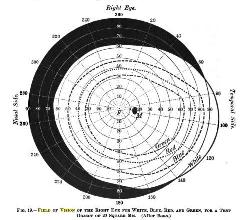
At an idle moment recently, I was wondering what shape my field of vision has. A quick Google search took me to Alexander Duane’s and Ernst Fuchs’s 1899 textbook of ophthalmology, which is online. I am sure there is much more recent work–both empirical and conceptual–but I didn’t explore it. Instead, I began to speculate that this is a fairly complicated question.

My first responses were in terms of two-dimensional spaces–for instance, I thought that perhaps my field of vision was an oval with a perturbation around my nose. It’s oval rather than round because I have two eyes, and each has a separate field like the one pictured here. Putting them together creates an oval. So if you wanted to represent what I can see, you would take a wide-angle photo from my vantage point and cut out a roughly oval shape.

But my retinas are three-dimensional, as is the world they see. So should we say that my field of vision is a section of an ovoid with some irregularities created by my nose, eyebrows, and hair? Even that that answer seems oversimplified, since my eyeballs are capable of focusing at different depths (and even rolling around, although that might be forbidden in a test of one’s field of vision); and the world itself is not pasted on the inside of an oval–it extends into the distance. If we said that the shape of my field of vision was roughly ovoid, how big would that ovoid be? The night sky that is sometimes part of it is awfully far away. And I haven’t even mentioned that we see moving things and bright colors more easily than stable, dull things. By now, it’s beginning to sound as if my field of vision has no shape. But surely that can’t be right; my vision has limits and moves as I change my orientation. We’ve begun talking about the world, not what I see of it.

By the way, it is interesting how easily we accept a photograph as a representation of vision, even though it is flat and rectangular, whereas our field of vision is–at the very least–irregular and vaguely bordered.

Wittgenstein seems to want us to dispense with the goal of analogizing inner experience to something else, as if everyday experience required some explanation on terms other than its own:

    And above all do not say ‘After all my visual impression isn’t the drawing; it is this–which I can’t shew to anyone.’–Of course it is not the drawing, but neither is it anything else of the same category, which I carry within myself. … If you put the ‘organization’ of a visual impression on a level with colours and shapes, you are proceeding from the idea of the visual impression as an inner object. Of course this makes this object into a chimera; a queerly shifting construction. For the similarity to a picture is now impaired. — Philosophical Investigations, translated by Anscombe, IIxi.

For Wittgenstein, I take it, a field of vision has no shape, and we only feel that that’s strange because we are in the grip of a model of vision as inner photography. It’s actually something else entirely. And yet I keep returning to my initial thought that what I see is an oval with my nose intruding from the bottom.

a new book on the way

Palgrave Macmillan has offered me a contract to publish my “Dante book” (which needs an actual title–and I’m not sure what that should be). I have been working on the manuscript for 14 years, and it has gone through many profound structural changes as my thoughts have evolved and as I’ve assimilated useful criticism. It is great to think that the project will be done and between covers within months.

Here is the beginning of the introduction:

    This is a book about ethics or morality and fiction. Ethics encompasses what is right or good, what we ought to do and think, and how laws and institutions should be organized. I argue that we should often make ethical judgments and decisions by describing reality in the form of true narratives. Fictional stories provide excellent opportunities to deliberate about situations and issues that also occur in real life, and should be read, in part, as ethical statements. I argue that when the moral judgments supported by a good story conflict with general principles, we ought to follow the story and amend or suspend our principles, rather than the reverse. What makes a story “good” for this purpose is not its conformity to correct moral principles, but its merits as a narrative—for instance, its perceptiveness and coherence and its avoidance of cliché, sentimentality, and euphemism.

    The relationship between stories and moral principles is connected to other issues that I also explore: the proper role of emotion and reason in ethics; the scope of ethical judgments (i.e., how widely or in how many different contexts a given judgment ought to apply); cultural diversity and what that means for morality; partiality, or whether it is appropriate to favor people whom one knows; what kinds of context are relevant to the interpretation of literary texts; and the value of fictional versus true narratives.

This is a book of humanistic scholarship: specifically, literary criticism and moral philosophy. Those are my roots, even though I spend almost all my time on quantitative social science or policy analysis. My day job is to study and promote “civic engagement” or “active citizenship”; and it has proved useful to study those topics empirically. (Hence CIRCLE.) I don’t think either phrase appears in this book manuscript. But there is a deep connection in my mind, which I hope to make explicit in a later project.

The thesis of my “Dante book” is that an indispensable technique for moral judgment is the description of concrete, particular situations in narratives. I argue that no set of principles, no procedure, no algorithm for weighing values, and no empirical data could ever replace this process of description. It is an art and a skill; some people practice it better than others, and it can be taught. But it is not the special province of any credentialed experts, such as lawyers, economists, or moral philosophers. It cannot be replaced–even in a distant utopia–by rules or systems.

In my “Dante book,” I draw some conclusions about the purposes and methods of the humanities. (In fact, it has been suggested that I entitle the volume, Dante’s Moral Reasoning: Reforming the Humanities.) In my other work, I follow the implications beyond the academy into the domain of politics. We cannot tell what is right and good unless active, engaged citizens discuss concrete cases. They will only be motivated to discuss and to inform their conversations with experience if they have practical roles in self-government. That is the fundamental connection between my two main interests: moral judgment and civic engagement.