Category Archives: advocating civic education

civic engagement in “the projects”

I was in New York City today, meeting with people who help young

people play serious roles in HUD’s HOPE VI program. This is the program

that tears down very troubled federal housing projects—usually dense clusters

of crime-ridden high-rises—and replaces them with more dispersed, small-scale,

economically diverse housing. In quite a few HOPE VI sites across the country,

young people from "the projects" are participating in planning, mapping

assets, or starting "social entrepreneurship programs" such as micro-businesses

and farmers markets. These are powerful stories and there’s a lot of potential

for more good work in HOPE VI sites.

historians on the civic ed. bill

This is from the National

Coalition for History (NCH)

Washington update:

We now have some additional information

and some troubling news … The Senate appropriations committee recommends a program

increase of $15 million specifically for the President Bush’s "We the

People" initiative [to promote the teaching of history and civics in

schools]. While at first the increase might appear to be a cause for celebration,

the committee failed to embrace the administration’s recommendation of $25 million

and it made it clear that it wants the final design of the NEH’s "We the

People" initiative to reflect "congressional priorities" — meaning

pending legislation (S. 504) sponsored by Senator Lamar Alexander — the "American

History and Civics Education Act of 2003" — that recently passed the

Senate 90-0 and is currently pending in the House.

For what

little it’s worth, I have endorsed the

Alexander bill, which would mainly create summer academies for teachers and students.

However, it would be troubling if the necessary money came straight out of the

NEH budget.

According to the NCH, some in the "history community …

point out that the Alexander bill is heavily loaded with what is characterized

as ‘value-laden concepts,’ thus raising concerns about ‘the politicization of

the teaching of history.’" The ideal of value-free history is dubious, for

both epistemological and moral reasons. However, I can see the historians’ point

that it is dangerous for Congress to mandate particular values in the teaching

of history. At least, this should be done carefully and with public debate. I

also think that there is a difference between "civics" (which ought

to be heavily value-laden) and history (which needs to be more "objective").

This difference makes it problematic to lump history and civics together in the

same federal program with the same authorizing language.

the young don’t read newspapers

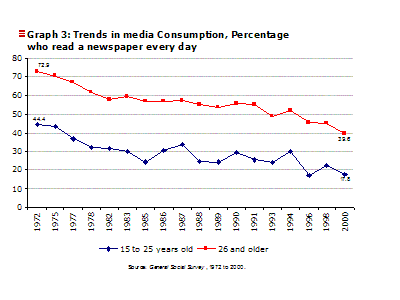
According to CIRCLE’s new fact

sheet on media use, this is the trend in newspaper readership since 1972:

We know that newspaper reading correlates with many forms of civic engagement,

so this trend is worrisome. (It is also very bad news for the newspaper industry.

Why don’t they do something aggressive to reverse the decline, like giving millions

of free newspapers to schools?) I think one piece of the problem is that young

people don’t learn how to read a newspaper. My own experience as a volunteer

high school teacher has taught me that the "inverted pyramid" style

of journalistic writing assumes a lot of background knowledge, and thus makes

news stories baffling to inexperienced teenagers. They can learn to read newspapers,

but they don’t pick up this skill by osmosis.

new research on civic ed

I was in Boston today, for the International

Society for Political Psychology‘s annual conference. I went to give a presentation

on The Civic Mission of Schools.

While there, I heard interesting papers on civic education and on the effects

of public deliberation. I’ve summarized the latter papers on the DD-Net

blog. Regarding civic education:

  • Jon Miller of Northwestern

    University Medical School presented a very important study that has followed 3,000

    young Americans from 1987 to the present. Based on the data that his group has

    collected, they are able to show what factors predict political engagement in

    early adulthood. The courses taken in high school and students’ performance in

    these courses do not seem to matter at all. This finding is somewhat at odds with

    the Civic Mission of Schools, which claims that school-based civic education

    works, at least when done well.

    There’s a lot more to be said on this topic.

    For example, Miller’s work doesn’t distinguish between the kind of civic education

    that we would recommend and ordinary civic education. Furthermore, ordinary civic

    education does seem to increase students’ knowledge, which can itself be

    considered a good. Still, it should give us pause to note that there was no observed

    connection between taking a government/civics class in high school and voting

    later on.

  • Arthur "Skip" Lupia of Michigan is writing a very

    interesting book that applies insights from cognitive science to the question

    of civic education. There are obstacles to learning about civics that are hard-wired,

    he believes; and good teaching must address these obstacles. For example, when

    two equally respectable people say opposite things—which often happens in

    politics—we tend not to put either view into our long-term memories. I think

    it is undeniable that biological constraints are relevant. But I would have to

    be persuaded that the findings of cognitive science were very solid before I would

    want them to influence policy.

strategy issues for civic ed

As I’ve noted before,

people in the civic education world are now seriously discussing a national

campaign to revive "civic ed" in schools. But there are interesting

debates about strategy. It seems to me that people variously believe:

1)

All the action is at the state level, where standards, assessment methods, and

textbooks are chosen. So we have to intervene there, and right away. Any federal

legislation that actually passes will be small potatoes.
2) A new campaign

should focus at the federal level, since others are advocating in the states.

Federal legislation is significant because it can generate national interest and

leverage resources, and it needs to be good.
3) We need a public relations

campaign to get people concerned about civic education and to raise the public

salience of the issue.
4) Public relations is irrelevant, because policymakers

are going to make decisions about standards and assessment too soon to be influenced

by popular opinion. Besides, it would be far too expensive to raise public concern

sufficiently.
5) We need to develop grassroots-level campaigns in favor of

civic education, involving various local stakeholders and young people themselves.

6) We should tailor messages for select decision-makers, especially officials

in state departments of education, stressing ways that they can improve civics

without huge financial costs and without risking lower test scores in reading,

writing, and math.

I have views on these matters (leaning toward 1 and 4,

and 5 and/or 6), but I’m by no means sure that I’m right.