Category Archives: advocating civic education

realism in civic education

As the Stanford psychologist William Damon observes, if you ask students to define “democracy,” they tend to say that it means equal power for all plus the freedom to do what you want. But freedom and equality are in tension. In a system of one person, one vote, majorities will support laws that constrain individual choice. In a free polity, people will accumulate various forms of capital (cash, knowledge, social networks) that give them unequal political power. Even taken separately, freedom and equality are utopian goals. We don’t know how to achieve perfect freedom. A minimal state would leave young people at the mercy of their parents and deprive many citizens of the education and economic security that are the basis of free choice. Yet if we have a government, we do not have perfect private liberty. Likewise, we don’t know how to achieve complete political equality. In any commercial system, wealthy people have more political clout than poor people. As Charles Lindblom argued, firms have a “privileged position” because they can always withdraw investments from a community or nation that harms their interests. There seems to be no way around that logic. Even in communist and socialist regimes, party leaders accumulate power and hand it down to their children, as if they owned “the people’s” farms and factories. Finally, if we could maximize both freedom and equality, it is not clear that we would want to do so. We also care about prosperity, sustainability, the conservation of nature, pluralism, cultural excellence, community values, and other goods that trade off against each other.

Young people should think about these tradeoffs, so that they can make intelligent choices and not be disappointed by the failure of utopian hopes. For what it’s worth, the following would be something like my own view: We live in a commercial polity that is deeply imbued with, and dependent on, prosperity. In order to have economic growth, it is necessary to cede some political power to the people who make decisions about investments. As a result, they will live better than their fellow citizens. The questions become: Who makes decisions about investments (a few very rich individuals, professional corporate managers, or many investors)? What motivations guide them? (For instance, an educated, landed aristocracy will have different motives from a publicly traded corporation.) And how can we make sure that the power of investors is really used to promote general prosperity rather than very narrow self-interests?

A “realist” civic education would be quite different from what we give most young people today. It strikes me that standard social studies teaching combines excessive idealism about grand abstract goods with reflexive cynicism about our actual institutions. So young people think that “democracy” means perfect freedom and equality, but “the government” and “politicians” merely answer to the highest bidder. In truth, the modern state does have perverse and corrupt incentives, but it should be measured against a realistic standard.
the civic education movement comes of age

Between 1970 and 2000, most academic researchers said that adults’ political and civic behavior was not affected by what they had learned in their schools. In short, civic education didn’t work. Meanwhile, schools were moving away from their traditional mission of creating good citizens–among other things, by dropping their courses on civics, government, and contemporary issues. Nevertheless, some nonprofit groups labored to provide good civics textbooks and curricula; some teachers worked hard to implement those programs or ones of their own devising; and a few scholars collected data on civic development.

Because that body of research and educational work existed, it was possible around 2000-2 to gather the field together in several venues and forums (at the Education Commission of the States, under the aegis of NACE, and then at the invitation of Carnegie Corporation of New York and CIRCLE). At these meetings, the participants agreed that there were specific forms of civic education that worked, as shown by fairly rigorous research; but public policies needed to be changed to allow all students to benefit. One result of those discussions was the launch of the Campaign for the Civic Mission of Schools, whose Steering Committee met today.

At the meeting, which I chaired, we were shown an elaborate website that allows anyone to find civic education “practices” (curricula, programs, etc) by type, state, purpose, or grade level. This website is a useful tool created by the Campaign. More important, it collects much of the valuable work on which the campaign itself is based. The launch of the website is thus a significant symbolic moment for my little community.

We also saw (most of us for the first time) a set of exam and survey questions that can be used to assess civic learning. These quuestions have been selected by some of my colleagues from hundreds of tests and surveys conducted since 1973. Their collection of vetted and approved questions is another handy tool–and another symbol of past work that supports current and future practice.

high schools in a high-risk era (2)

Here’s another take on an issue that I’ve written about recently, the “rat race” in our high schools:

We live in an era of expanded opportunities. There are more careers and lifestyles to choose from. Some people have confidence that they can innovate successfully, realizing their private ideas and goals. The “dot-com” expansion of the late 1990s was just an example of that opportunistic spirit.

The other side of the coin is individualized risk. We don’t have as many strong, tight-knit neighborhood communities as we used to. The array of voluntary associations has changed; fewer groups provide guaranteed support in return for long-term commitment. The government’s safety net is weaker, and fewer people belong to unions. Corporations don’t even pretend to offer long-term job security. Public-sector careers are less desirable than in the past.

Continue reading

high schools in a high-risk era

(Macon, Georgia) At last weekend’s meeting, we discussed economic insecurity and its effects on young people. Many high school students believe (whether or not it’s true) that their lifetime prospects of earning satisfactory wages depend on their climbing as high as possible on a ladder that ascends from their local community college to the branch campus of their state university, on to the flagship state school and regional private colleges, and then all the way up to the summits of Harvard and MIT. Their sense of insecurity and omnipresent risk (some scholars argue) leads to a “rat-race” mentality in which everything they do only matters if they can put it on their resumes and use it for admission to college. They feel compelled to obtain marks of success that they can advertise. They see other students as competitors and doubt that local groups and networks have much value.

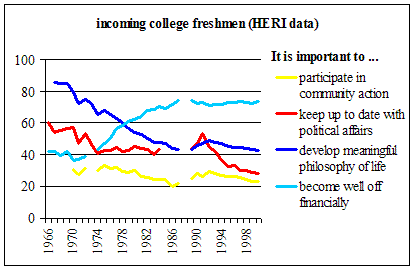
To the extent that these generalizations apply, they could help to explain some well-documented findings: young people have low and declining trust for their peers and they are less likely to join formal voluntary groups than in the past. Increasing numbers of adolescents report that they volunteer, but often their participation is episodic (see pdf); and many cannot explain to interviewers why they serve. Some admit that they are basically “padding” their resumes. There may be a sense of hollowness in today’s adolescence, as if what you do when you’re 16 is simply practice–a competitive “try-out”–for life that really begins after graduation.

Any change in this situation would presumably require economic growth, greater financial security, and more sharing of risk. After all, real family income has been basically flat since the early 1970s, and families are shouldering more individualized risk as unions shrink and health coverage gets worse. These trends could have negative effects on adolescents’ sense of security, mutual trust, and concern for their communities.

I’m afraid there is not much that I can do (or participate in doing) that can mitigate such pervasive social problems. However, I am trying to become involved in the debate about high school reform, and lately I’ve wondered whether comprehensive reform might make a positive difference. After all, today’s large, anonymous high schools are relentless sorting mechanisms. Their wide variety of courses, extracurricular activities, and social groups create numerous internal competitions and hierarchies. Students are left to make their own choices among these offerings. If they aren’t ambitious enough, then they cannot ascend very high on the college hierarchy; but it’s just as damaging if they aim too high and get poor grades. Since young people see their performance as having dire economic consequences, they agonize about how to make themselves look successful.

Again, the high school “rat-race” is largely a phenomenon of increased insecurity and individualized risk in the broader economy. Nevertheless, it seems possible that students would feel more comfortable and fulfilled if they attended small high schools with coherent, required curricula, lots of opportunities for participation in diverse groups, partnerships with adult institutions, and guidance from teachers who knew them as individuals. These are hallmarks of whole-school reform.

student government

Research by Daniel McFarland and Carlos Starmanns finds that there’s a great variation in the quality of high school student governments. Some have elaborate and evolving constitutions that establish significant powers for students over budgets and discipline. Others are merely clubs whose members are chosen in popularity contests. This is an important issue, because research since the 1960s has consistently found that students are more committed to democracy and have better skills if their schools offer student “voice.”

In general, the wealthier the school’s population, the more power is given to its student government. However …

Alternative schools?charter, magnet or private?seem to offer opportunities for meaningful political participation greater than even the wealthiest public schools. Student councils typically consist of 20 to 40 officers, regardless of school size, so these generally smaller schools enable a greater percentage of students to hold office. And because alternative schools tend to have a clear mission, their constitutions try to uphold school values?by encouraging the election of moral exemplars, for example. However, alternative schools also tend to give faculty tighter control over students (including reins on elections), leading McFarland and Starmanns to wonder whether such schools raise citizens who are not used to thinking for themselves.

I’m interested in whether it’s the poverty of neighborhoods or low per-pupil spending that seems, all else being equal, to predict a weak or non-existent student government. We at CIRCLE plan to do some simple statistical analysis to evaluate whether the level of per-capita school spending correlates with students’ civic engagement, controlling for other factors. If schools without adequate funds tend to sacrifice student government, that would be one of several ways in which low funding could hamper civic education.