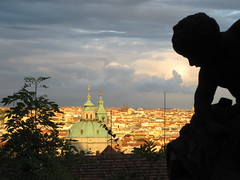
 I think few people really enjoy visits to beautiful old places, and they’re not helped by most guide books and tours, which just attach dates, artists’ names, and styles to the objects on view. Guides also tell anecdotes about events that happened to occur where one is standing. The result is history as one thing after another, which is fundamentally tedious. Much more compelling is some kind of explanation that presents works as intentional efforts to solve problems within their cultural contexts.
I am unqualified to explain Prague in those terms. I don’t speak the language, haven’t read most of the acknowledged classics of the literature, and have only spent a total of 14 days there. But this is a blog, so qualifications are waived. Here is my brief introduction to the city, based on four of its historical figures and their contexts.
1. Emperor Charles IV (1316-1378)
To imagine the Prague of 1350, think of the high middle ages: of ladies in tall conical hats, troubadours, sophisticated theologians. Also remember plague victims and open sewers; but it’s a mistake to think of those times as ignorant and backward (as in Steve Martin’s “Theodoric of York” skit). Progress was never linear or uniform; life was probably better in Central Europe in 1350 than in 1640, during the wars of religion. Certainly, the culture was highly sophisticated and developed. Looking out over the city, one can pick out the medieval parts (mixed with some modern imitations) by looking for angular spires, pointed arches, and steep triangular roofs. 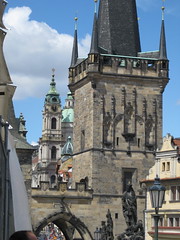
Prague became the capital of the whole of central Europe whenever the local monarch was elected Holy Roman Emperor, which happened on several occasions over the centuries. (Its status as an occasional capital helps to explain its magnificence.) When Charles IV was elected, he became the highest figure in the vast hierarchical system called feudalism. Each piece of land was assigned simultaneously to serfs, a local lord, a major lord, often a king, and the emperor; and each of these had different rights and duties. The whole system was circumscribed by law; and the feudal law reflected general principles that could also be discerned in ecclesiastical law, municipal law, and even the rules of chivalry and courtly love. The same way of thinking was also evident in theology, which Charles IV studied at the great university of Paris as a youth. Medieval Europeans loved hierarchies and patterns generated by distinctions and rules; but within each cell of a pattern, they welcomed improvisation and elaboration. A clear illustration is a Gothic church, with its regular pointed arches and windows, each heavily and uniquely decorated. All of this took work: one intentionally brought diversity into order and then embellished the results.
Charles IV personally made Prague a city of greater sophistication, elaboration, and order by founding the university that bears his name and commissioning major works of architecture. To explore his city, one could climb the medieval Jind?išská gate tower and look for other Gothic tours and spires, walk through Old Town Square with the Týn Church and famous clock, visit the university and bridge both named for Charles as their founder, and ascend to the Royal Castle, within which is St. Vitus Cathedral–substantially built under Charles’ patronage by a great Gothic master, Peter Parler.
The Cathedral is good place to think about the Czech people and what has defined them, in Charles’ day and thereafter. One answer emphasizes the Slavic side. Czechs were originally a group of Slavs not sharply differentiated from other Slavs. (It is the human condition to belong to groups not sharply distinct from others.) Today their language is defined by dictionaries and grammars and is different from Slovak or Polish. In the middle ages, Bohemia was already a province, along with the other Czech province of Moravia. It had a quasi-mythical founding figure, “good” king Wenceslas (Vaclav; pronounced “vatzlav”) who was expected to return, like Arthur, to serve his people. Thus Czechs were of the tribe of Vaclav. That was also Charles’ given name, before he ascended to the imperial throne, when he became Karel/Karl/Carolus. But the population he ruled included many who spoke German or Yiddish. That remained the case in Bohemia until 1948. Thus another answer is: Czechs were a multi-ethnic people in a melting pot. Charles himself spoke German and Czech along with Latin, French, and Italian (and all five languages have had deep impact in Prague).
2. Emperor Rudolf II (1552-1612)
Rudolf held the same offices as Charles, plus others. He was a Hapsburg, thus of German extraction, although he too spoke several languages. The political system he oversaw was still feudal; serfs on huge estates paid for the massive and numerous Renaissance and baroque palaces that crown Hrad?any hill. But this was the beginning of the age of absolutism. Although Rudolf was not an absolute monarch like Louis XIV somewhat later on, he had more power and a more effective bureaucracy than Charles IV had possessed at the high point of feudalism.
We are now in the Renaissance, whose definition is the recovery of Greco-Roman culture. At the peak of the Italian Renaissance, the result is simplicity, clarity, and still perfection. A Madonna by Raphael is an idealized woman in a peaceful and transparent three-dimensional space, often framed by classical architecture. But the recovery of ancient civilization also dredged up all kinds of odd and esoteric ideas and practices: magic, religious cults, speculative philosophies, and strange and deliberately distorted works of art. Renaissance Europeans were always interested in the eccentric side of the ancient world, but this interest rose in Rudolf’s time and especially in his own circle. He made his court the world’s center for occult and cabalistic studies, collected a huge museum of strange objects, and patronized the style of art we call Mannerism. This style deliberately eschewed clarity and perfection and made an issue out of the artist’s personal style (“maniera”)–the odder the better. Mannerist architects played with the classical rules, using traditional elements of Ionic or Corinthian orders but deliberately turning them backwards or upside-down.
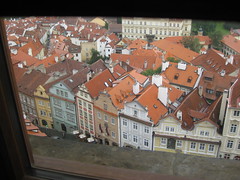 Magic and the occult were not yet distinguished from science. Rudolf brought both Kepler and Brahe to Prague and made it the greatest scientific center of the age. We could see his era as a struggle (not perhaps fully conscious) between the transparent and the secretive, and between classical norms and personal eccentricities.
It would be hard to conduct a walking tour of Rudolf’s Prague, since he locked himself in his castle to avoid assassins; and not much other Renaissance architecture survives. Better to look out of the Castle windows at the subjects’ houses below. There is also some important Mannerist art in the Sternberg Palace.
Rudolf provides a good opportunity to think about religion. In Charles IV’s day, all of Europe north of the Alps was Catholic, with the exception of the Jewish ghettos, of which Prague’s was particularly important. But the Protestant Reformation came especially early and strongly to Bohemia, thanks to the influence of the pre-Protestant religious reformer Jan Huss. During Rudolf’s reign, as religious wars raged in France and the Low Countries, tensions simmered in Prague. Everyone had to take a side and could easily be burned at the stake for taking the wrong one–unless one were the Emperor. Rudolf seemed neutral or perhaps committed to his own strange and unorthodox beliefs. After he died, religious conflict dominated Central Europe and may have killed 20 percent of the whole population. The Thirty Years War ended with Bohemia under Austrian rule and mandatory Catholicism.
III. Wolfgang Amadeus Mozart (in Prague 1786-9)
Mozart was not a Czech; he was a German-speaking subject of the Austrian Empire. But he did some of his most important work in Prague and especially liked the city. He is a representative figure from an era in which Prague was a provincial Austrian capital and German was the only official language.
Mozart found a Baroque city. There had been an enormous investment in religious art and architecture as the authorities tried to institutionalize Catholicism after 1648. They naturally commissioned Baroque works, that being the style of the era. Baroque artists were learned in the classical orders, but they changed them to make them dynamic and dramatic. Every surface (pilaster, column, lintel, frieze, and cornice) might be bent and decorated. Buildings were situated for theatrical effect, emerging surprisingly from crowded streets or looming dramatically above. Paintings and statues were likewise situated within and around buildings for dramatic impact.
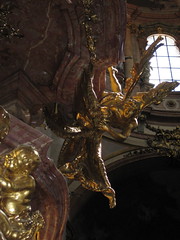
Baroque is an art of ornament. The real structure of an object is concealed with embellishments. Windows are hidden to allow the light to play mysteriously on painted surfaces. In its final phase, rococo, the ornament becomes the art. Gilt frames break loose from paintings and flow all over walls in abstract, plantlike forms.
Rococo seemed to reflect the artifice and inauthenticity of a culture dominated by feudalism and Catholicism, when the most sophisticated people (such as Mozart) were republicans and free-thinkers. So rococo contended against at least two major alternatives: neoclassicism and romanticism. Mozart dramatically reduced the ornamentation typical in Baroque music; instead, he combined several musical themes in related keys to build ordered and transparent musical structures. Don Giovanni, the transcendent example of his classical style, was first performed at the Neoclassical Estates Theater in Prague.
This was a city, then of Baroque theatrical propaganda versus Enlightenment and Neoclassicism; of absolutist feudalism and revolutionary thinking; of artifice and critique.
IV. Franz Kafka (1883-1924)
Kafka was an unobservant Jew, a Czechoslovak citizen with a Czech name who spoke German, and a potential victim of the German State if he hadn’t died prematurely. He was alienated, skeptical, detached. These are hallmarks of modernism, of which Prague was a major center. It was the only place in the world where Cubist buildings were constructed (see Josef Go?ár’s Cubist House of the Black Madonna with Gothic spires in the distance); and it was the seedbed of literary theory. 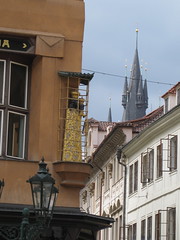
One could contrast Kafka to the highly talented and abidingly popular Czech artist Alfons Mucha (1860-1939). Mucha was a Czech nationalist and a Slavophile (although not at all antisemitic). He thought that the Czech people had an essential character that could be celebrated in art. The way to celebrate it was to illustrate dramatic episodes of Czech history in a realistic yet idealized style. His illustrations decorate, for example, the Municipal House, a shrine to Czech culture and language that was deliberately built at the head of Na Prikope street–am Graben to Kafka–which was the center of Prague’s German-speaking cafe and theatrical life. In contrast to Mucha, Kafka didn’t fit in, didn’t believe in the essential character of any nation, couldn’t complete any public project, and didn’t think that he could or should tell straightforward stories. I emphasize the negative, but of course he invented some of the greatest stories of our age.
A day devoted to Kafka might begin with the old Jewish synagogues, because he was interested in his heritage and the Prague-Jewish traditions of Cabala. It is then possible to see some of his old cafes, plus many important Cubist and other modernist buildings. There is even the world’s only Cubist lamppost on Wenceslas Square.
Reading the City
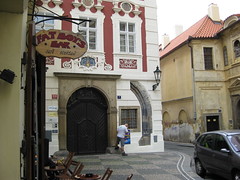
A final photo posted below shows a Gothic arch from the Middle Ages still embedded in a house that was given a Baroque facade in the eighteenth century, behind a modern commercial sign in the new international language of English, and a guy on a cell phone. This is Prague, endlessly fun to interpret if one begins to learn its codes.

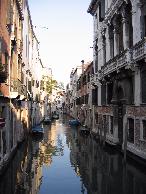 I love Venice. My family and I just returned from an idyllic week there and are mourning our departure. However, we noticed that a lot of the other visitors didn’t look very happy. Maybe they were having a better time than it seemed as we watched them trudge across the Piazza San Marco. I’m sure that some of them enjoy activities that I don’t happen to like (such as shopping), and that’s great. But I also know from overhearing their conversations that at least some of the hundreds of thousands of tourists who visit this small city every day are quite unhappy.