Category Archives: Barack Obama

the legacy of the Civil Rights Movement

I have some reflections on the recent spat between Senators Clinton and Obama, but first, here is the actual “text” of their dispute as accurately as I can capture it.

At the Democratic Debate in New Hampshire, Senator Clinton said: “So, you know, I think it is clear that what we need is somebody who can deliver change. And we don’t need to be raising the false hopes of our country about what can be delivered. The best way to know what change I will produce is to look at the changes that I’ve already made.”

Back on the trail, Senator Obama said, “For many months I’ve been teased, almost derided, for talking about hope … We saw it in the debate last night. One of my opponents said, ‘We can’t just offer the American people false hopes of what we can get done.’ False hopes!” Later, in Labanon, NH, he amplified his position: “Dr. King standing on the steps at the Lincoln Memorial, looking out over that magnificent crowd, the Reflecting Pool, the Washington Monument: ‘Sorry, guys. False hope. The dream will die. It can’t be done.’ ”

Then, on Fox News, Major Garrett asked Senator Clinton if she would respond to Senator Obama, and she said, ‘I would, and I would point to the fact that that Dr. King’s dream began to be realized when President Lyndon Johnson passed the Civil Rights Act of 1964, when he was able to get through Congress something that President Kennedy was hopeful to do, the president before had not even tried, but it took a president to get it done. That dream became a reality. The power of that dream became real in people’s lives because we had a president who said, ‘We are going to do it,’ and actually got it accomplished.”

During and after this exchange, the candidates, their surrogates, and pundits have said many things that do not deserve to be taken seriously or at face value. But I thought the comments themselves raised valid and relevant issues about how major social change is accomplished.

For the sake of simplicity, we might say that there were three great reasons for the civil rights reforms of the 1960s: (1) The charismatic leadership of people like Dr. Martin Luther King, Jr. and his colleagues and rivals; (2) the skillful political maneuvering of politicians like Lyndon Johnson; and (3) the great popular movement that arose from grassroots voluntary institutions, especially Black churches.

If we interpret Senator Clinton charitably, I think she was saying that Democrats are at risk of voting for charisma (Senator Obama) without realizing that you also need the skills, tactics, and experience of professionals like Lyndon Johnson–and by analogy, herself. Other critics of Senator Obama also believe that what he basically offers is charisma. For instance, Paul Krugman has recently written, “The Democrats in general make far more sense [about Chinese trade policy]. But among at least some of Barack Obama’s supporters there seems to be a belief that if their candidate is elected, the world’s problems will melt away in the face of his multicultural charisma.” I thought that Krugman created a straw man; but it’s true that charisma is inadequate and voters should pause before voting for the candidate who happens to be the best speaker.

Clearly, the third ingredient of the civil rights movement–neither political tactics nor charismatic leadership, but grassroots organizing–was crucial to its success. Senator Obama might have emphasized that point in his response to Senator Clinton (instead of attacking her for besmirching the sainted memory of Dr. King). In fact, at his next opportunity to speak after Senator Clinton talked about “false hopes” in the debate, Senator Obama said, “And just to wrap up, part of the change that’s desperately needed is to enlist the American people in the process of self-government.” He could have amplified that point over the succeeding days and noted that Lyndon Johnson couldn’t have done a thing without active pressure from citizens. He could have used language like Rich Harwood’s: “No candidate, no matter how gifted or skilled, can through their campaign offer redemption to a nation on its stained history. Surely, the candidate can help lead and give voice to such a process, but the great work of coming together will ultimately only occur through the efforts of people in their communities, and only over time.”

Alas, we do not have large, highly active, interlinked progressive organizations that are rooted in the working class, as we did from 1930s through the 1960s. A pessimist might say: Therefore, the best we can get is whatever skilled political tacticians can win by playing the Washington game effectively. The question is who’s the most skillful tactician in the race? (I’m not actually sure of the answer, because none of the three leading Democrats has a legislative record even close to LBJ’s.)

An optimist would say: There are pieces of a civic infrastructure in America, and innovative ways for citizens to engage. The right kind of national leader can strengthen that infrastructure by encouraging active citizenship rhetorically and by implementing policies that get ordinary people more involved. The first step is to change the debate we have seen over the last few days. It should not be about who supports civil rights policies, nor about who respects Martin Luther King. It should be about how to achieve positive social change.
the Obama “theory of change”

Mark Schmitt’s essay on Senator Obama has been very widely cited (and should be applied to politicians other than Obama himself). Schmitt argues that, as president, Obama might win legislative victories by treating conservatism as a legitimate philosophy and presuming that his opponents honor the same basic values that he does–e.g., health care for all. This assumption would put Republicans in a difficult position if the evidence favored progressive proposals. Obama’s conciliatory and deliberative style might win over a few Republican senators, Schmitt says, and that is essential if Democrats want to pass legislation.

Continue reading

Obama’s service plan

As I write, Barack Obama is at Cornell College in Iowa unveiling his national service plan, along with Senator Harris Wofford. The text of the plan is here (pdf) and here’s the speech. It’s ambitious in that it envisions dramatically expanding the number of slots in federal programs such as the Peace Corps; creating new corps especially devoted to various important public issues (such as clean energy and health); changing financial incentives so that colleges and universities will fund more student service; integrating service better into k-12 education; and funding “social entrepreneurship” in the nonprofit sector. It is a $3.5 billion/year plan, which is a serious investment.

I think national service programs represent an important aspect of civic renewal. They create opportunities for people to work on public problems without having to enter bureaucracies or obtain credentials–that’s how I’d define “social entrepreneurship.” They express respect for ordinary Americans’ potential to contribute. (For instance, Obama would enlist Americans who speak foreign languages to go overseas and represent us.) And good service programs provide an education in citizenship for participants of all ages.

I do not believe, however, that national and community service exhaust our options for civic renewal. Other major goals include: promoting effective public deliberation about policy, reforming the political system to make it more responsive and deliberative, and revising substantive policies in areas like health and education so that they encourage public participation. Senator Edwards has advanced important ideas regarding public deliberation and political reform. The November Fifth Coalition is showing what it would mean to reform substantive policies. There is still room, clearly, for Senator Obama and other candidates to propose more ideas to renew democratic participation.

I’ll be interested in the degree to which the press reports the new Obama service agenda. Most of the coverage of Edwards’ “democracy agenda” was generated by colleagues and associates of mine who deliberately wrote supportive op-ed pieces (collected here). Their message was: Edwards has good ideas, but there is plenty of room for other candidates to stake out civic ground. I’d say that remains the case even after today’s excellent speech by Senator Obama.

the case for Nehamiah

Here’s a stark contrast:

1. Paul Krugman, “Played for a Sucker,” New York Times, Nov. 16: “On Social Security, as on many other issues, what Washington means by bipartisanship is mainly that everyone should come together to give conservatives what they want. We all wish that American politics weren’t so bitter and partisan. But if you try to find common ground where none exists–which is the case for many issues today–you end up being played for a fool. And that’s what has just happened to Mr. Obama.”

2. Harry C. Boyte: “Our Passive Society Needs Some New Nehemiahs,” Minneapolis-St. Paul Star-Tribune, Nov. 16: “In today’s America, as we have come to look to others — experts, great leaders, celebrities — to save us from our problems, we have similarly become afflicted by civic illness. Our bitter divisions along lines of partisanship, income, race, religion and geography are fed by devaluation of the talents and intelligence of people without credentials, degrees and celebrity status. Our citizenship declines while we are entertained as spectators, pacified as clients and pandered to as customers.

“We need new Nehemiahs who call forth America’s democratic genius of a self-reliant, productive, future-oriented citizenry, leaders who tackle tough issues in a collaborative way and reject the rescuer role. Such leaders would tap the talents of citizens to address public problems on which government is necessary but not sufficient, from climate change to school reform. They would challenge us to create healthy communities, not simply provide access to health care. They would recall that democracy is a way of life, not simply a trip to the ballot box.

“The great leaders in our history — from Abraham Lincoln to Jane Addams, Franklin Roosevelt to Martin Luther King Jr. — have always called upon citizens to address common challenges, and in the process helped the nation remember its democratic soul.”

I’m with my friend Harry, and here are four reasons. First, Krugman treats the Republican Party and conservatism as monolithic, imagining that every member of those large conglomerations plays from the same disreputable script. (Cf. all these comments on Think Progress.) In fact, Republicans and conservatives are quite diverse, and some are very discontented with Karl Rove’s style of politics.

Second, Krugman’s argument is ad hominem. Instead of saying, “Senator Obama, you are wrong about Social Security; it’s not really in crisis,” Krugman says, “Senator Obama, you are a sucker for trying to meet conservatives half way.” Maybe compromise isn’t even Obama’s intent. He may actually believe that Social Security is in crisis. (Many people do.) When we stop giving arguments and reasons and start calling people “suckers,” it’s very hard to move forward.

Third, it’s going to be impossible to solve any of our real problems unless someone builds a broad constituency. The ruling coalition must be wide enough to embrace some conservatives and some Republicans. Fifty-one percent is enough to knock things down (if you are ruthless), but it is not enough to build things up.

Finally, Krugman’s political strategy presumes that liberal leaders can win elections and then implement smart policies that will make the country better. I think this is a long-term strategic error. No policies can solve problems without public support and public participation. In order for liberalism to fly, Americans are going to have to feel genuine connections to public institutions. They will not feel truly connected to government until (a) it seems to reflect some consensus and some civility and (b) it addresses their cultural discontents, which are deep and valid. The majority of Americans have genuine worries about a coarse culture, and unless liberal leaders can address their concerns in an inclusive, bridge-building way, liberalism is doomed.

the Democratic primary

State primaries are the only contests that really count for selecting a presidential nominee. The national population never weighs in, which notoriously means that people count for a lot more in New Hampshire than in, say, Maryland. Nevertheless, the candidates are surely interested in their standing among all Americans who register with their party. That’s partly because their level of national support will influence state primary voters. And it’s partly because the primary calendar is so compressed and unpredictable this year that it’s risky to rely on particular states.

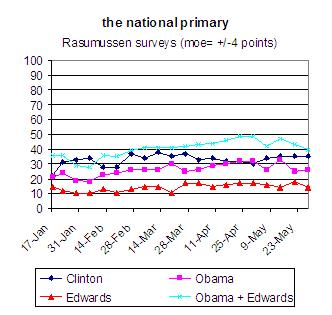
Here, then, is a graph showing support for Senators Clinton, Obama, and Edwards among likely Democratic voters nationwide. (Source for the data.)

The three leading candidates have gained since January, at the expense of “don’t know/undecided.” Senator Clinton quickly rose to the mid-30-percent range and has then had very stable support. Support for Senators Edwards and Obama has been more volatile and has sometimes traded-off. For example, during the third week of March, Obama gained at Edwards’ expense, but then that trend reversed. It’s as if 35% of the Democratic electorate has settled on Senator Clinton, and the rest prefers an alternative–but hasn’t decided who that should be.