Regressions, pentameters, dialogues,
Memoranda of understanding, plots,
Research contracts, policy briefs, lectures,
Op-eds, philosophical arguments,
Budget narratives, translations, fact sheets,
Hortatory afterwords, blind reviews,
Close readings, scatterplots, interview notes.
These are things I write but not as well
As they are written. I read and relish
Much better than I compose and create.
A poor place to be at age forty-two;
The biography shelf stands in reproach.
I plead restlessness and indiscipline.
Dissatisfaction, ambition, ego–
Susceptibility to the thin charm
Of seeing first name, last name, title in print–
Lure of the easy August downhill path
Plus unconfessed daydreams of synthesis
And a hapless, unquenched love of the world.
Category Archives: verse and worse
Martha’s Vineyard, August 2009
Objects in view: one set of sculpted cliffs,
Venerated by the Wampanoags,
Topped by a Yankee lighthouse whose clocklike beam
Won the Paris Exposition prize, one
Steaming sea stirred by an African storm,
One red sunset, one skipping long-limbed child,
My child, whose footprints the sea erases.
Too much to say about all this, too hard
To say it; too many layers, too wide
The scope, from Pilgrims’ footfalls to the trope
Of ocean sunsets as the end of all.
Too much Homer, Arnold, Childe Hassam.
A place we travel hours to admire
Is no sight to try to praise in words.
Better to turn from the loud-resounding sea
To other sites where long-limbed daughters play,
Suns set, and settlers built on worshipped land:
Takeout windows, mowed weeds between sidewalks
And parking lots, driveways, on-ramps, strip malls.
Love not only what glimmers and is vast,
But just as deeply our own darkling plain.
the hourglass
One grain of sand is not a heap of sand.
If one grain is no heap, two cannot be.
If two are not a heap, neither are three.
So keep adding grains from your open hand–
One million’s no heap if built up from one.
But if you could find such a thing as a heap,
You’d do no harm by taking part to keep.
A heap’s still a heap when one grain is gone.
Now say that this pile of sand’s in a glass,
With a neck that allows the grains to slide through,
One or two at a time–now and then, a few–
Til the sand’s at the base and no more will pass.
Instant by instant, time, like sand, creeps.
A life is just a heap of time, and so,
Though each day must fall, the life cannot go.
(Unless we believe that there really are heaps.)
snapshots from February and March
Out of the bathroom window in the middle of the night, a scene from an expressionist painting. The moon, too large, glares through black tree limbs. Snow forms a smooth shape, a pearly pool, amid the trunks. Houses stand at crazy angles.
- Two people walk through the cold naked grove;
The moon goes with them, they gaze at it.
The moon slips over tall oak trees;
No cloud obscures the heaven’s light
Into which the black spikes reach.
(From Richard Dehmel, Zwei Menschen, 1903)
A woman is running, screaming up Winter Hill in Somerville toward a gas station, where a knot of people stands. One of them is a police officer. Her dog lies on his side as if asleep.
False spring on Brattle Street: grand Victorian houses, an anthology of architectural styles. Joggers, toddlers in strollers, buds on the manicured foliage.
On a beach near Gloucester, the vacation houses have a slum-like look. They are small and boarded-up for winter; the streets are deserted in the cold sea air. There’s a game of horse-shoe on the sand, and dogs run joyfully in the surf.
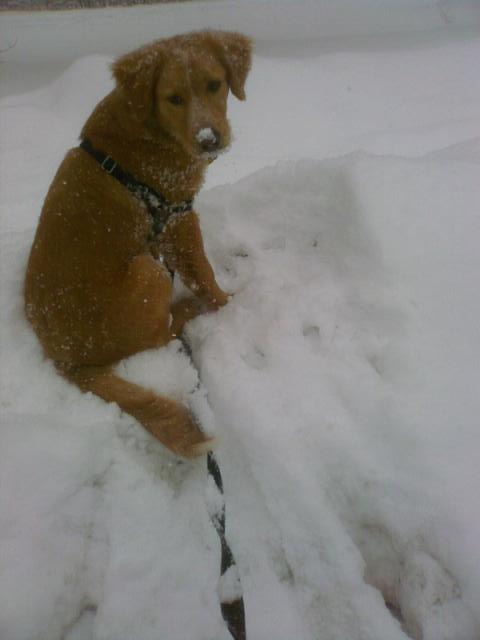
for I will consider my dog Barkley
For I will consider my dog Barkley.
For he has no inkling of things metaphysical.
For he never meets a creature who is not his friend.
For if he worships, it is done his way.
For first he sniffs incessantly in circles.
For secondly he tugs the leash.
For thirdly he tastes whatever he finds.
For fourthly he chews and recalls.
For fifthly he sits on a lap and sleeps.
For he is an enthusiast.
For he knows not jealousy nor suspicion.
For embarrassment troubles him not.
For when anyone lies on the ground, he rushes to resuscitate.
For, tho he is brave, shadows and mean dogs frighten him.
For sad sounds disturb him.
For he can flatten himself like a gerbil to pass under gates.
For, tho he cannot fly, he is an excellent gamboler.
For he can detect tiny scraps of food.
For he is much more waggery than gravity.