Category Archives: press criticism

too much coverage of the Virginia Tech tragedy

The amount of coverage has been staggering–dozens of stories per day in the top national newspapers, nightly broadcast news programs that are lengthened by half an hour, 24-hour repetitions of the same information on cable news, even a blow-by-blow account in the “Kid’s Post” section of the Washington Post, which my 7-year-old reads. I first found out about the Blacksburg tragedy because a student TV news crew stopped me on the street to ask my opinion. This is a global phenomenon: Le Monde and the BBC also led with Cho Seung-hui’s picture when I looked.

It’s a choice to devote so much space and time to those 33 deaths. Bombers killed 158 in US-occupied Baghdad on Wednesday. Nigeria, the biggest country in Africa, saw violence connected to its presidential vote. Comparisons are odious; they imply that one doesn’t care about particular victims and that human lives can be counted and weighed. I do sympathize with the Blacksburg victims and their families. I sympathize because I have been told their stories in detail; but there are many other stories that I could have been told–other tragedies, or (for that matter) other narratives that are important but not tragic.

Perhaps the Virginia Tech victims deserve sympathy from all of us, but I suspect they would prefer less attention. I find it hard to see how the deserve something they don’t want.

One reason to tell the Virginia Tech story in detail is to provide us with the information we might need to act as voters and members of various communities. For instance, I work at a university much like Virginia Tech and could agitate for new policies in my institution. But it is generally a bad idea to act on the basis of extremely rare events. There have been about 40 mass shootings in the USA. During the period when those crimes have occurred, something like half a billion total people have been alive in America. That means that 0.000008 percent of the population commits mass shootings. There cannot be a general circumstance that explains why someone does something so rare. The availability of weapons, mental illness, video games–none of these prevalent factors can “explain” something that in 99.999992 percent of cases does not happen. (Bayes’ theorem seems relevant here, but I cannot precisely say why.)

It is foolish to use such rare events to make policy at any level–from federal laws to school rules. For instance, if lots of people carried concealed weapons, there is some chance that the next mass killer would be stopped after he had shot some of his victims. But millions of people would have to carry guns, and that would cause all kinds of other consequences. The day after the Blacksburg killings, two highly trained Secret Service officers were injured on the White House grounds because one of them accidentally discharged his gun. Imagine how many times such accidents would happen per year if most ordinary college students packed weapons in order to prevent the next Blacksburg.

The last paragraph was a rebuttal to those who want to use Cho Seung-hui as an argument for carrying concealed weapons. But it would be equally mistaken to favor gun control because it might prevent mass shootings. Maybe gun control is a good idea, but not because it would somewhat lower the probability of staggeringly rare events. Its other consequences (both positive and negative) are much more significant.

If obsessive coverage of a particular tragedy does not help us to govern ourselves or make wise policies, it does reduce our sense of security and trust. It reinforces our belief that “current events” and “public affairs” are mostly about senseless acts of violence. It plants the idea that one can become spectacularly famous by killing other people. These are not positive consequences.

It is moving that some students have started a “reach out to a loner” campaign on the Internet. They are trying to respond constructively to something that they have been told is highly important. Imagine what they might accomplish if they turned their attention to the prison population, the high-school dropout problem, or even ordinary mental illness.
whom does a White House reporter represent?

Another person who spoke on Saturday at Penn State was David E. Sanger, the chief White House correspondent of the New York Times. After his speech, I asked him whom he thought he represented when he rode on Air Force One or sat in the White House briefing room. He replied, “You always represent your readers.” I asked him who he wished his readers were. I was wondering, for instance, whether he would like to reach (and therefore “represent”) a cross-section of the whole national population, if that were possible. He replied that Times readers are always going to be unusual in some respects. They have a high median level of education and tend to have especially enjoyed their own college experiences. He argued that skew was acceptable as long as everyone can get access to the Times, which is easy now via the website.

That’s a plausible answer. It’s better than claiming that the Times only serves the truth. Despite its slogan (“All the News that’s Fit to Print”), the newspaper obviously makes choices about what stories to cover and whom to interview, based on value-judgments about what is most important. Sanger had conceded that point in earlier comments.

I can imagine a reporter saying that he represents no one, or only his employer. But that would raise questions about why he should have access to the president of the United States. I can also imagine a New York Times reporter saying that she represents “the American people.” That’s consistent with the Times’ image as an objective source of information for any citizen (regardless of creed, region, or party) who wants to make independent decisions. I’ve previously quoted Adolph Ochs, who said, when he bought the Times in 1896, that he intended to “give the news, all the news, in concise and attractive form, in language that is parliamentary in good society, and give it early, if not earlier, than it can be learned through any other reliable medium; to give the news impartially, without fear or favor, regardless of any party, sect, or interest involved; to make of the columns of The New York Times a forum for the consideration of all questions of public importance, and to that end to invite intelligent discussion from all shades of opinion.” That’s a high ideal, and it reflects a kind of implicit contract between the whole public and the Times’ reporters. That contract has come into question with recent scandals, but I don’t think that tighter ethical rules would fully resolve the problem. The Times cannot represent the whole American people if the 1.1 million people who buy it are skewed by class, ideology, and region. It could struggle to make its readership nationally representative, but that would probably require a change of tone, topics, and perspective. Perhaps it is best to say, as Sanger did, that he simply represents his readers and welcomes anyone to join their company.

box score political reporting

One of the standard clich?s of journalism is the treatment of political news as if it were a sport. Each event is described as a victory or a defeat for a particular politician. For instance, here’s how the two papers that I read over breakfast this morning reported the latest Administration policy on prisoners:

The New York Times: The new policy “reverses a position the White House had held since shortly after the Sept. 11 attacks, and it represents a victory for those within the administration who argued that the United States’ refusal to extend Geneva protections to Qaeda prisoners was harming the country’s standing abroad.”

The Washington Post: “The developments underscored how the administration has been forced to retreat from its long-standing position.”

The Administration’s change of position was a defeat: that’s a fact. And it’s undeniable (almost tautological) that the shift was a “victory” for those who opposed the status quo. But reporters could choose many other facts to provide: for example, information about what has been done to various prisoners. The reliance on political wins and losses has the following serious drawbacks:

1) It encourages laziness. You don’t have to do any actual reporting to figure out that an event is good or bad for a politician.

2) It reinforces the notion that politics is a spectator sport, in which the important question is “Who’s winning?” (not, “What’s happening?”).

3) It adds to the political cost that incumbents incur when they change course for good reasons. When George Bush found out that Abu Zubaydah, whom he had described as Al-Qaeda’s chief of operations, was mentally ill and of no consequence, he supposedly told CIA Director George Tenet, “I said he was important. You’re not going to let me lose face on this, are you?” If that’s true, it’s evidence of almost criminal irresponsibility. But Bush also knew that if he changed his position, the press would report that as a sign of weakness–a “setback” or “defeat”–instead of allowing the president to take credit for learning. Reporting politics as a box-score only increases the odds that leaders will act like Bush.

(In fairness, I should note that after I read this morning’s papers and decided to write this post, I looked around for other examples of box-score journalism on the prisoner issue. The AP, Reuters, and L.A. Times stories really did not use that frame.)

the press and civic engagement

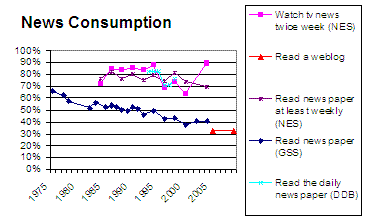
Below the fold, I have pasted a longish draft essay on the evolution of the news media and its impact on democracy. (A revised version will go into a book on civic engagement that is due next month.) In essence, I argue that we had a particular model of the news business between 1900 and 2000 that became increasingly dysfunctional for citizens. It offered limited opportunities to write the news–that’s a well-known flaw. It also assumed an audience of people who were interested in public issues and who trusted professional reporters to be objective, balanced, reliable, and independent. That audience encompassed the most active citizens, as surveys show. But it shrank rapidly in the last quarter of the 1900s. Resurrecting the twentieth-century press now seems impossible, but the new digital media have promise.

Continue reading

newspapers and civic engagement

Almost two centuries ago, Tocqueville detected a close relationship between journalism and civic engagement. Newspapers were the main news organs of his day, and he wrote that “hardly any democratic association can do without” them. “There is a necessary connection between public associations and newspapers: newspapers make associations and associations make newspapers; and if it has been correctly advanced that associations will increase in number as the conditions of men become more equal, it is not less certain that the number of newspapers increases in proportion to that of associations. Thus it is in America that we find at the same time the greatest number of associations and of newspapers.”

I wanted to see whether the relationship that Tocqueville observed impressionistically remains true. Yesterday, using the 2000 American National Election Study, I found strong, statistically significant relationships between people’s frequency of reading a newspaper, on one hand, and their likelihood of volunteering, working on a community issue, attending a community meeting, contacting public officials, belonging to organizations, and belonging to organizations that influence the schools (but not protesting or belonging to an organization that influences the government). To illustrate these relationships with an example: 42.4 percent of daily newspaper readers belonged to at least one association, compared to 19.4 percent of people who read no issues of a newspaper in a typical week.

I did not control for other factors, such as education. Nevertheless, it appears that residents who engage in their communities also seek information from a high-quality source–and vice-versa. Having information about current events gives one relevant facts and motives to participate; and participation leads one to seek information.

Rates of newspaper reading have fallen sharply. I realize there is nothing sacrosanct about the printed daily newspaper; websites or radio and television broadcasts could, in theory, be just as good for civic engagement. But there is no evidence that the electronic media have yet compensated for the decline in newspaper consumption.