Category Archives: press criticism

media bias and election outcomes

The conservative world is abuzz with the idea that liberal news media are either hurting McCain or making his polling results look worse than his real support in the public. I know plenty of liberals who believe that the rise of Rush Limbaugh and Fox News accounts for conservative electoral victories after 1992. These two claims don’t cancel out; one or both could be true. But a full statistical model of election outcomes would have to factor in at least:

a. The fit between candidates’ positions and public opinion

b. The candidates as communicators/symbols

c. Strategic and tactical political decisions by campaigns

d. Grassroots activity by citizens

e. Campaign finance

f. Changes in the real economic and social circumstances of voters before the election

g. The real performance of the incumbent administration

h. Media bias

I can imagine that (h) would account for some of the variance in election results. But I don’t think it can explain too much, because there is a lot of evidence about the importance of (f). Specifically, changes in inflation-adjusted, disposable household income before an election remarkably predict whether the “in” or “out” party wins. And people know their own income; they don’t need the media to tell them.

We should wish that (a), (d), and (g) would explain most of the variance in election results. Those are the democratic inputs. Political reforms should maximize the importance of these factors. (H) is unfortunate, but I doubt it’s very important once the other factors are considered.
part of the problem

I generally don’t like to quote at length from prominent blogs, but I can’t improve on this reaction by Jay Rosen:

I was watching CNN for Obama’s speech. Moments after it concluded Wolf Blitzer was asked to tell us what he heard in it. Wolf’s ear is the big ear for the Best Political Team on Television, according to CNN. So he went first. And according to Blitzer, Obama’s speech boils down to a “pre-emptive strike” against various attacks on the way: videos, ads, and news controversies that are sure to keep Reverend Jeremiah Wright and “race” in play as issues in the campaign. (I don’t have his exact words; if someone out there does, ping me.)

Wasn’t the speech about that very pattern?

This is the style of analysis–and the level of thought–we have become miserably utterly used to, especially from Blitzer, but also many others on TV: everything is a move in the game of getting elected, and it’s our job in political television to explain to you, the slightly clueless viewer at home, what the special tactics in this case are, then to estimate whether they will work.

That Blitzer, offered the first word on that speech, did the savvier-than-thou, horse race thing tells you about his priorities (mistakenly “static,” as Obama said about Wright) and his imaginative range as an interpreter of politics (pretty close to zero.)

Compare Wolf to active, thoughtful citizens who care:

“The Rev. Joel Hunter, senior pastor of a mostly white evangelical church of about 12,000 in Central Florida … said the Obama speech led to a series of conversations Wednesday morning with his staff members. “We want for there to be healing and reconciliation, but unless it’s raised in a very public manner, it’s tough for us in our regular conversation to raise it.”

Julie Fanselow: “Time and again Tuesday, speakers at Take Back America and writers on blogs like The Super Spade and Booker Rising and Pam’s House Blend echoed and dissected and even wept over what Obama had said in Philadelphia.”

Rich Harwood reflects on what we should do when someone (such as Rev. Wright) “cross[es] the line of politeness and rupture[s] norms of give-and-take.” We should, says Rich, “step forward and renounce them in ways that reflect the kind of public life and politics we seek to create. Let us take in the fullness of their argument and respond in kind – with clarity, forthrightness, and strength of conviction, even love. I do not suggest that anyone should back down, but neither do I advocate a slash and burn response that poisons the very public square we wish to invigorate.”

Less favorable to Obama, but equally responsible and deliberative, is Bill Galston’s take.

an opening for the news media

David Carr, a financial reporter for the New York Times, argues that the rising youth turnout rate offers the news media an opportunity to expand their audience among young people. He quotes me, saying, “I think that there is a clear message in here for the media: these campaigns have made very direct and serious pitches to young people and they have responded. … I think it demonstrates that if you approach them in a specific way about things they care about, they will engage.”

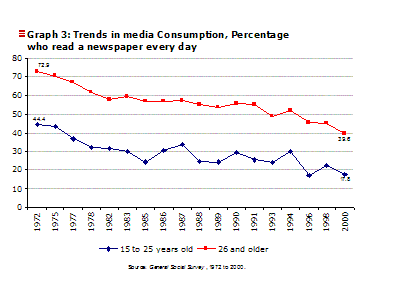
This is certainly an important issue, because using the media (especially a daily newspaper) correlates powerfully with voting and all forms of civic participation, including membership in groups. For young people, news consumption has fallen:

This graph provides an incomplete picture. It doesn’t continue until 2004-7, when you would see some increase in newspaper readership. And it omits other news sources, such as the Internet. But notice that the decline was long, slow, and steady and started well before the Internet achieved mass scale.

I serve as a trustee of the Newspaper Association Foundation and do other work in this field because I believe that the news media (as well as schools and other institutions) need to invest more in building young people’s interest in the news. They are also going to have to rebuild trust, because American youth are more cynical–or sophisticated–about bias and spin in the press than they used to be. The graph below shows trends in trust; our qualitative research finds that young people are especially sensitive to perceived bias and manipulation.

interacting with “the media”

(We’re heading west for Thanksgiving, and this will be my last post until Monday.)

I have minuscule impact on the news media, but I do have interesting experiences with journalists.

For example, yesterday at 7 am, I walked the halls of XM Radio in Northeast Washington, DC. XM Radio produces 170 separate channels of audio programming, mostly for specialized audiences. I was on my way to be interviewed for “POTUS ’08,” a channel that talks about nothing but the presidential campaign, 24 hours a day, 7 days a week. I should note that the questions turned out to be very good; they went far beyond the usual horse-race analysis. But what struck me were all the studios for the other radio channels, visible through glass windows along the groovy curving halls as I walked to my interview. Baseball jerseys and bats covered the walls of one studio, where three guys were talking into mikes. Another studio looked like a business suite with leather furniture and copies of the Wall Street Journal. It all seemed like a Monte Python skit. I expected to see the “Yo-Yo Channel” around the next corner, with people in beanies keeping their Imperials in motion, 24/7.

Later in the same day, a crew came to interview me for a documentary about the future of democracy (not about my book of that name; about the actual future of our actual democracy). The crew is also filming the interview process to create a video blog about making the documentary. That explained why there were two cameras, one filming the other one. Again, I should note that the interview questions were very thoughtful.

Finally, not long ago, a foreign TV crew came to interview me about KidsVoting USA. This is a fine program that involves discussing a campaign in school and then conducting a mock election. A rigorous study has found that participants’ parents actually vote at higher rates, because the program stimulates discussion of politics around the dinner table. The TV crew had gone to Duluth, Minnesota (i.e., the heartland) to film a KidsVoting class and some dinner-table conversations. After the interview, the reporter told me privately that she was so moved by what she saw in Duluth that she was thinking of quitting her job to start KidsVoting in her home country. She wanted my advice about fundraising.

7 questions about the campaign

On the front page of Saturday’s Washington Post, in a “Campaign Memo” addressed “To: The Voters” about “The Seven Things You Need to Know about the 2008 Race,” Dan Balz addressed the following questions:

1. Is the Clinton campaign a true juggernaut — or is that just what she wants everyone to believe?

2. Is there a Republican front-runner?

3. Is anyone on either side positioned to break into the top tier?

4. Does the new, turbo-charged calendar make Iowa and New Hampshire more important — or less?

5. Is it too late for Al Gore or Newt Gingrich to get into the race?

6. Do ideas matter in this election?

7. When do I really need to start paying attention, and should I trust the polls?

These are questions for spectators who are considering following the 2008 campaign as they might follow the NFL season–as a contest among professional teams. The big underlying question is: Who’s going to win? But what if you follow the campaign as a citizen concerned about the country and the world? Then your questions would be quite different:

1. What are our problems as a country?

2. What are some leading diagnoses and interpretations of these problems?

3. What should we do about our problems?

4. What role do I have?

5. What role does the next president of the United States have?

6. What are the candidates saying about how they would play their roles if elected?

7. What does other evidence (such as the candidates’ records, behavior on the campaign trail, choice of advisers, and core constituencies) tell us about how they would play their roles?

Perhaps Dan Balz would say that he cannot address my questions without editorializing. But he can hardly claim that he merely provides “the facts,” since his memo is full of declarative judgments about the horse race. (In his magisterial opinion, it is too late for Gore and Gingrich. No candidate has proposed any significant big ideas yet. Etc.) Besides, I’m not asking the Post to tell us what our problems are and how to solve them. I’m asking them to give us the factual basis to help us make up our own minds–along with a sampling of interesting views quoted from a variety of experts and activists.