Category Archives: democratic reform overseas

thoughts on Hugo Chavez

After President Chavez of Venezuela won the right to seek perpetual reelection, it occurred to me that:

1. Venezuela poses no risk to the United States. Its government must sell oil on the international market or it will collapse economically. If Chavez decides not to sell to us, we can still buy oil at the global price: it’s a commodity. Leaving aside short-term psychological shocks from a Venezuelan embargo, they have little power to affect world prices. They can use their oil revenues to fund overseas military adventures, but their military options are limited. Because Venezuela does not threaten us, we have limited standing to try to influence that country. However …

2. Chavez is almost certainly moving in exactly the opposite direction from what we need in the 21st century. He is centralizing power in the national government; merging military, administrative, and partisan-political authority; combining personal macho charisma with media celebrity and formal power; reducing political pluralism, checks-and-balances, and civil liberties; exploiting fossil fuels to the maximum; monopolizing the market, press, and state sectors; and trying to exacerbate the deep tensions in Venezuelan society instead of helping everyone to work together. I’d recommend a 180-degree different course. But …

3. Chavez occupies a huge and growing political niche. It is remarkable, in a world where about one billion people live on less than $1 per day, one quarter of children in developing countries are underweight because of inadequate food, and one quarter of children in the same countries are not in school, that there isn’t a more active and aggressive political movement that demands urgent economic redistribution.

I would generally favor moderate and market-based solutions to poverty, but the credibility of the market must surely suffer now that Wall Street and the City of London have been shown to be incapable of managing even their own affairs. I think there would already be a much more robust global radical left if we hadn’t just passed through the long aftermath of the Soviet fiasco. Russian Communists first eliminated many rivals on the left and then collapsed, leaving a remarkable void. If Intel and Microsoft suddenly went bankrupt, there would be a lot fewer new computers in production next year. But the computer industry would revive to meet the demand, and the same thing will happen with the redistributionist left.

Thus for me the interesting question is to what extent Chavez (and Evo Morales, and Mahmoud Ahmadinejad) will fill the political niche of opposition to global capitalism. From my own biased perspective, it seems much better if someone like President “Lula” da Silva of Brazil can obtain international leadership. In fact, I’d love to see the Obama administration take thoughtful and effective steps to build Lula up–not in our interests so much as the interests of the Global South.
civic innovation in Britain

I’ve written before about the civic agenda of the current British government, which includes better civic education in schools, decentralization of power, and innovative opportunities for citizens’ work. Via Henry Tam, here is a government paper entitled “Communities in Control: Real People, Real Power.” It’s a long and detailed paper, but here are some highlights:

  • Participatory budgeting is a Brazilian invention; citizens are invited to meetings where they can collectively allocate portions of the local capital budget to purposes of their choice. In Brazil, participatory budgeting has increased the fairness of public-sector spending and has reduced corruption. It is now being used in 22 local councils in Britain, and the UK Government wants it to be used everywhere. (I believe that the Obama Administration should build Participatory Budgeting into its economic recovery plan.)
  • Citizens Juries are randomly selected bodies of citizens who meet for a substantial amount of time, deliberate, and make public decisions. Citizens Juries are now being used in the UK. A recent comment on this blog suggested that they are a strategy to avoid the traditional forms of representation, such as students unions, which are less tractable. That’s possible, but there have been very impressive experiments with Citizens Juries in other countries.
  • The Government intends to implement a “duty to involve” rule that would apply to most local service-providers. That reminds me a bit of the “maximum feasible participation” mandate of the War on Poverty in the US during the 1960s. Maximum feasible participation was hardly a clear-cut success, but one interpretation is that we did not yet have a sufficient infrastructure (set of practices, institutions, and trained people) to handle it. The infrastructure has improved over the last 40 years–probably in the UK as well as here.
  • The paper acknowledges the importance of “strong independent media” and promises support for “a range of media outlets and support innovation in community and social

    media.” It’s tricky for a government to intervene in the news media. One must consider freedom of the press and expression. On the other hand, the 20th-century local media system is collapsing, and governments should find ideologically and politically neutral ways to promote healthy local news and debate.

  • One of the major themes is civic renewal through decentralization. Gordon Brown has argued that the 20th-century Labour Party erred by trying to implement democratic socialism in a state-centered, nationalist form. In the developing world, centralization promoted various forms of corruption, whereas decentralization has lately permitted citizens to play more constructive roles.

the European city as site of citizenship

I met yesterday with a German visitor, a former mayor as well as an activist shaped by the sixties and by direct exposure to the Frankfurt School. We talked about European self-governing cities as sites of citizenship.

There is a very old tradition of autonomous or quasi-autonomous European cities, governed by guilds and associations (corporations; comuni; freie Städte). It was in the medieval Italian city-states that civic republicanism was reborn, in imitation of classical ideals of eloquent deliberation, military and civilian service, and mutual obligation. Autonomous European cities also built an impressive array of institutions: hospitals, churches, alms houses, schools, colleges, and green spaces. By the seventeenth century in the Atlantic countries, and by 1900 in Central Europe, all these cities had become subject to large nation-states, managed from their metropolitan capitals. But even in Britain, where power and population shifted early to London, the provincial cities continued to construct impressive nonprofit and public institutions that reflected and developed their local cultures and continued local traditions of governance. Lord Mayors in British cities still wear medieval or renaissance garb, for a reason.

The twentieth century, as Gordon Brown has noted , was an era of centralization. Social democrats, conservative nationalists, and even Thatcherite neoliberals all generally disparaged or ignored the traditions of civic autonomy. But those traditions could be revived–and may be reviving–as the European Union draws power away from the nation state. Brown, a Glaswegian, has explicitly evoked the civic traditions of his city in Victorian times, before his own party helped to centralize authority in London.

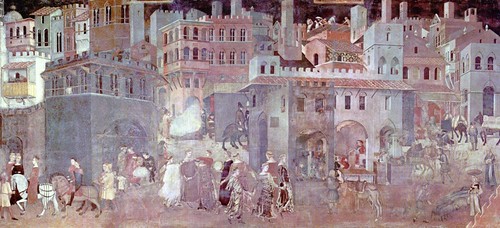
Ambrogio Lorenzetti, “The Effects of Good Government on the Life of the City,” in the Palazzo Publico (seat of the comune), Siena

Shouldn’t we worry that citizenship defined by a town or city is exclusive? What about immigrants and other newcomers? That is a concern, but it’s worth noting that some of the old self-governing cities (from Venice to London) were highly cosmopolitan, and cosmopolitanism was basic to their identity. I recognize that London apprentices used to riot against Flemish and Huguenot migrants; and Venice coined the very word “Ghetto” as the place to lock its Jews. But there were also traditions of inclusion. I may be over-influenced by personal experience, but I happened to attend a primary school within the medieval limits of the City of London, where the Christian socialist headmaster taught his rather diverse student body to see themselves as citizens of the ancient corporation. A recent Lord Mayor of that same corporation had exactly my (Jewish) name, Peter Levine. As a child, I was proud of my American identity but could simultaneously consider myself a Londoner, because London has always been a melting pot.

But wasn’t civic government highly stratified and unequal, with local ruling classes lording it over local proletariats? Again, that’s a real concern; but I would offer two responses. First, cities should not be completely autonomous. They should be taxed, regulated, and funded by higher levels of government whose principles include fairness and equality. Second, although I favor equality, I also believe that the owners of capital need discretion and will always have a privileged position. So our goal should not be to remove inequality but to tie the interests of the wealthy to those of the community. The wealthy class in a proud and quasi-autonomous city is more embedded and accountable than the wealthy class in a large nation state or an international market.

Finally, as Steve Elkin argues, municipal politics is an excellent school of democratic citizenship. The scale is big enough, and the institutions are formal enough, that every kind of issue arises–from economic redistribution to morals to global warming. But the scale is modest enough that problems are concrete and citizens have opportunities for personal leadership and face-to-face interaction.

Overall, this is an argument for what the Europeans call subsidiarity (pushing authority down to the lowest practicable level) as way to address the “democracy deficit” and restore a sense of active citizenship.

social accountability in the USA

In Paris last week, I met a senior minister from Uganda who said that not many years ago, 83 percent of Uganda’s education budget was wasted or stolen–not spent on education. I also met a Filipino activist who said that in his country, textbooks were often stolen or lost before they reached classrooms. Both countries have achieved enormous improvements by involving citizens in monitoring and assessing school budgets and administration. According to independent evaluations, 80 percent of education funds now reach schools in Uganda, partly because the money is tracked by citizens.

It occurred to me that in the District of Columbia, about 71 percent of the education budget is not spent on schools. Some of it may be properly used for such purposes as special education. But most of the 71 percent is lost in the downtown bureaucracy. The Washington Post has printed photos of stacks of textbooks that were never distributed to schools; electronic equipment is routinely delivered without software or support. These statistics and stories are very reminiscent of Uganda and the Philippines, and indeed of most of the world.

The obvious question is whether we could use public participation in the US as a tool to reduce serious corruption and waste. This would be a great achievement because …

1. One of the worst sources of disadvantage in our society is the dramatically unequal quality of education. An obvious way to improve education for Washington’s least advantaged students would be to seize some of the $7,200 per student that is currently being used/wasted in the downtown bureaucracy so that it could be spent instead on smaller classes and better facilities.

2. Getting the public involved in accountability might shift the attention away from test scores and toward administration. Today’s high-stakes tests are supposed to motivate teachers and students to work harder and more effectively–that is the main strategy for improving education. When students fail the tests, we start to wonder whether public schools can possibly achieve success (or whether our kids can possibly succeed). If citizens could audit or review the performance of their schools, they might shift the pressure away from teachers and students, who, after all, receive less than 30 percent of the budget in DC. Citizens might conclude that the marginal impact of reforming central school systems would be much greater.

3. Public participation would be an alternative to the main accountability measures that are currently used or contemplated in our schools today. We test kids and punish them for failing; and we allow parents to take their kids out of schools. In Washington, roughly half of the student body has already left, either for the suburbs or for charter schools; but we don’t see better performance in the public system–nor are the charters very successful. Maybe it would work better to get citizens directly involved in school reform.

4. Students could help to monitor their own schools, which would be a powerful form of civic education.

5. I believe that the Achilles heel of the American left is the poor performance of public institutions, such as the DC Public Schools. At some level, all of us–including left-liberals–know that such systems are deeply flawed. We lose political struggles, not because Americans love corporations, nor because voters are blind to social needs, but because they don’t believe that public institutions are effective and trustworthy tools. It would be politically powerful to acknowledge this problem and to propose innovative solutions that tap the energy of citizens, like those used in Uganda in the Philippines.

social accountability and public work

(En route to Baltimore) “Social accountability” means various techniques for getting citizens involved in monitoring government. The World Bank has published a booklet called “From Shouting to Counting” (pdf) that provides examples. In Uganda, the government provides detailed information about how it actually spends its education funds, disseminating the data by radio and newspaper. At the same time, control over education has been somewhat decentralized. Armed with detailed information, Ugandans are able to demand efficient performance from their local schools. In more than 100 Brazilian cities, the municipal government empowers large, basically voluntary citizens’ councils to allocate a proportion of the municipal budget through a process called Participatory Budgeting (PB). And in Rajasthan (India), a non-governmental organization began demanding public records and holding informal public hearings to uncover waste and corruption.

I suspect that it would be wise to embed social accountability in a broader concept of “public work” (see Boyte and Kari, 1996). Here’s a table to clarify what I mean:

  Social accountability as a stand-alone process Social accountability as part of "public work"
example Project in Malawi in which citizens are recruited to audit public spending Project in the Philippines in which citizens monitor the distribution of school textbooks and (when necessary) physically move them to schools
major analogy Citizens as legislators or jurors Citizens as voluntary workers
nature of power Zero-sum: more for citizens means less for the state. Thus power must be granted by, or seized from, the state Potentially expandable: by working together, citizens create greater capacity
intended outcomes More efficiency and less corruption in the administration of a government program. Defining and addressing a community problem
state and civil society Two sectors that exchange information and negotiate Lines are blurred: government employees are seen as citizens
options when problems are uncovered Legal remedies (lawsuits, calling the police); public disclosure and shaming Legal remedies and public disclosure; direct voluntary action to remedy the problem
accountability By government, to citizens In principle, by everyone to everyone
recruitment Representative sample of citizens is recruited for the task of monitoring government Members of an association take on a voluntary task. They also develop the next generation of active members
preconditions Legal rights of assembly and expression; formal system for accountability Legal rights of assembly and expression; active voluntary associations