Category Archives: fine arts

John Donne, The Ecstacy

(In Portsmouth, New Hampshire) In a review by John Carey, I came upon a strange and wonderful John Donne poem, “The Ecstacy.” Here it is in the left column with my literal paraphrase to the right. (Literal interpretation seems to me a necessary first step in understanding metaphysical poetry, or any dense verse.)

THE ECSTACY

by John Donne

WHERE, like a pillow on a bed,

    A pregnant bank swell’d up, to rest

The violet’s reclining head,

Sat we two, one another’s best.

1. Two people (the narrator and a woman; see 4) who are fond of one another sit on a flowery bank.

Our hands were firmly cemented

    By a fast balm, which thence did spring;

Our eye-beams twisted, and did thread

Our eyes upon one double string.

2. They hold hands and look into one another’s eyes.

So to engraft our hands, as yet

    Was all the means to make us one;

And pictures in our eyes to get

Was all our propagation.

3. They unite by holding hands and visualizing the same object (possibly the propagation of the violet mentioned below: 10)

As, ‘twixt two equal armies, Fate

    Suspends uncertain victory,

Our souls–which to advance their state,

Were gone out–hung ‘twixt her and me.

4. Their souls meet in between their bodies and …

And whilst our souls negotiate there,

    We like sepulchral statues lay ;

All day, the same our postures were,

And we said nothing, all the day.

5. negotiate (possibly about whether to have sex; see 13) while they lie still and silent for the whole day.

If any, so by love refined,

    That he soul’s language understood,

And by good love were grown all mind,

Within convenient distance stood,

6. If a third person who fully understood love stood nearby, …

He–though he knew not which soul spake,

    Because both meant, both spake the same–

Might thence a new concoction take,

And part far purer than he came.

7. he could benefit morally from what they say in one voice, which is:

This ecstasy doth unperplex

    (We said) and tell us what we love;

We see by this, it was not sex;

We see, we saw not, what did move:

8. “This state of fusion shows us that we did not love sex or bodily motion, …

But as all several souls contain

    Mixture of things they know not what,

Love these mix’d souls doth mix again,

And makes both one, each this, and that.

9. but the union of two souls that were never self-sufficent.

A single violet transplant,

    The strength, the colour, and the size–

All which before was poor and scant–

Redoubles still, and multiplies.

10. If you replant a single flower (perhaps the violet in 1), it can grow and multiply.

When love with one another so

    Interanimates two souls,

That abler soul, which thence doth flow,

Defects of loneliness controls.

11. [Likewise,] when two souls are in love, they create one better soul.

We then, who are this new soul, know,

    Of what we are composed, and made,

For th’ atomies of which we grow

Are souls, whom no change can invade.

12. We are this new soul, composed of our own original souls as atoms.

But, O alas! so long, so far,

    Our bodies why do we forbear?

They are ours, though not we; we are

Th’ intelligences, they the spheres.

13. But why do we shun our bodies?

We owe them thanks, because they thus

    Did us, to us, at first convey,

Yielded their senses’ force to us,

Nor are dross to us, but allay.

14. It was through our bodily sensations that we learned to love; bodies are not superfluous but are mixed with souls into an alloy.

On man heaven’s influence works not so,

    But that it first imprints the air;

For soul into the soul may flow,

Though it to body first repair.

15. Just as heaven (i.e., stars or angels) must influence us through the physical medium of air, so a soul communicates with a soul by means of the body.

As our blood labours to beget

    Spirits, as like souls as it can;

Because such fingers need to knit

That subtle knot, which makes us man;

16. We struggle bodily to create images that are like souls (referring either to the common thought mentioned in 3 or to conceiving a child).

So must pure lovers’ souls descend

    To affections, and to faculties,

Which sense may reach and apprehend,

Else a great prince in prison lies.

17. Thus we must descend from thought to our senses …

To our bodies turn we then, that so

    Weak men on love reveal’d may look;

Love’s mysteries in souls do grow,

But yet the body is his book.

18. and appreciate one another’s bodies.”

And if some lover, such as we,

Have heard this dialogue of one,

Let him still mark us, he shall see

Small change when we’re to bodies gone

19. And if the third person stayed to watch us have sex, he would still think that we were spiritually united.

The movement of the poem is from static bodies upward to thoughts and then back into animated bodies. At the beginning, “we” are two separate motionless physical objects (we “sat”; we “lay”). In the middle verses, “we” are one disembodied consciousness, addressing a passive third party and deciding whether to reenter our bodies. At the end, body and soul are one.

I read the poem as an argument by a male narrator to a female lover that they should have sex, because it will be like “ecstasy” (a religious “state of rapture that stupefies the body while the soul contemplates divine things”). In that case, the claim that both souls speak as one in the middle of the poem is more of a hope or a lure than a fact. There is some irony in the poem–a gap between what the narrator means and what he says, and perhaps also between how he sees himself and how we are supposed to see him. But the irony hardly cancels the sensuality of this poem that begins with pregnant swelling banks and ends with souls gone to bodies in plain view of an approving observer.

angles on US history

(Indianapolis) I’m attending a meeting on teacher education. During a morning session on the teaching of American history, there was some criticism of a certain national historical narrative that’s often retold by children when they are asked what they’ve learned in school. According to this story, from time to time, Americans have realized that there are problems, such as slavery or segregation; and then the government has solved each problem by law.

Even though this is a celebratory and patriotic narrative, it’s not a conservative one. It emphasizes progress by and through government, contrary to a truly conservative national history, which would begin with a self-reliant, faithful people and end with a decadent welfare state. For similar reasons, conservatives should dislike the patriotic iconography of official Washington, with its monuments to Jefferson and Washington as the founders of the government that now occupies vast marble office buildings (including the 3.1 million-square-foot structure named for Ronald Reagan). Certain kinds of populist or participatory leftists may be equally hostile to the progressive/statist story, because it ignores citizens and their agency.

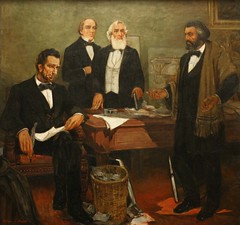
With such thoughts in my mind, I walked over to the Indiana State Museum and saw an exhibition of paintings by William Edouard Scott (1884-1964), an African American artist born in Indianapolis and educated in Chicago and Paris. His works tell a strongly progressive narrative of American history, although not one centered on the government. An easel painting (“Freedom,” 1960) shows, from bottom to top, Crispus Attucks being shot by the British in 1775, John Brown (1850), “Abe Lincoln and Fred Douglas” (1863), Thurgood Marshall raising his hand to testify (1954), and an eagle marked “NAACP” downing a bird marked “KKK.”

In 1915 alone, Scott painted 20 murals in public high schools in Chicago and Indianapolis. The same year, he painted murals for the office buildings of the Chicago Defender, a major African American newspaper. The Defender editorialized, “When our new buildings are decorated by the works of our own artists we are contributing something substantial to American progress, especially if we obtain the services of well trained men or women.”

Note the evocations of racial identity and solidarity, contributions to the American commons, progress, patriotism, excellence, expertise, and equality of women and men. This was a common kind of discourse in the mid-1900s, and one that the state sometimes funded. For instance, Scott won a Federal Arts Project competition in the war year of 1942 to decorate the Recorder of Deeds building in Washington, DC. He produced a mural — shown above — of Frederick Douglass appealing to President Lincoln to enlist Black troops in the Union Army. (Douglass himself became the Recorder of Deeds in 1881.) Credit: dbking; some rights reserved.

Gonzalo’s commonwealth

Gonzalo is the most virtuous character in Shakespeare’s Tempest, a man “whose honor cannot / Be measured or confined” (v,1,135-6). He arrives on Prospero’s island in the company of vile politicians who have organized a coup and are prepared, some of them, to kill for even more power. They mock him after he makes his speech in favor of his ideal society:

I’ th’ commonwealth I would by contraries

Execute all things, for no kind of traffic

Would I admit; no name of magistrate;

Letters should not be known; riches, poverty,

And use of service, none; contract, succession,

Bourn, bound of land, tilth, vineyard, none;

No use of metal, corn, or wine, or oil;

No occupation; all men idle, all

And women too, but innocent and pure;

No sovereignty —

SEBASTIAN: Yet he would be king on ‘t

ANTONIO: The latter end of his commonwealth forgets the beginning.

GONZALO: All things in common nature should produce

Without sweat or endeavor; treason, felony,

Sword, pike, knife, gun, or need of any engine

Would I not have; but nature should bring forth

Of its own kind all foison, all abundance,

To feed my innocent people.

SEBASTIAN: No marrying ‘mong his subjects?

ANTONIO: None, man, all idle: whores and knaves.

GONZALO: I would with such perfection govern, sir,

T’ excel the Golden Age. (ii,1,161ff.)

Gonzalo sounds like Rousseau–and has Rousseau’s problem, acutely noted by the wicked Sebastian and Antonio in their prose interruption to his blank verse. Gonzalo would need power to create his society without power. When he says, “I would … execute all things” he implies that he would be sovereign, yet there would be no sovereignty in his anarchistic commonwealth. He must force men to be free.

Rousseau would not be born for another century. But Gonzalo quotes another Frenchman, Montaigne, whose essay “On Savages” described Native Americans as happy and free. There were two “savage” natives on Prospero’s island when he arrived (although Caliban was actually an earlier immigrant). Prospero quickly made both of them his slaves, thus acting “contrary” to Gonzalo. Also against Gonzalo’s principles, Prospero demands “service,” charges people with “treason” and “felony,” and controls his daughter’s marriage “contract” and “succession.” Prospero seems to be the hero of the play, which is presented as a comedy. Yet modern readers mostly recoil at his treatment of Caliban, his paternalism toward Miranda, and his slave Ariel’s obsequiousness.

Yet Prospero is the hero, I think, and Shakespeare’s vision is a dark one. Gonzalo may be appealing, but he is ineffectual. He has served the usurping Duke Antonio and supported the law of that regime (see i.1,30). He does nothing to overthrow Antonio or create a Golden Age. Prospero was also originally an idealist. He shunned “temporal royalties” in favor of his library, becoming a harmless scholar (i,2,131). He wanted to “abjure” his “rough” powers, as he finally does in Act V. Unfortunately, power did not vanish in Milan because Prospero refused to exercise it. His own brother and confederates overthrew him and sent him into a dangerous exile with only his child.

Then he came to a place with no sovereignty, a desert island. He had his books. Otherwise, there was no property, no crime, no border, no master or slave. But now Prospero understood that he could not simply abjure power without putting himself in grave danger. He would have to be master or mastered. Thus he made himself dictator of his new “dukedom” until, by means of an elaborate scheme, he was able to restore justice. When he finally arranges for a lawful succession, his own story is over. “And thence retire me to my Milan, where / My every third thought shall be my grave” (v,1,378-9).

Prospero wishes to avoid ruling–as does Lear at the beginning of that play. Gonzalo describes a society without rulers–just like Lear’s vision once he is out on the heath (iv,6). But Gonzalo is actually nothing but a tool of a despotic state. Prospero realizes he must use rough power to restore order and imperfect justice before he dies. Shakespeare takes that to be a happy ending.
my home as described by Stephen Dunn

(Syracuse, NY) We’re visiting my parents in the house where I grew up. It’s a cottage on the top of a steep hill. The back yard leads into a large urban park: nicely landscaped with meadows and stands of cypress trees, but always somewhat dangerous. Inside, as I’ve noted before, there are almost 30,000 books. Wherever there are spaces over bookcases or on the stairwells, my parents have hung prints. These are mostly rather sedate works–but on the steps to the attic hangs a Kathe Kollwitz engraving of Death or the Devil dragging a mother away from her baby. The furniture in the living room was once upholstered in white leather.

All this is background to a poem that Stephen Dunn wrote when his family rented the house from us. I think this must have been 1973-4, when Dunn was a visiting professor at Syracuse University and we were in London. The poem, typed on a real typewriter that bit into the paper, reads:

Letter to a Distant Landlord

This is the 20th century and you

are invisible, across the Atlantic,

beyond reach. We sleep in your bed,

we make love where

you made love and it’s strange

we’ve not met.

This house, though, does speak

of you; all the books, the good

junk in the attic, that

startling print in the upstairs hall.

You’ve brought the past forward

to mingle like a fine, old grandfather

with the appliances and dust.

And we approve.

Even the ghosts here are intelligent.

They wait til the children are asleep

then sit in the white chairs

in the livingroom. Some nights

it’s Nietzsche, last night it was

Marx. They are all timbre

and smoke, all they want is

for me to get off my ass, to break

my spririt’s sleep.

But they don’t insist. They’ve seen

so much their rancor has turned

to sighs. We do not learn

is what they’ve learned.

Yet we are comfortable in your house.

It is what we wanted.

The park nearby is beautiful

and dangerous, a 20th century park,

the kind we must walk through. Our small

belligerent dog picks fights there

with Shepherds. They pick fights with him.

Sometimes though they’re all tails and tongues,

like us, and the air smells good

and the grass is freshly cut.

And so we send our checks

and try to imagine your hands,

your face, the way you discuss

the things you must discuss.

Some day after you’re back,

smelling our smells and rearranging

your lives, maybe we’ll appear

at your door disguised as ourselves.

We’ll say we’re looking for a house

(that’ll be our only hint), sneak

the glimpses we want, and move on

like strangers who brushed by

on their way somewhere else

and don’t know why, in this century,

they cannot stop.

I love this poem as an evocation of my home, Dunn’s private life, and the 20th century. I’d only quarrel with one aspect (and even on this point I grant Dunn his license). I doubt that the ghosts in our house talk about Nieztsche and Marx very often. There are shelves of books by those authors that might conjure their spirits once in a while, but I’m sure they don’t reign over the house. The local spirits are English, bewigged, dusty, and interested in facts rather than theories.

on mannerism and modernism

Over the weekend, I spent some time in the El Greco room of the National Gallery, Washington, which holds the finest collection of his work outside Spain. The National Gallery wisely hangs El Greco alongside Tintoretto, an artist 23 years his senior who was a direct influence. Both painters depict figures elongated beyond realism. They hide the backgrounds or otherwise pull their subjects out of three-dimensional space onto the plane of the picture. They leave their brushwork visible; they choose unearthly colors; and they draw attention to their own tortured emotions.

Continue reading