I’m going to try a little light blogging again, although I’m still very emotionally preoccupied. Throughout this difficult period, I have been trying to use novels as a distraction–reading works by Alan Furst, Patrick O’Brien, and Ward Just that could be classified as “genre fiction.” It struck me yesterday that that disparaging phrase is a solecism. Should we call Hamlet “genre fiction” because tragedy is a “genre”?
Category Archives: fine arts
a new self-consciousness in art
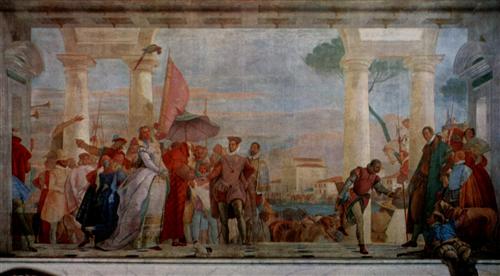
Traditionally, artists work within a style, but they don’t think of themselves that way. They either equate their style with art itself (believing that they depict nature as it always has been depicted), or else they offer abstract and universal reasons for their stylistic choices. For example, classical styles were often defended on the ground that the ancient Greeks had discovered universal principles of beauty and representation.
Then, at a certain point, it became obvious that all art depicts the world through a style, that styles differ from time to time and place to place, and there is no independent aesthetic standard that makes one better than all the others.
Since then, to make a picture has been an entirely different matter. You must start by picking a style. The most obvious move is to use someone else’s style, which is why revivalism became the major mode in the early nineteenth century, the age of Gothic revival and the troubadour style; of Greek revival; and of orientalism. There have been various efforts to avoid style altogether–abstraction, minimalism, surrealism–but they have all quickly become styles of their own.
I have been convinced of this Hegelian story for more than twenty years, and I have seen a lot of images in that time. I’m always looking for the moment when full stylistic self-consciousness begins. As of our last trip to Paris, I’m pushing the onset back a few decades. The Musée Jacquemart-André owns a fresco that Tiepolo painted in the mid-1750s to depict the arrival of King Henri III (of France) at the Villa Contarini, near Venice, in 1574. (Click for a large image). Tiepolo chose to paint this image in the style of Veronese. He didn’t copy an actual Veronese–something that might have been done centuries before. Instead, he painted the scene as Veronese would have seen and shown it. I don’t think that choice would have occurred to any artist before 1750, and once it happened, art was on its way to modernism.
nostalgia, imagination, redemption
On plane rides last week, I very much enjoyed reading Michael Chabon’s The Yiddish Policeman’s Union. Chabon imagines that in 1941, a temporary refuge was created for European Jews around Sitka, Alaska. The piny islands filled with millions of Yiddish-speaking, urban “Yids” who created a kind of shtetl or Brooklyn of the North. Unfortunately, their lease ends around the present time, which is the time of the narration. Thus the whole district is threatened with “reversion”–which means a new diaspora for the population. In this context, a Raymond Chandleresque detective story unfolds.
Nostalgia and imagination are two keynotes of the Jewish experience. The religious are nostalgic for the ancient Kingdom; they imagine the Messiah. The secular are nostalgic for Poland ca. 1920 or Brooklyn ca. 1950. They are prone to imagine Marxist or Libertarian utopias; fictional narratives built out of nostalgia; or successful assimilation. At the personal level, nostalgia for youth and flights of imagination seem especially common among Jews, although maybe I’m just thinking about myself.
Michael Chabon imagines–with phantasmagoric clarity–a whole world of Sitka Jews. He threatens this world with closure, thereby making his main characters and his readers nostalgic for a completely imaginary past. The Sitka world itself is built on nostalgia and imagination: as in Williamsburg, Brooklyn, the rabbi’s house is an exact replica of his old home in Eastern Europe, but the inhabitants dream of Zion. Chabon is nostalgic, too, for hard-boiled detectives who live in flop-house hotels and walk noir streets. Out of that material, he imagines something completely original.
If nostalgia and imagination are two thematic centers in the book, a third is redemption. Chabon sets up a powerful contrast between religious redemption and the redemption that involves two human beings who forgive one another and decide to move forward together. Achieving that requires imagination and some suspension of nostalgia.
or what you will
On reading Twelfth Night recently, I was moved by the ending. Feste the Fool is left standing alone to sing of the cold winter, when the rain it raineth every day. Twelfth Night marks the end of Christmas, an interlude from work. This particular Christmas in Illyria also seems a break from the weather, for no one speaks of cold even though most of the action is outdoors. A willow cabin seems sufficient shelter. These are perhaps the “Halcyon days” of the winter solstice, what we would call an “Indian summer” (cf. 1 Henry VI, I,ii,131).
This Christmas is also a break from war and–most strikingly–from family. Orsino, Olivia, Viola, and Sebastian, the romantic leads, are all orphaned and childless. There is no mention of any family, either, for the minor characters of Sir Andrew Aguecheeck, Sir Toby Belch, Malvolio, Antonio, Maria, and the Fool. Since these characters have no parents or children, they have no one to govern them and no responsibilities. Virtually any of these people could be paired with anyone else. Even gender is no bar, for Viola is dressed as a man and attracts Olivia’s love. Illyria is like summer camp or freshman year at college. The characters are not wanton, but for them, everything is undecided.
The marriages of Olivia and Sebastian, Viola and Orsino represent a happy ending, but also the end of the interlude. After their weddings, Illyria will have a governing structure; families will be created in separate households. Immediately before everyone leaves the Fool alone on the stage, Orsino carelessly addresses his fiancée by the name she has used in her guise as a man:
Cesario, come–
For so you shall be while you are a man,
But when in other habits you are seen,
Orsino’s mistress, and his fancy’s queen!
Orsino still sees Viola as “Cesario” and wants to postpone their marriage (and her transformation into a woman) until after the play ends. Maybe his slip of the tongue is homoerotic, but I think it is something else as well. Orsino wants to prolong the interlude, the time when he pines for a distant lover to the sound of “high fantastical” music, no one is attached to anyone, people drift freely from court to court, and you can do what you will. But the Fool is the most knowing character throughout the play, and once Orsino sweeps offstage with his retinue, the Fool sings of the winter that is adult life:
But when I came to man’s estate
With hey, ho, the wind and the rain
‘Gainst knaves and thieves men shut their gate
For the rain it raineth every day.
Susanna Clarke’s industrial revolution
I think this is a fairly obvious point, but I can’t find it elaborated anywhere in the web: It seems to me that Susanna Clarke’s very entertaining novel Jonathan Strange and Mr Norrell is an allegory of the Industrial Revolution. (Crooked Timber’s John Quiggin sort of says so, but very briefly.)
In real life, steam-driven mass manufacturing was born in the North of England. The financial, human, and social capital came in part from old Northern cities like York. But York did not become a major manufacturing center–that was the fate of cities like Manchester and Sheffield, which basically sprang up in the early 1800s.
The Industrial Revolution began during the Napoleonic Wars when, for example, pulley blocks for British ships were mass produced. But new manufacturing techniques did not seem to alter the war profoundly. Meanwhile, the new techniques were being used to create specialized luxury goods, such as Wedgwood pottery. The use of steam power and interchangeable parts was still a gentleman’s pastime and an interesting sideshow.
But these innovations expanded beyond anyone’s control or expectations. Suddenly, factories that burned fossil fuels and used interchangeable parts were producing most of England’s ordinary products (such as clothes); were employing a large proportion of the population; were threatening to enable mass human slaughter through deadly armaments and chemicals; and were changing the landscape itself–driving iron railroads across it and tearing the mountains open for coal.
[Spoiler warning: I reveal the conclusion of this very suspenseful novel below the fold.]